
A Social Security benefits calculator is a powerful online tool designed to turn your earnings history into an estimate of your future retirement, disability, or survivor benefits. While it seems straightforward, its true value lies in transforming abstract retirement goals into a concrete monthly income figure, providing a tangible foundation you can build a comprehensive financial plan around.
How to Get a Clearer Picture of Your Financial Future
Assembling a retirement plan often feels like solving a complex puzzle. You have various pieces—your 401(k), IRAs, investments, and other assets—and it can be challenging to see how they all fit together. A social security benefits calculator is the tool that helps you find the cornerstone of that puzzle by clarifying what is frequently your most dependable stream of future income.
This guide will walk you through precisely how these calculators work, from the basics of inputting your data to advanced strategies for claiming benefits. Consider it your roadmap to financial confidence. The ultimate goal is to empower you to make informed decisions that align with your long-term vision for retirement. Mastering this tool is the first critical step toward converting years of hard work into a predictable retirement paycheck.
Laying the Groundwork for a Solid Retirement Plan
Obtaining a realistic estimate of your Social Security payment is fundamental to building a durable financial plan. This single number becomes the anchor for many other critical decisions, directly influencing some of your most significant financial choices:
- Figuring Out Your Retirement Timeline: When you have a reliable projection of your monthly benefits, you can realistically assess when you can afford to stop working.
- Structuring Your Income Streams: The estimate helps you determine how much you'll need to withdraw from other retirement accounts to bridge any income gaps and maintain your desired lifestyle.
- Sharpening Your Tax Strategy: Your Social Security benefit affects your total taxable income, which is vital information for smart tax planning, such as deciding if a Roth conversion is a viable option. For more on this topic, our guide on the Roth conversion calculator is an excellent resource.
By translating your complete work history into a specific dollar amount, a social security benefits calculator provides a solid foundation to build upon. It transforms the vague, distant concept of retirement into a measurable goal you can actively pursue.
Ultimately, this calculator is far more than a simple number-crunching tool. It's a strategic asset that empowers you to make smarter, more informed choices for the next phase of your life, allowing you to model different "what-if" scenarios and see the real financial impact of your decisions before committing to them.
How the System Actually Calculates Your Social Security Check
Have you ever wondered what happens behind the scenes when a Social Security calculator generates your benefit estimate? It's not financial wizardry—it's a direct formula that distills your entire working life into a few essential figures.
The primary ingredient is your work history, but not all of it. The Social Security Administration (SSA) focuses on your 35 highest-earning years. It takes those years, adjusts each one for wage inflation to create a level playing field, and then calculates your average indexed monthly earnings.
This crucial figure is your Average Indexed Monthly Earnings (AIME). Think of it as the bedrock upon which your entire benefit amount is constructed. Every social security benefits calculator, from the most basic to the most sophisticated, starts with this number.
From Average Earnings to Your Final Benefit
Once your AIME is determined, the SSA applies a specific formula to calculate your Primary Insurance Amount (PIA). Your PIA represents the full benefit you are entitled to receive if you file for Social Security at your full retirement age (FRA).
However, it's not a straightforward percentage. The formula uses "bend points" to apply different percentages to different portions of your AIME.
The system is intentionally progressive, designed to replace a higher percentage of a lower earner's income and a smaller percentage of a high earner's. This structure ensures a meaningful safety net for all retirees, regardless of their career earnings.
For example, the formula might provide 90% of the first portion of your AIME, 32% of the next, and 15% of any earnings above a certain threshold. It is this tiered system that converts a lifetime of work into a predictable monthly retirement check.
This entire process connects the dots between your working years and your retirement years.
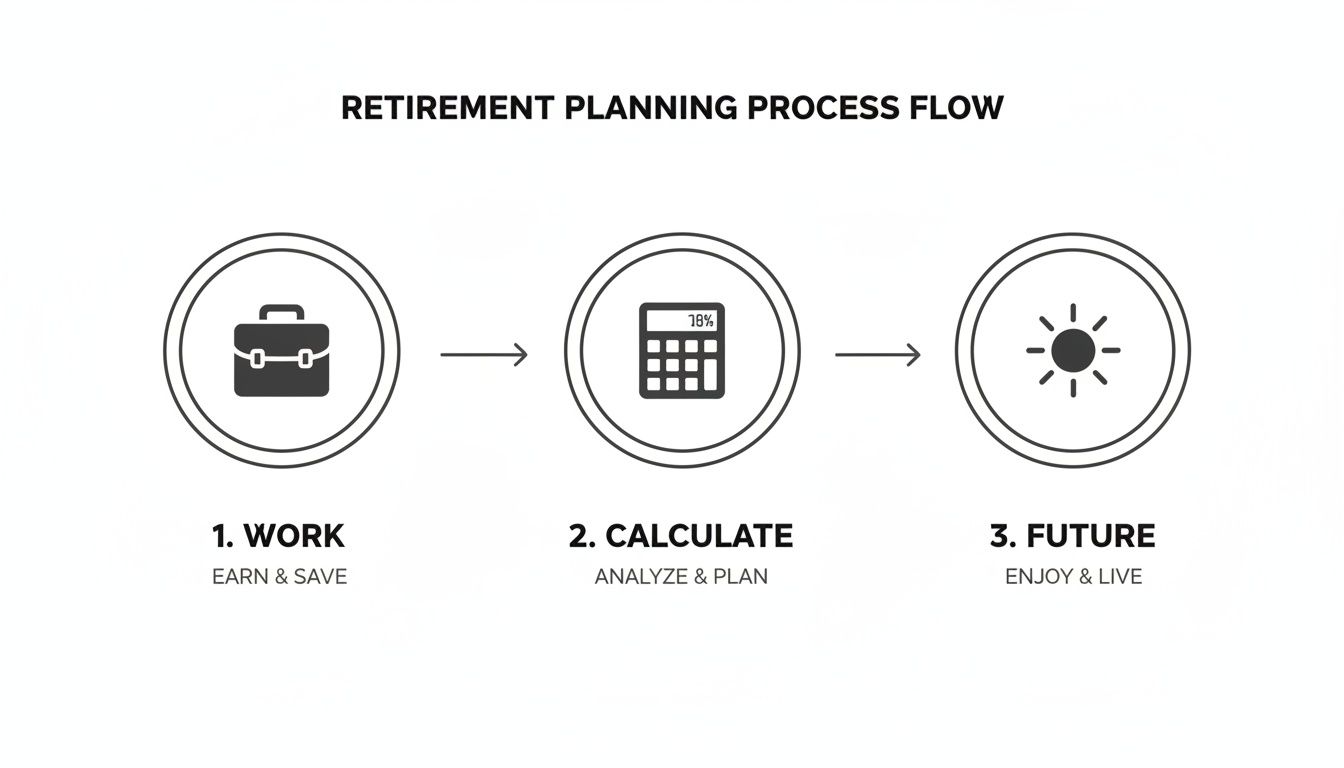
Using a benefits calculator is that vital intermediate step—it translates what you’ve already earned into a clear picture of what you can expect in the future.
Key Factors That Influence Your Benefit Estimate
At its core, any calculator is only as reliable as the data you provide. Several key inputs drive the final estimate, and understanding them is crucial for interpreting the results.
Ensuring these inputs are accurate is the first step toward a dependable projection. Minor miscalculations, especially concerning future earnings, can significantly skew the results.
Why Every Working Year Counts
The 35-year rule has a bigger impact than many people realize. If you have fewer than 35 years of earnings on your record, the SSA doesn't just average the years you worked. Instead, it assigns a zero for each missing year.
Those zeros can be detrimental to your benefits. They significantly lower your AIME, which permanently reduces the monthly payment you will receive for the rest of your life.
This is why working "just one more year" can often make a substantial difference, particularly if it's a high-earning year. That single year can replace a zero or a low-income year from decades ago, providing a measurable boost to your AIME and, consequently, your final benefit.
With nearly 73 million beneficiaries in 2024 and an average monthly retirement check around $1,869, the real-world impact is massive. Projections for 2025 show the formula applying 90% to the first $1,234 of AIME, 32% up to $7,452, and 15% for amounts above that. You can read the full research about these projections to see just how these numbers are evolving year to year.
Choosing the Right Social Security Calculator for You
Not all Social Security calculators are created equal. A simple online search will reveal everything from basic government estimators to advanced third-party software. The right tool for your needs depends on whether you are looking for a rough ballpark figure or a precise number to anchor your financial plan.
Your best approach is to always start at the official source—the Social Security Administration (SSA). They provide several calculators, and knowing which one to use is the first step toward getting a number you can genuinely trust.
Think of it like getting directions. Sometimes a quick sketch is all you need to get oriented. Other times, you need a detailed topographical map before you venture into the wilderness.
The Official SSA Calculators
The SSA's own tools are your most reliable resources, but they serve different functions. Understanding the distinctions will help you progress from a vague estimate to a solid projection for your retirement planning.
- The Quick Calculator: This is your back-of-the-napkin estimate. You enter your date of birth and current earnings, and it generates a rough benefit amount in today's dollars. It's useful for a quick check if you're years away from retirement, but it has one major drawback: it does not use your actual earnings history.
- The 'my Social Security' Portal Calculator: This is the gold standard for accuracy. Once you create a secure account on the SSA's website, the calculator pulls data directly from your complete, official earnings record. This isn't just an estimate; it's a projection based on the exact income history the SSA has on file for you.
This is the login page for the official 'my Social Security' portal, a secure gateway to your personal earnings records and benefit estimates.
Using the portal calculator elevates your planning from guesswork to strategy because the numbers are rooted in your real-world work history.
Third-Party Financial Planning Calculators
Beyond the official government site, you will find numerous calculators offered by financial planning firms and wealth advisors. These tools often include more advanced features, allowing you to model how Social Security integrates with your entire retirement portfolio.
These third-party tools are incredibly valuable for strategic planning. They can model how different claiming strategies might affect your 401(k) withdrawal rates or the longevity of your entire investment portfolio.
However, a word of caution is necessary. As powerful as these tools can be, their accuracy depends entirely on the data you input. A simple typo when entering your earnings history can throw off the entire projection by a significant amount.
That's why the best practice is a two-step process. First, obtain your official estimate from the 'my Social Security' portal. Then, use that verified number in a more advanced third-party tool to run different financial scenarios. This ensures your retirement strategy is built on a foundation of solid, accurate data.
The Million-Dollar Decision: When to Claim Your Benefits
Deciding when to claim your Social Security benefits is one of the most critical financial choices you will ever make. This is not a minor detail; it is a decision that can influence your income for decades, shaping your quality of life, your spouse's financial security, and the longevity of your retirement savings. The difference between an optimal and a suboptimal choice can easily amount to hundreds of thousands of dollars over a lifetime.
A reliable social security benefits calculator is the best starting point. It helps you visualize these vastly different outcomes. By entering your numbers and experimenting with various claiming ages, you can see exactly how starting early, waiting for your Full Retirement Age (FRA), or holding out for the largest possible check will impact your long-term finances.
The Three Main Claiming Windows
Ultimately, your choice boils down to three primary windows. Each presents a clear trade-off between receiving cash sooner versus securing a larger payout later.
- Claiming Early (Age 62): You can begin receiving benefits as soon as you turn 62, but be aware: your monthly payment will be permanently reduced. If your Full Retirement Age is 67, this reduction is about 30%. You receive more checks over your lifetime, but each one is smaller.
- Claiming at Full Retirement Age (FRA): This is the benchmark—the age at which you are entitled to 100% of the benefit you have earned. For anyone born in 1960 or later, your FRA is 67. Claiming at this age provides your full, unreduced benefit, also known as your Primary Insurance Amount (PIA).
- Delaying Past FRA (Up to Age 70): This is where patience truly pays dividends. For every year you wait past your FRA, your benefit increases by a guaranteed 8%. This is an inflation-adjusted return that is difficult to find elsewhere. If you can wait until age 70, you will lock in the largest possible monthly check—approximately 24% higher than your FRA benefit.
A Simple Break-Even Analysis
So, which path is best? The answer often depends on your life expectancy. This is where a break-even analysis is useful. It helps you identify the age at which the cumulative benefits from delaying finally surpass the total amount you would have received by claiming early.
Let's consider a quick example. Assume your full benefit at age 67 is $2,000 per month.
- If you claim at 62, your benefit is reduced by 30% to $1,400 per month.
- If you wait until 70, it grows by 24% to $2,480 per month.
By starting early, you would collect $84,000 ($1,400 x 60 months) before someone waiting until 67 receives their first check. However, the person who waits until 70 gets an extra $1,080 every month compared to the early filer. A quick calculation reveals the break-even point typically falls in the late 70s or early 80s. If you live beyond that age, delaying pays off substantially.
The decision is a calculated bet on your own lifespan and financial needs. There is no single "right" answer, only the one that is right for your unique circumstances.
Factors to Consider Beyond the Numbers
While a social security benefits calculator provides the hard data, this decision involves more than just math. This system supports a massive population; as of April 2025, a staggering 73.9 million Americans were receiving benefits, which shows just how much we all rely on this safety net. With the worker-to-beneficiary ratio dropping to just 2.7 in 2023, smart planning has never been more important.
You must weigh several highly personal factors:
- Your Health and Family History: Your expected longevity is the single biggest variable in any break-even calculation.
- Your Immediate Financial Needs: If you delay claiming, do you have sufficient income from other sources to bridge the gap?
- Your Spouse's Situation: Remember, your claiming decision can have a significant impact on the survivor benefits your spouse may receive in the future.
- Your Overall Retirement Plan: Social Security is just one component of your financial picture. You might need to tap into other forms of guaranteed retirement income to make a delay strategy work.
Thinking about your entire financial future is key, which is why it's so helpful to start effectively planning for retirement in your 30s. Social Security is a cornerstone of that long-term strategy. At the end of the day, a calculator empowers you by modeling these different paths, turning a daunting decision into a series of clear, manageable choices.
Unlocking Advanced Strategies for Couples and Families

For a single individual, Social Security planning is primarily a solo effort focused on optimizing one's own benefit. For couples and families, however, it becomes a strategic team effort. Your decisions are intertwined, and the right coordination can result in tens or even hundreds of thousands of dollars more in lifetime household income.
A good social security benefits calculator serves as your playbook for exploring these complex scenarios. It helps you shift from thinking about your benefits in isolation to viewing them as a shared household asset. How one spouse claims can profoundly affect the other's financial security, particularly when survivor benefits are considered. This is where the conversation moves from simple arithmetic to true legacy planning.
Maximizing Household Income with Spousal Benefits
One of the most valuable—and often misunderstood—tools in the Social Security system is the spousal benefit. If one partner has a smaller benefit based on their own work history, they may be able to claim a larger amount based on their spouse's record.
This spousal benefit can be worth up to 50% of the higher-earning spouse's full retirement age (FRA) benefit. There is a condition, however: the higher-earning spouse must file for their own benefits before the other can claim the spousal top-up. A calculator allows you to compare these options side-by-side, making it clear which path yields the higher monthly income.
The single most powerful strategy for a couple is often for the higher earner to delay their own claim until age 70. This action not only maximizes their personal benefit but also permanently increases the potential survivor benefit for their partner.
Think of that decision as a form of longevity insurance for the surviving spouse. You are locking in a larger, inflation-adjusted income stream that they can rely on for the rest of their life, no matter what happens.
Planning for Survivor, Divorced Spouse, and Child Benefits
Beyond the standard spousal strategy, a robust social security benefits calculator can help families navigate other life events. These rules are less common but are absolutely critical for comprehensive financial planning.
- Survivor Benefits: A surviving spouse is typically eligible for up to 100% of what their deceased partner was receiving. This is where delaying the higher benefit truly pays off for the surviving partner.
- Benefits for a Divorced Spouse: If you were married for at least 10 years and have not remarried, you may be able to claim benefits based on your ex-spouse's record. Crucially, this does not reduce their benefit or affect their current spouse in any way.
- Benefits for Dependent Children: Benefits can also be extended to minor, unmarried children or adult children who were disabled before age 22, providing an essential safety net.
These provisions are the backbone of the program's family protections. In 2024, of the 6 million new awards, 62% went to retired workers and 10% to disabled workers, with women accounting for 55% of all adult beneficiaries. Ultimately, running these scenarios through a calculator isn't just an exercise—it's a fundamental step in safeguarding your family's financial future.
Putting Your Benefit Estimate into Action
Receiving your number from a Social Security calculator is a significant milestone. However, you should view it as the foundation of your retirement plan, not the completed structure. The real work begins now: integrating that benefit estimate into the broader context of your financial life.
This is the point where you stop viewing your 401(k)s, IRAs, and other savings as separate accounts and start treating them as an integrated system. Your Social Security benefit is the bedrock that determines how much pressure you will need to place on your other assets each year. For instance, a higher-than-expected benefit might allow you to reduce your withdrawal rate, helping your investments last longer and protecting them from market volatility.
Creating a Cohesive Retirement Income Stream
The objective is to blend all your income sources—your Social Security check, pension payments, investment withdrawals, and perhaps part-time income—into a single, smooth, and predictable cash flow. It’s about understanding the role each component plays. Social Security, for example, offers a unique advantage: a steady, inflation-adjusted payment that is guaranteed for life, a feature your investment portfolio cannot promise.
To achieve this, you need a well-designed plan. There are numerous retirement withdrawal strategies available, each designed to balance income needs with growth and the risk of outliving your money. The best strategy for you will depend on your personal risk tolerance, the size of your nest egg, and your envisioned lifestyle.
Factoring in the Impact of Taxes
One aspect that often surprises retirees is that their Social Security benefits may be taxable. Whether they are, and to what extent, depends on your "combined income" as defined by the IRS. This is calculated by adding your adjusted gross income, any non-taxable interest, and half of your annual Social Security benefits.
For single filers, if that combined income is between $25,000 and $34,000, you could owe income tax on up to 50% of your benefits. If it exceeds $34,000, up to 85% of your benefits could be taxable. For married couples filing jointly, the thresholds are $32,000 and $44,000.
Tax planning is not an afterthought; it is a fundamental part of ensuring your retirement income lasts. Overlooking this can result in a significant reduction in your monthly cash flow for decades.
Once you understand these rules, you can make more strategic decisions with your other accounts. For example, you might choose to withdraw money from a tax-free Roth IRA in a given year to keep your "combined income" below a key threshold, thereby minimizing the tax on your Social Security. This type of forward-thinking maximizes the amount of money that actually ends up in your pocket.
Finally, here is a simple checklist to help you turn your estimate into an actionable plan.
- List All Income Sources: Document everything on paper: pensions, investments, rental income, and your new Social Security estimate.
- Create a Retirement Budget: Be realistic about your expected lifestyle and build an honest budget around it.
- Develop a Withdrawal Plan: Determine a sustainable withdrawal rate from your savings that complements your guaranteed Social Security income.
- Consult a Financial Advisor: A professional can help pressure-test your plan, identify tax efficiencies, and ensure everything is aligned with your personal goals.
Got Questions About Benefit Calculators? We've Got Answers.
Navigating the world of Social Security can feel like solving a complex puzzle, especially when you're trying to obtain a reliable estimate of your future benefits. A social security benefits calculator is an indispensable tool for this task, but it’s natural to have questions about its accuracy, limitations, and what the numbers truly mean for your retirement.
Let's address some of the most common questions to help you plan with greater confidence.
How Accurate Is the Official Social Security Calculator?
When you use the calculator on the official "my Social Security" portal, you are getting an estimate that is as close to reality as possible. It is not a generic tool; it pulls data directly from the Social Security Administration's (SSA) official record of your year-by-year earnings. It is the gold standard for a personalized estimate.
However, it is crucial to remember that it is still a projection, not a guarantee. Your final benefit amount could differ due to several factors:
- Future Earnings: The calculator must estimate what you will earn between now and retirement. A significant promotion or career change could make that estimate inaccurate.
- Legislative Changes: Congress has the authority to amend Social Security laws, and future changes could affect how benefits are calculated.
- Cost-of-Living Adjustments (COLAs): Future COLAs are based on inflation forecasts, which can be unpredictable.
What if I Have Gaps in My Work History?
That is not a problem. The calculator is designed to handle this scenario. Social Security’s formula is based on your 35 highest-earning years, so if you have fewer than 35 years of work on record, the calculator will simply use a zero for each missing year.
This is where the tool becomes particularly powerful. Those zero-earning years can significantly reduce your Average Indexed Monthly Earnings (AIME), which in turn lowers your benefit payment. Seeing this impact visually can be a "lightbulb moment," demonstrating how working a few more years to replace those zeros can provide a substantial boost to your lifetime retirement income.
How Do I Figure Out Spousal or Survivor Benefits?
While basic calculators focus on your individual retirement benefit, the official SSA website offers more advanced tools for these important family situations. To estimate spousal benefits, you will typically need to input the earnings histories for both you and your spouse. The calculator will then determine if you are eligible for a benefit based on their record—which can be up to 50% of their full benefit—and whether that amount exceeds what you would receive on your own.
The process is similar for estimating survivor benefits. For couples, running these calculations is essential. It helps you develop a claiming strategy that maximizes your total household income, both while you are both alive and for the surviving spouse. Of course, beyond retirement, you might wonder about other benefit types. Understanding the specific Social Security Disability requirements is vital for anyone who may need to apply for those benefits.
What Are the Most Common Mistakes People Make?
When using a social security benefits calculator, a few common errors can create a misleading picture of your retirement. One of the most significant is being overly optimistic about your future salary, which can lead to an inflated benefit estimate and a potential shortfall later.
Another frequent mistake is viewing the number in a vacuum. People often forget that the estimate is in today's dollars and does not fully account for how future inflation will erode its purchasing power.
However, the biggest oversight is failing to see the bigger picture. This includes forgetting that your benefits might be taxable or not considering how your claiming age affects your spouse's future survivor benefit. Using the calculator as a standalone oracle, instead of as one piece of a much larger retirement puzzle, is the most common mistake we see.
At Commons Capital, we know that a Social Security estimate is just a starting point. Our team specializes in weaving these numbers into a complete wealth management strategy, helping you navigate complex financial decisions with clarity and confidence. We work with you to make sure every aspect of your financial life is working together to hit your long-term goals.
Discover how Commons Capital can help you build a comprehensive retirement plan.