
Imagine having a small army of elite analysts working around the clock, combing through mountains of market data to spot opportunities no one else sees. That's what artificial intelligence technologies are bringing to the table for modern wealth management. This isn't some far-off, futuristic concept; it's a real tool that adds muscle to the strategic guidance you already get from your financial advisor.
The New Era of Investing with AI
Welcome to a new chapter in investing, where hard data and precision meet seasoned financial expertise. We're seeing a massive shift as artificial intelligence technologies are woven into wealth management, moving us away from old-school analysis and toward a more dynamic, predictive, and personal way of handling significant portfolios. For high-net-worth individuals and family offices, this means tapping into an incredible level of analytical horsepower.
Instead of just looking at historical performance and the usual market signals, AI gives us a peek into the future. It can chew through immense datasets—from global economic reports to real-time market sentiment on social media—in the blink of an eye. In doing so, it picks up on subtle patterns and connections that are simply impossible for the human eye to catch alone. This completely changes how investment strategies are put together and acted upon.
Shifting from Reactive to Proactive Strategies
At its core, the real advantage of these advanced systems is their ability to see around corners—to anticipate market shifts and flag potential risks before they become major problems. Moving from a reactive to a proactive stance is absolutely critical for protecting and growing wealth in the complex financial world we live in today.
A few key advantages really stand out:
- Sharper Decision-Making: AI delivers deep, data-backed insights, giving advisors the confidence to make better-informed calls.
- Serious Efficiency Gains: By handing off the heavy lifting of data analysis to AI, advisors can focus their time on what really matters: high-level strategy and client relationships.
- True Personalization: Investment strategies can be customized with incredible precision to an individual’s unique financial picture, their specific goals, and even their ethical preferences.
This isn't just a fleeting trend; it’s a fundamental rewiring of the financial services industry. To get a better handle on how these systems work, it's helpful to understand how something like AI search engine optimization uses similar models to process and rank information, a foundational concept that applies across any industry, including finance.
The global artificial intelligence market has absolutely exploded, hitting an estimated USD 638.23 billion in 2024 and projected to climb to a staggering USD 3,680.47 billion by 2034. This kind of growth shows AI is no longer a niche technology but a cornerstone of modern economies. You can dig into the full market analysis on Precedence Research.
This guide will walk you through the core AI tools that are making a difference, showing you how they deliver real, tangible value in building portfolios, assessing risk, and creating personalized financial plans. Think of it as your roadmap to putting AI to work for a smarter investment journey. For a deeper dive, check out our insights on decoding the future of wealth management.
Understanding the AI Tools Driving Your Portfolio
To have a really productive conversation about your financial strategy, it helps to get a feel for the key artificial intelligence technologies at play. These aren't just abstract ideas from a sci-fi movie; they are specialized tools, each with a distinct job in strengthening your portfolio's performance.
Think of them as a team of digital specialists working right alongside your human advisor.
At the front of the line is Machine Learning (ML), which is basically a master pattern-finder. Imagine an analyst who could digest decades of market data in a few seconds, spotting subtle trends and recurring signals that would be completely invisible to the human eye. ML models do exactly that, forecasting potential market moves with a level of data-driven confidence that’s worlds beyond traditional analysis.
Interpreting Market Chatter with NLP
Next up, we have Natural Language Processing (NLP). This is your dedicated global news analyst, working around the clock. NLP systems are built to understand human language, which lets them read and interpret enormous volumes of text from sources like:
- Central bank announcements and dense policy papers
- Quarterly earnings call transcripts
- Global news articles and financial reports
- Social media chatter about specific assets or sectors
By analyzing the tone, context, and key phrases in all this content, NLP can gauge market sentiment almost instantly. It acts as an invaluable early warning system for potential shifts in investor confidence or the economic outlook, adding a crucial layer of qualitative insight to the hard numbers crunched by machine learning.
Crafting Strategy with Generative AI
Finally, there's the one everyone is talking about: Generative AI. This is the creative strategist on your team. It goes beyond just analyzing what's already there to create something entirely new. Think drafting a customized investment proposal based on your specific life goals, or taking a dense, 50-page market research report and boiling it down to five clear, actionable bullet points.
This technology is far from a passing fad; it represents a massive area of investment and growth.
Generative AI is seeing explosive growth, valued at USD 37.1 billion in 2024 and forecasted to reach USD 220 billion by 2030. This segment attracted USD 33.9 billion in global private investment in the last reported year, an 18.7% jump from 2023, signaling immense investor confidence. To see more on this growth, read the full research on ABI Research.
To put it all together, here’s a simple breakdown of how these technologies support your wealth management strategy.
Key AI Technologies in Wealth Management
Understanding this trio—ML for prediction, NLP for interpretation, and Generative AI for creation—gives you the power to engage more deeply in conversations about how technology is being put to work to protect and grow your wealth.
How AI Actually Boosts Portfolio Performance
Let's move past the theory and into what this really means for your money. For high-net-worth investors, the game isn’t just about growth—it’s about smart, risk-managed growth. This is where artificial intelligence technologies come in, offering a level of analytical horsepower that was simply out of reach before. It's about turning a firehose of complex data into real, tangible advantages for your portfolio.
The biggest shift is moving beyond the old-school asset allocation models. Diversification is still king, of course, but AI takes it to a whole new level with multidimensional analysis. It can chew through thousands of variables at once—macroeconomic reports, geopolitical shifts, even real-time market sentiment—to build portfolios with genuinely better risk-adjusted returns.
AI-Driven Portfolio Optimization
Imagine building a portfolio the traditional way is like using standard LEGO bricks. You can build something solid, but you’re stuck with the shapes you’ve got. AI is like having a custom 3D printer that creates the perfect, unique brick for every single connection, resulting in a structure that's far stronger and more efficient.
This process is all about finding assets that don't just move in opposite directions but are dynamically hedged against specific, modeled risks. An AI might suggest an allocation that looks a little strange at first glance. But under the hood, it's been mathematically engineered to weather a predicted spike in inflation while still capturing gains from an overlooked sector.
An AI platform can crunch more than 10,000 data points for a single security—a task that would take a human analyst weeks—and make allocation decisions almost instantly. That kind of speed is a game-changer for grabbing fleeting market opportunities and heading off risks before they snowball.
This is especially critical when markets get choppy. Instead of just relying on historical averages, AI models can run thousands of simulations based on what's happening right now. This stress-tests a portfolio against what might happen next, giving you a much clearer picture of the potential downside and letting you make proactive adjustments instead of reactive ones.
Hyper-Personalization of Financial Advice
Beyond just the numbers, artificial intelligence technologies are ushering in a new era of truly personal advisory services. The standard risk questionnaire gives a snapshot, but it barely scratches the surface of an investor’s real life, legacy goals, and unique financial picture. AI creates a financial plan that's alive and dynamic, not static.
This hyper-personalization can look like a few different things:
- Life Event Modeling: An AI can model the financial ripples from major life events—selling a business, a multi-generational wealth transfer—and adjust the strategy on the fly.
- Goal-Oriented Investing: It ties every single investment decision back to specific, long-term goals, whether that’s funding a family foundation or structuring a complex estate.
- Custom Thematic Investing: For investors who are passionate about certain sectors, AI can pinpoint the best risk-managed ways to play those themes. If you're looking to invest in this trend directly, exploring the best AI ETFs for 2025 is a great way to gain exposure to the technology itself.
Uncovering Opportunities in Alternative Investments
Finally, AI is a master at finding value where human eyes might miss it, especially in murky markets like alternative investments. In areas like private equity, venture capital, and niche real estate, data is often a mess—unstructured, buried in documents, and hard to compare.
AI algorithms can tear through legal filings, private placement memorandums, and proprietary market data to flag promising deals that would otherwise fly under the radar. By identifying undervalued assets or predicting breakout potential in early-stage companies, AI provides a serious edge. It turns the slog of due diligence from a bottleneck into a competitive advantage, leading directly to better returns and a more sophisticated, forward-thinking partnership with your advisor.
Integrating AI Into Your Wealth Strategy
Bringing artificial intelligence technologies into your wealth management strategy doesn't mean you need to become a coding expert overnight. Far from it. The real skill is learning which questions to ask, ensuring your advisory firm is using these powerful tools effectively and, most importantly, responsibly.
The goal here is partnership. It’s about finding the right balance where sophisticated algorithms do the heavy lifting on data analysis, leaving your seasoned advisor to provide the strategic oversight, ethical guidance, and deep understanding of your personal goals that only a human can. This framework is built for high-net-worth individuals and family offices who want to confidently weave AI into their financial future.
The Human-in-the-Loop Approach
The smartest application of AI in finance today follows the "human-in-the-loop" model. This isn’t about letting a black box make the final call with your capital. It’s about creating a powerful synergy where the computational muscle of AI is guided by the nuanced judgment of an experienced advisor.
Think of it as a collaboration. This model ensures every AI-driven recommendation is vetted, contextualized, and aligned with your unique financial DNA before any action is ever taken.
You should feel completely comfortable asking your advisory team pointed questions about how they operate:
- How are you using AI to generate insights? Knowing if it’s being used for risk modeling, spotting market opportunities, or building portfolios helps clarify its role in your strategy.
- What’s the review process for AI recommendations? There absolutely must be a clear protocol where human experts validate any automated suggestion.
- How do you handle potential algorithmic bias? A forward-thinking firm will have clear strategies to find and correct biases that might creep in from the historical data AI models learn from.
For those looking to understand the bigger picture of managing a complex financial life, our detailed guide on private wealth management is a great place to start.
A Practical Path to AI Adoption
Jumping into AI doesn't have to be an all-or-nothing leap. The best approach is often gradual, starting with foundational applications and scaling up as you get more comfortable and start seeing the results. A phased rollout lets you capture the benefits without a disruptive overhaul of your entire strategy.
This flowchart shows a typical path for how AI can optimize, personalize, and ultimately uncover fresh insights for your portfolio.
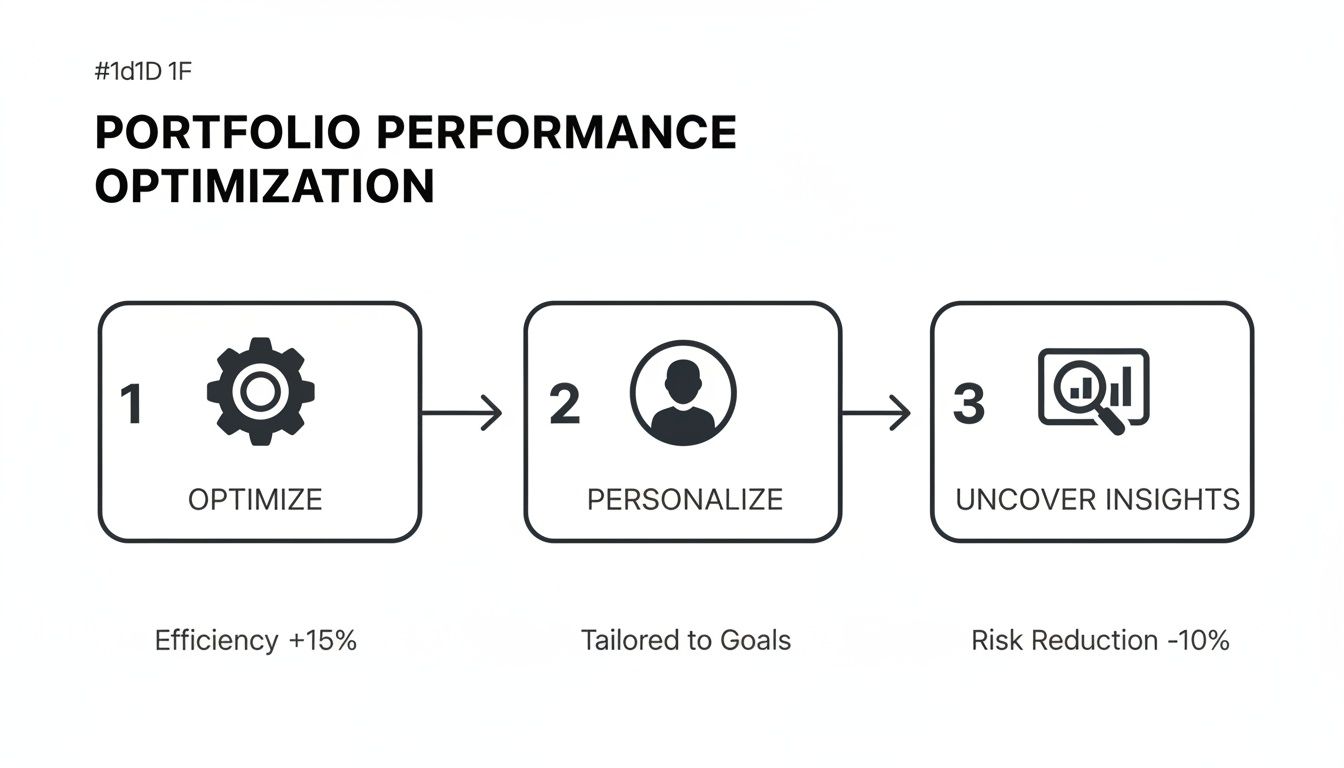
As you can see, the process moves logically from broad optimization to highly specific, personalized actions that can reveal opportunities you might have otherwise missed.
Evaluating a Firm’s Tech and Security
When you’re vetting a wealth management firm’s use of artificial intelligence technologies, their commitment to data security has to be front and center. Your financial data is incredibly sensitive, and any firm leveraging AI must have ironclad security protocols to protect it.
Don't hesitate to press them on the details. You need to verify they employ strong encryption, strict access controls, and regular, independent security audits.
The rapid spread of these tools makes this diligence even more critical. By late 2025, generative AI adoption is projected to hit 16.3% of the global population. In trailblazing nations like the United Arab Emirates, usage is expected to be as high as 64.0% among the working-age population.
This isn't just a trend; it's a fundamental shift. It underscores the importance of partnering with firms that are not just early adopters, but leaders in secure and ethical implementation. You can discover more insights about these global AI adoption trends from Microsoft. By asking the right questions, you can ensure your financial strategy is powered by technology that is both effective and secure.
Navigating the Risks of AI in Finance
Any smart strategy weighs both the upsides and the downsides. As powerful as AI is, bringing it into the world of wealth management means we have to tackle the risks with a clear-eyed, proactive approach. For high-net-worth individuals and family offices, understanding these risks—and how they’re being handled—is the bedrock of confidence. It’s how you know your interests always come first.
This isn’t about glossing over the tough stuff. It’s about facing potential issues head-on, from locking down sensitive financial data to making sure the algorithms behind your recommendations are fair, transparent, and in line with a regulatory landscape that’s changing by the day.
Safeguarding Your Financial Data
In this business, data is the most valuable asset, which makes security completely non-negotiable. Weaving artificial intelligence technologies into wealth management platforms demands robust, multi-layered security protocols. The goal is simple: protect your sensitive personal and financial information from any and all cyber threats or unauthorized eyes.
Leading firms don’t just put up a single firewall; they build a secure digital fortress around your data. It's a comprehensive security posture, not just a simple checklist.
Here’s what that looks like in practice:
- End-to-End Encryption: All your data, whether it's sitting in a database or moving between systems, is scrambled using top-tier cryptographic standards.
- Strict Access Controls: Only authorized personnel can access sensitive client information, and even then, they can only see what is absolutely necessary for their job. This is known as the principle of least privilege.
- Regular Security Audits: We bring in independent, third-party security experts to do rigorous penetration testing and vulnerability scans, making sure our defenses are always a step ahead.
- Continuous Monitoring: AI-powered systems are on watch 24/7, actively hunting for and neutralizing potential threats in real time—before they can ever cause harm.
These layers work in concert. While the AI gets the data it needs to generate insights, that data remains completely confidential and secure at all times.
Addressing Algorithmic Bias
One of the biggest conversations around AI right now is algorithmic bias. Here’s the thing: an AI model is only as smart as the data it learns from. If the historical data used to train an investment model is riddled with hidden biases—whether related to gender, race, or even just outdated market thinking—the AI can accidentally keep those same biases alive in its recommendations.
A biased algorithm might, for instance, wrongly flag certain investment opportunities as "too risky" just because they don't fit old patterns. That could cause you to miss out on valuable diversification or growth. This is exactly why proactive bias detection is so crucial.
Responsible firms deal with this directly through rigorous governance. This means constantly testing models for fairness and accuracy, feeding them diverse datasets for training, and always keeping a "human-in-the-loop." An experienced advisor is there to review and validate what the AI suggests. The objective is to ensure the artificial intelligence technologies deliver objective, data-driven advice that’s free from unfair or inaccurate baggage.
Staying Ahead of Regulations
The rulebook for AI is being written as we speak. Regulators like the SEC are working hard to establish clear guidelines for its use in financial services. Staying compliant isn't just about following the law; it’s a core part of managing wealth ethically and transparently. It means ensuring that AI systems are explainable, fair, and aligned with fiduciary duties.
Navigating this complex web of rules requires deep expertise. For firms with a global footprint, a practical AI GDPR compliance guide can be indispensable. By prioritizing transparency and sticking to the highest ethical standards, wealth managers build trust. It’s the clearest way to show a commitment to putting clients first, proving that innovation and responsible governance can—and must—go hand-in-hand.
What Does the Future Hold for Your Financial Legacy?
Looking over the horizon, artificial intelligence is shaping up to be much more than just a powerful analytical engine for wealth management. It's on a clear path to becoming a genuine strategic partner, deepening the collaboration between you and your advisor in ways that will redefine financial planning.
We’re already seeing the early stages of this shift. It’s no longer just about optimizing a portfolio. We're now entering an era of incredibly sophisticated predictive analytics, especially in the thorniest areas of wealth, like multi-generational estate planning and philanthropic strategy. AI can model future scenarios with a level of detail that was previously unimaginable, helping families navigate complex tax laws and succession plans with a newfound sense of clarity.
Putting Elite Strategies Within Reach
One of the biggest changes coming down the pike is the democratization of strategies once reserved for the largest institutions. Historically, things like complex hedging techniques or access to certain alternative investments were off-limits to most, simply because of the sheer analytical horsepower required.
AI is knocking down that barrier by handling much of that heavy lifting. This allows advisory firms to bring these exclusive, high-performance strategies to a wider circle of high-net-worth clients. It’s leveling the playing field and opening doors to growth that just weren't there before.
The real story here is simple: AI is a powerful force multiplier for human expertise. It tackles the immense data processing and the routine analysis, which frees up your advisor to focus on what you actually hire them for—understanding your family’s unique dynamics, offering nuanced counsel, and building a relationship that lasts.
Ultimately, bringing AI into the fold isn't about chasing another percentage point of return. It’s about building a smarter, more resilient, and forward-looking foundation for your family’s wealth. Adopting these tools ensures your legacy isn't just protected—it's thoughtfully prepared for whatever complexities the future holds. This is what it looks like when expert human guidance is backed by unparalleled technological capability.
Your Questions, Answered
It's completely normal to have questions when you hear about artificial intelligence technologies being used in wealth management. Let's tackle some of the most common ones that investors and families bring up when they're thinking about the real-world impact of AI on their financial future.
We've put together some clear, direct answers to help you navigate this space with confidence.
Is an AI Going to Replace My Financial Advisor?
No, not at all. The real goal here is collaboration, not replacement.
Think of AI as a powerful analytical engine that supercharges your advisor's expertise. It does the heavy lifting—poring over massive datasets and spotting patterns humans might miss. This frees up your advisor to focus on what they do best: strategic thinking, understanding your unique family dynamics, and providing the kind of nuanced counsel a machine never could. This is what we call a "human-in-the-loop" model, and it gives you the best of both worlds.
How Secure Is My Financial Data with These AI Tools?
This is a critical question, and for top-tier firms, data security is non-negotiable. Your sensitive financial information is shielded by multiple layers of defense, including:
- End-to-end encryption, which scrambles your data whether it’s sitting in a file or being sent across a network.
- Strict access controls to ensure that only fully authorized personnel can view information, and only when absolutely necessary.
- Regular, independent security audits to proactively find and patch any potential vulnerabilities before they become a problem.
These measures mean that while artificial intelligence technologies can analyze the data to find valuable insights, the raw information itself remains completely confidential and locked down.
Can AI Handle More Than Just My Stock Portfolio?
Absolutely. While AI is fantastic at analyzing public markets, its real power lies in its versatility. It's increasingly being used to spot opportunities and manage risk in complex alternative investments that go far beyond simple stocks and bonds.
We're talking about things like:
- Private Equity: Sifting through private company data to flag promising deals before they hit the mainstream.
- Real Estate: Modeling market trends to pinpoint undervalued commercial or residential properties.
- Tax Optimization: Running complex simulations to map out the most efficient strategies for transferring wealth across generations.
The versatility of AI is what makes it so valuable. It can be applied across your entire portfolio, giving you a truly holistic view of your financial picture—not just a small slice of it. This kind of comprehensive analysis is the bedrock of sophisticated wealth management today.
How Do I Get Started with AI in My Investment Plan?
The best first step is always a direct conversation with your financial advisor.
Ask them about their firm's approach to using artificial intelligence technologies. You'll want to discuss how these tools can be specifically aligned with your long-term goals, your personal risk tolerance, and what you hope to achieve for your legacy. An open dialogue ensures that any technology being used is there to serve your strategy, not the other way around.
At Commons Capital, we integrate advanced AI to sharpen our strategic financial guidance, ensuring your wealth is managed with both precision and deep personal insight. Schedule a consultation with our advisory team to learn more.