For high-net-worth investors searching for the best AI ETF for 2026, the optimal choice is not a one-size-fits-all answer. The decision ultimately depends on your personal financial goals, risk tolerance, and the specific segment of the artificial intelligence market you wish to target. The top contenders for the coming year are the funds best positioned to capitalize on the surging demand for computational power, widespread enterprise adoption of AI, and innovative monetization models for AI services.
The 2026 Outlook for AI Investments
Artificial intelligence has evolved from a futuristic concept into a fundamental driver of economic growth, making strategic exposure to this sector essential for any modern portfolio. The critical question for high-net-worth individuals has shifted from if they should invest in AI to how to do so effectively.
The performance of the AI sector speaks for itself. Many AI ETFs have delivered double-digit returns, significantly outpacing even the tech-heavy Nasdaq 100. In fact, most AI-related funds rallied strongly year-to-date, with the group as a whole surpassing the Nasdaq 100's impressive 17% gain.
This macroeconomic backdrop sets the stage for a deeper analysis. Our objective is to help you navigate the various options from a strategic wealth management perspective. For additional context on the broader technology landscape, our guide to investing in robotics and AI offers valuable insights.
Top AI ETF Contenders for 2026 at a Glance
Before we delve into a detailed analysis, here is a high-level summary of the top contenders for the best AI ETF in 2025, comparing their core investment strategies and risk profiles.
Each of these ETFs provides a distinct approach to AI exposure, which we will unpack to determine its suitability for your portfolio.
In 2025, private AI investment surpassed $150 billion, with a significant pivot toward infrastructure. This trend indicates that the market is moving beyond initial hype and into the capital-intensive phase of building the foundational systems required to scale AI globally.
Understanding Market Dynamics
The current artificial intelligence market is influenced by several powerful forces. Understanding these trends is crucial for selecting an ETF that is well-positioned for future growth.
- Computational Demand: The demand for powerful GPUs and advanced data centers is unprecedented. ETFs with substantial exposure to semiconductor and infrastructure companies are poised to benefit.
- Enterprise Adoption: Businesses across all industries are integrating AI into their operations to enhance efficiency and develop new products. This trend favors ETFs with a broad, application-focused investment approach.
- Monetization Models: There is a significant shift from free research tools to paid, subscription-based AI services, creating stable and predictable revenue streams for software-centric companies.
To gain a better understanding of future market directions, reviewing various business forecasting methods can be highly beneficial. This due diligence is essential as we move into a detailed, comparative analysis of the leading funds.
How to Look Under the Hood of an AI ETF
Selecting the right AI ETF for 2025 requires more than just sorting by the lowest expense ratio. While cost is a factor, a thorough evaluation involves a deep dive into the fund's core structure to ensure it aligns with your long-term financial objectives.
The first step is to dissect the underlying index methodology. This is the ETF's "rulebook," dictating which companies the fund holds and why. Some indexes are market-cap weighted, naturally favoring mega-cap tech giants. Others employ more nuanced strategies, such as equal-weighting or proprietary scoring, to identify pure-play AI innovators.
An index that simply mirrors large-cap tech stocks offers stability but may dilute your exposure to true AI growth stories. Conversely, a fund hyper-focused on smaller, niche firms presents explosive potential but also carries significant volatility. The methodology reveals the fund's true investment philosophy.
Assessing Portfolio Concentration and Risk
A common mistake with thematic funds is unintentional risk concentration in a few holdings. Many AI ETFs are heavily weighted toward a handful of semiconductor or software companies. While these firms are vital to the AI ecosystem, overexposure to a single stock or sub-sector can be detrimental.
To assess this, examine the ETF's top ten holdings. If one or two positions constitute 15-20% or more of the fund, it's a red flag. Your performance becomes overly dependent on a few companies, defeating the purpose of a diversified ETF.
A well-constructed AI ETF should diversify across several key categories:
- The Enablers: Companies building the essential hardware, such as semiconductors, data center equipment, and infrastructure.
- The Innovators: Firms developing the core AI models, algorithms, and software platforms.
- The Beneficiaries: Businesses in various sectors that are effectively using AI to gain a competitive advantage.
This balanced approach helps mitigate risk if one segment of the AI value chain underperforms, creating a more resilient investment.
Figuring Out Thematic Purity
Not every fund with "AI" in its name is a true AI fund. "Thematic purity" refers to the degree to which a fund is genuinely invested in the core artificial intelligence theme. Some ETFs cast such a wide net that they include companies with only a tangential connection to AI, essentially operating as broad tech funds in disguise.
To verify thematic purity, you must look beyond the top ten holdings. Scrutinize the full list and identify companies whose primary revenue streams are directly linked to AI. A fund with high thematic purity ensures your capital is aimed squarely at the AI revolution, not just the broader technology sector.
An ETF's rebalancing strategy is a critical, yet often overlooked, component. A fund that rebalances quarterly can pivot quickly to capture emerging leaders, while one that only rebalances annually might get left behind in a sector this fast-moving.
Scrutinizing Fees and Rebalancing Strategy
While expense ratios shouldn't be the sole determinant, they are important as they directly impact your returns. Fees for thematic ETFs can range from as low as 0.35% for passive funds to 0.75% or higher for actively managed ones. It's crucial to understand what you are paying for. For a detailed breakdown of how fees impact returns over time, you can review our analysis of investment management fees.
Equally important is the fund’s rebalancing schedule. The AI sector moves at a rapid pace, and your chosen fund should be able to keep up. A quarterly rebalance allows managers to trim overextended positions and reinvest in new opportunities, keeping the strategy agile. An annual rebalance, however, can feel sluggish and leave the fund over-weighted in last year's winners. Understanding these mechanics is vital before committing capital.
A Comparative Analysis of Leading AI ETFs
Choosing the best AI ETF for 2026 requires a deeper analysis than a cursory look at year-to-date returns. It's essential to understand the nuances of each fund. Not all AI ETFs are created equal; each has a unique philosophy, risk tolerance, and construction, making it suitable for different portfolio types.
Let's dissect the top contenders, moving beyond surface-level metrics to uncover the strategic details that drive their performance and shape their potential. This is about understanding how each fund fits into a specific investment thesis.
Thematic Focus: Robotics and Automation vs. Disruptive Innovation
The primary distinction among top AI ETFs lies in their core theme, which dictates their market worldview. This contrast is clearly visible when comparing the Global X Robotics & Artificial Intelligence ETF (BOTZ) and the ARK Autonomous Technology & Robotics ETF (ARKQ).
BOTZ is a pure-play on the industrial and commercial applications of AI and robotics. Its portfolio is heavily weighted toward companies building machinery and software for automation in sectors like manufacturing, healthcare, and logistics.
- Investment Thesis: An investor in BOTZ is betting on the tangible, real-world deployment of automation. This fund targets companies that enhance productivity and efficiency through physical robots and the AI that controls them.
- Ideal Scenario: BOTZ is designed to thrive when industrial capital expenditure is high and companies are aggressively upgrading their operational infrastructure, such as automated warehouses, surgical robots, and advanced manufacturing plants.
ARKQ, in contrast, adopts a broader "disruptive innovation" theme. While it includes robotics, its scope extends to more forward-looking areas like autonomous vehicles, 3D printing, and space exploration.
- Investment Thesis: An ARKQ investor is targeting companies that could create entirely new markets or radically disrupt existing ones. The focus is less on immediate industrial applications and more on groundbreaking technological shifts that are still emerging.
- Ideal Scenario: This fund is suited for periods of rapid technological advancement and high-risk appetite, aiming to capture the explosive growth of companies in the early stages of market disruption.
The choice between BOTZ and ARKQ is a strategic one. BOTZ offers focused exposure to the current industrial AI revolution, while ARKQ represents a high-conviction bet on a wider spectrum of future-shaping technologies.
To properly compare these funds, you must examine their underlying index, portfolio mix, and the "purity" of their AI exposure. The framework below outlines these critical evaluation points.
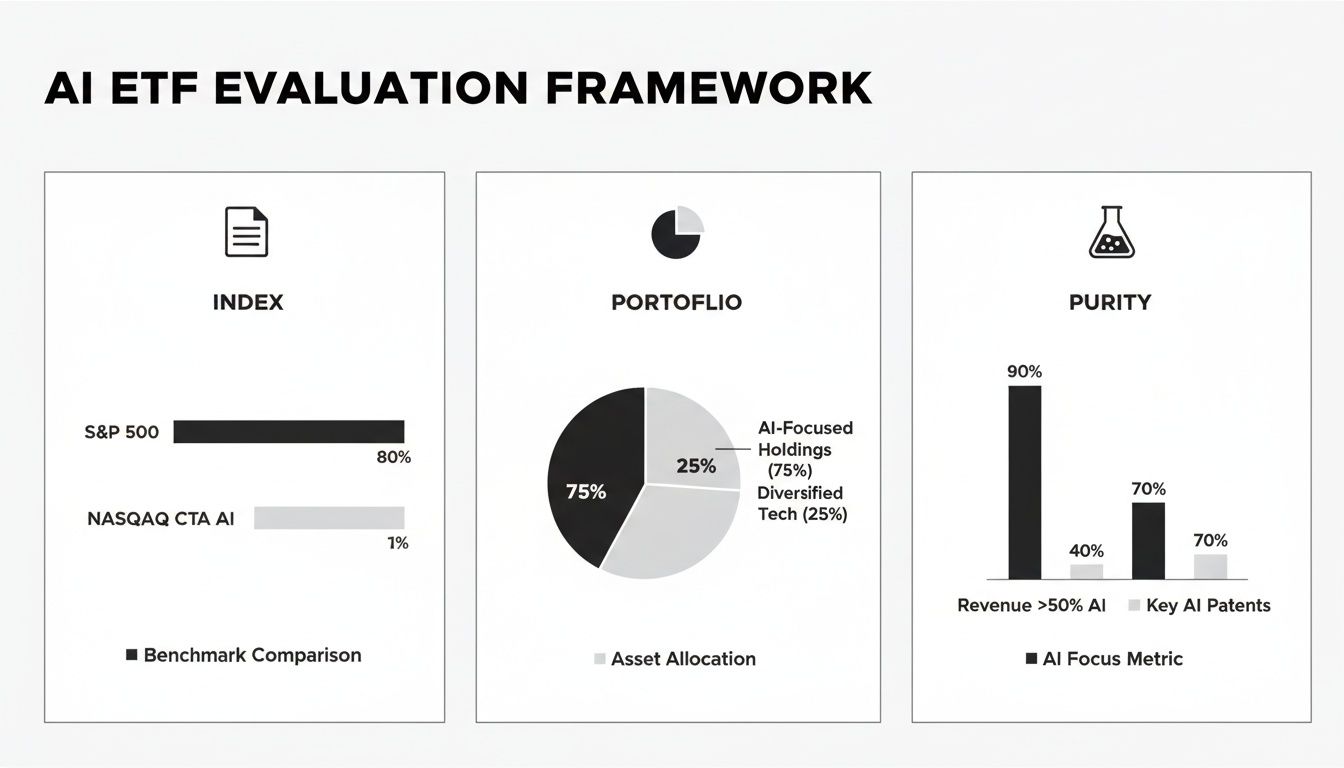
This illustrates that a true evaluation goes far beyond performance charts; it requires a deep dive into the fund's construction.
Detailed Comparison of Top AI ETFs for 2026
To make an informed decision, it's crucial to compare these funds side-by-side. The following table provides a snapshot of key metrics for some of the leading AI ETFs, offering a direct comparison of their performance, cost, and investment strategy.
Data as of Q4 2024. Returns are annualized and subject to market fluctuation. Holdings may change.
This table highlights the trade-offs at a glance. Note the differences in expense ratios, the active vs. passive management styles, and the concentration in top holdings, which directly impacts risk and potential reward.
Performance Under Different Market Conditions
An ETF’s performance is a direct reflection of its underlying strategy. Individual AI funds can behave very differently based on their holdings and focus. For instance, ARKQ was a standout performer in a recent one-year period, posting gains of 42.63%. You can discover more insights about top-performing AI ETFs to see how various strategies have performed in real-world scenarios.
This outperformance demonstrates the upside of an actively managed, high-conviction approach when growth stocks have strong market momentum. However, this same strategy can lead to significant volatility when market sentiment turns against speculative tech.
In contrast, a fund like the iShares Robotics and Artificial Intelligence Multisector ETF (IRBO) takes a more diversified and potentially steadier approach, typically holding over 100 companies with smaller individual weightings.
- During a Bull Market: IRBO might lag a more concentrated fund like ARKQ because its gains are spread across a wider base of stocks.
- During a Bear Market: Its diversification can act as a cushion, potentially leading to smaller drawdowns as losses from a few high-flyers are offset by steadier performers.
This highlights the classic trade-off: higher concentration for potentially higher returns, or broader diversification for potentially lower volatility.
Dissecting Top Holdings and Concentration Risk
An ETF's top holdings reveal its core convictions and its biggest risks. A look at the top three holdings of our example funds tells a compelling story.
Global X Robotics & Artificial Intelligence ETF (BOTZ)
- NVIDIA Corp: The leader in AI chips, forming the backbone of the fund's infrastructure bet.
- Intuitive Surgical Inc: A dominant player in robotic-assisted surgery, representing the healthcare automation theme.
- Keyence Corp: A Japanese company specializing in industrial automation sensors and machine vision systems.
The heavy concentration in these names means BOTZ's performance is tightly linked to the semiconductor cycle and capital spending in healthcare and manufacturing.
ARK Autonomous Technology & Robotics ETF (ARKQ)
- Tesla Inc: A major bet on autonomous driving and EV technology.
- Trimble Inc: A leader in GPS and other technologies crucial for automation.
- Kratos Defense & Security Solutions: A play on unmanned systems and drones.
ARKQ's holdings show a clear focus on disrupting transportation, aerospace, and defense. Its high concentration in a few key names makes it a more aggressive and volatile instrument than a broadly diversified fund.
Ultimately, determining the best AI ETF for 2026 depends on an investor's specific goals. There is no single "correct" answer, only the right fit for a well-defined portfolio strategy. The first step is to answer a key question: Do you want targeted exposure to industrial automation, a high-growth bet on future tech, or a diversified play on the entire AI ecosystem? Once you have that answer, you're on the right track.
Looking Beyond the Usual Suspects: Niche and International AI ETFs
While many investors gravitate toward large, US-centric AI funds, a world of specialized and international ETFs offers unique opportunities. These niche funds can provide geographic diversification and target specific sub-themes within the AI ecosystem, moving your portfolio beyond the obvious names. For a sophisticated investor, this global perspective is critical for building a more resilient portfolio.
Focusing solely on domestic markets means potentially missing major AI innovations in Europe and Asia. International AI ETFs are designed to capture these opportunities, providing exposure to companies that standard US-heavy indexes often overlook. This is a smart way to reduce concentration risk and tap into different economic cycles and regulatory environments.
The Case for a Global Playbook
Expanding your AI investment horizon beyond North America is a strategic necessity, not just a diversification tactic. Many global leaders in specialized areas like industrial robotics, machine vision, and AI-powered healthcare are based in Japan, Germany, and other developed nations. Including funds with significant international holdings gives you a more complete picture of the global AI supply chain.
For example, a globally-focused ETF might offer direct exposure to:
- European AI Leaders: Capturing innovation from established industrial giants and nimble software firms across the continent.
- Asian Tech Hubs: Gaining access to key players in semiconductor manufacturing and AI application development in countries like Japan and Taiwan.
Adopting this global lens ensures your portfolio isn't entirely dependent on the fortunes of a few Silicon Valley giants, creating a more balanced and durable long-term position.
It's All in the Index Methodology
A key differentiator for international and niche ETFs is their underlying index construction. They often use unique methodologies that go beyond simple market-cap tracking. Many focus on companies that generate a significant portion of their revenue directly from AI-related activities, providing a purer, more concentrated thematic investment.
The AI ETF space expanded significantly throughout 2025, offering investors several high-quality options. For instance, the L&G Artificial Intelligence UCITS ETF (AIAI) tracks the ROBO Global Artificial Intelligence Index, which focuses on businesses at the forefront of machine learning and NLP in sectors like healthcare, manufacturing, and finance. You can explore more about top AI ETFs to watch on ig.com.
Another compelling fund is the WisdomTree Artificial Intelligence UCITS ETF (WTAI), which tracks the Nasdaq CTA Artificial Intelligence Index, designed to capture companies across the entire AI value chain.
What we find particularly compelling about WTAI is its methodology. It segments companies into three distinct buckets: Enablers, Enhancers, and Engagers. This structure provides balanced exposure, covering everything from core hardware creators to the end-users implementing AI in their operations.
This thoughtful construction is what separates a true thematic fund from a broad tech ETF with only a loose connection to artificial intelligence. You know exactly what you own.
Zeroing In on Specific AI Sub-Themes
Beyond geography, niche ETFs allow you to place strategic bets on specific sub-themes with high growth potential. Instead of a general "AI" fund, you can target narrower verticals that align with your market thesis.
Consider these examples:
- AI in Healthcare: ETFs concentrating on companies using AI for drug discovery, medical imaging, and robotic surgery.
- Natural Language Processing (NLP): Funds prioritizing firms developing advanced conversational AI and sophisticated language translation technology.
- AI Infrastructure: Highly focused funds that invest almost exclusively in the semiconductor, data center, and cloud computing companies that form the physical backbone of the AI industry.
By selecting ETFs with a laser-sharp thematic focus, you can fine-tune your portfolio's exposure with incredible precision. This allows you to build a custom allocation that reflects your beliefs about where the most valuable AI applications will emerge. For a high-net-worth investor, this level of control is essential.
Integrating AI ETFs into a High-Net-Worth Portfolio
Incorporating an AI ETF into a high-net-worth portfolio is a calculated move that involves strategic allocation, risk management, and a long-term perspective. The goal is not to chase a hot trend for short-term gains but to use AI as a tactical growth engine within a stable, diversified framework. The best AI ETF for 2025 will be one that complements your existing assets, not one that hijacks your strategy.
For most high-net-worth clients, these ETFs are best treated as satellite holdings — smaller, targeted positions that orbit a core portfolio of traditional assets. This structure allows you to tap into the significant upside of AI without exposing your entire net worth to a notoriously volatile sector. Finding the right balance is key and must align with your personal financial goals and risk tolerance.
Tailoring Allocations to Your Risk Profile
There is no single "magic number" for how much to allocate to AI ETFs; it's a personal decision based on your risk tolerance. Let's consider a couple of common investor profiles.
An investor with a Conservative Growth profile might consider a modest 3-5% tactical allocation, likely in a broad, diversified fund like AIQ or IRBO. The objective is to gain exposure to the theme's long-term potential without significantly increasing overall portfolio volatility.
Conversely, an investor with an Aggressive Growth profile might commit 10-15% to the AI theme. This larger allocation could be split across several funds to capture different facets of the AI story, such as a core holding in a broad fund supplemented by smaller, more concentrated bets on robotics or semiconductors. This multi-fund approach helps diversify risk even within a high-conviction thematic play.
Tax Implications and Liquidity Considerations
For high-net-worth individuals, after-tax returns are what truly matter. Most AI ETFs are structured to be relatively tax-efficient, especially compared to actively trading individual stocks. However, it's important to pay attention to the fund's turnover rate.
High-turnover, actively managed funds can sometimes generate larger capital gains distributions, potentially leading to an unexpected tax liability. Always review a fund’s distribution history and prospectus to understand its potential tax drag.
Liquidity is another critical factor. Ensure any ETF you consider has sufficient trading volume, indicated by its average daily traded value. A highly liquid ETF allows you to enter and exit large positions without adversely affecting the market price, a must-have for managing substantial capital.
Portfolio Rebalancing and Strategic Discipline
Once an AI ETF is part of your portfolio, the work isn't over. The AI sector is prone to rapid growth spurts, which can cause your tactical allocation to swell and unintentionally increase your portfolio's overall risk. Disciplined rebalancing is essential.
Establish clear rebalancing rules from the start. For example, you might decide to trim your AI position if it exceeds your target allocation by a set percentage, such as 5%.
This disciplined process involves:
- Set a Target: Define your ideal allocation percentage.
- Monitor Regularly: Review your portfolio quarterly or semi-annually.
- Execute Systematically: Sell a portion of the outperforming asset to realign your allocation and reinvest the proceeds into underperforming areas of your portfolio.
This systematic approach removes emotion from decision-making and ensures your portfolio remains aligned with your long-term strategy. For a more in-depth look at building a resilient portfolio, our guide on high-net-worth investment strategies provides a comprehensive framework. Ultimately, successful integration of AI ETFs requires a thoughtful, structured approach, ideally managed with professional guidance.
Getting to a Final Decision on Your AI ETF
We've presented the data and analyzed the top funds, but the final step is moving from analysis to action. The objective was never to identify a single "best" AI ETF but to find the one that fits seamlessly into your financial picture. Your final choice should feel like a natural extension of your wealth strategy, not a forced addition.
This is the point where you double-check that the fund truly aligns with your long-term goals and that every detail, from its expense ratio to its rebalancing schedule, meets your standards.
Your Final Due Diligence Checklist
Before executing a trade, a final review is prudent. This isn't about second-guessing your analysis; it's about confirming the fundamentals one last time.
- Read the Prospectus: Go directly to the source. The prospectus details the fund's investment objectives, strategies, risks, and fees. Pay close attention to the fine print, especially regarding index construction and weighting.
- Check the Rebalancing Schedule: Understand how often the fund adjusts its holdings. A more frequent rebalancing schedule (e.g., quarterly) can be advantageous in a fast-moving sector like AI.
- Look at Historical Volatility: Analyze the fund's past performance, specifically its standard deviation and maximum drawdowns. This provides a realistic picture of how the ETF has behaved during market stress and helps set expectations for risk.
Completing this checklist should give you the confidence that your decision is sound and that you fully understand the investment.
The most critical piece of this whole process is context. An AI ETF that looks perfect on paper might be a terrible fit if it just duplicates exposures you already have or introduces a level of volatility you're not prepared to stomach.
Why Bringing in Your Advisor Matters
Navigating the complexities of thematic investing, especially in a rapidly evolving field like artificial intelligence, can be challenging. The right AI ETF for your portfolio in 2026 is one that has been thoroughly vetted against your entire financial situation.
A trusted financial advisor provides an objective, third-party perspective, pressure-tests your assumptions, and ensures your final selection is not just a good choice but the right one for your long-term objectives. Their role is to integrate this new position into a disciplined, goal-oriented wealth plan.
Common Questions About AI ETF Investing
Diving into AI ETFs often raises practical questions, particularly for those managing significant portfolios. Here are straightforward answers to common inquiries.
What’s a Reasonable Portfolio Allocation for AI ETFs?
We typically view AI ETFs as tactical, not core, holdings. For most clients, this translates to an allocation in the 3% to 10% range.
The ideal percentage for you depends on your personal risk tolerance, investment horizon, and existing portfolio composition. This is a conversation best had with your advisor to ensure you are adding potential upside without taking on excessive volatility. The goal is to gain exposure to the sector's growth, not to bet the farm.
Should I Consider Leveraged AI ETFs?
Leveraged ETFs are designed for short-term traders, not long-term investors. These complex instruments reset daily, which can lead to performance that significantly deviates from the underlying index over time due to "volatility decay."
For sophisticated investors with a very high risk tolerance, a small, tactical position might be considered, but only outside of core retirement accounts and with close professional oversight. The risks are amplified and are not suitable for everyone.
What's the Real Difference Between a Pure-Play AI ETF and a Broad Tech Fund?
Think of it as the difference between a scalpel and a Swiss Army knife.
A pure-play AI ETF is the scalpel. It focuses on companies where AI is the primary business — firms involved in robotics, machine learning platforms, or specialized AI chip design. This provides concentrated exposure, meaning higher potential returns but also higher, more focused risk.
A broad tech ETF, like one tracking the NASDAQ 100, is the Swiss Army knife. It holds giants like Apple or Microsoft that use AI extensively but are not solely defined by it. In this case, AI is just one of many growth drivers. You get a more diversified, less direct way to invest in the trend.
At Commons Capital, we specialize in helping high-net-worth individuals integrate sophisticated investment themes like artificial intelligence into a comprehensive wealth strategy. Contact us today to build a portfolio that aligns with your financial future.