
Forget chasing market highs for a moment. What if your portfolio's main job was simply to make sure the money you need in the future is actually there when you need it?
That’s the core idea behind liability-driven investing (LDI). It’s a strategy that flips the script—instead of maximizing returns at all costs, the goal is to align your investments to cover specific, predictable future expenses. Think of it as building a financial bridge to ensure you can meet big obligations like pension payouts or college tuition without a shortfall. This guide explains what liability driven investing is, how its mechanics work, and who benefits most from this approach.
The Fundamentals Of Liability-Driven Investing
With an LDI strategy, the mindset shifts from returns-first to security-first. The entire focus is on making sure your assets behave in the same way your liabilities do, particularly when interest rates or inflation move.
You’re essentially creating a dedicated pool of assets designed to match the cash flow and risk profile of your future debts. This involves a few key moves:
- Duration matching to immunize your portfolio against interest rate swings.
- Timing cash flows so money arrives exactly when payments are due.
- Hedging inflation risk with securities that protect your purchasing power.
To really get a handle on this, it helps to have a basic understanding bank assets and liabilities, as LDI borrows from the same balance sheet management principles.
Traditional Investing Vs. Liability-Driven Investing
So, how different is this from what most people do? Drastically. A traditional approach is all about beating the market. LDI is about meeting your promises. This table breaks it down.
The difference is night and day. One chases upside; the other eliminates downside risk related to a specific goal.
LDI ensures that when your obligations come due, the money will be there.
This is precisely why large institutions and families with significant long-term commitments lean on LDI for peace of mind. They aren’t gambling with their obligations.
Key Benefits Of An LDI Strategy
So why go this route? The main advantages of liability driven investing come down to predictability and control.
- Predictable Funding Status: You know where you stand in relation to your future debts.
- Reduced Contribution Volatility: Fewer surprises mean you won’t have to scramble for huge cash infusions if the market turns.
- Protection Against Interest Rate Moves: Your assets and liabilities move in tandem, neutralizing the biggest risk for long-term obligations.
It's a powerful way to lock in security, which is a cornerstone of any solid financial plan. If you're looking for more practical ways to build that kind of reliability for your own future, our guide on Guaranteed Retirement Income is a great place to start.
Pension funds and high-net-worth families are the classic users of LDI. They have known, significant commitments years or decades down the road and simply can't afford to come up short.
For example, imagine a pension plan knows it will owe $50 million in benefits in ten years. Instead of hoping stocks go up, it can buy a portfolio of bonds that also mature in ten years. As interest rates change, the value of those bonds will move in sync with the present value of that $50 million liability, keeping the plan fully funded.
This is a world away from picking the next hot stock or chasing an aggressive hedge fund strategy. The LDI process is methodical: first, you precisely measure your liabilities. Then, you set a target funding ratio and build a portfolio of assets to match it. Finally, you monitor it continuously to stay on track.
Let’s dig into the mechanics of how that works.
Core Components You Should Know
Every LDI strategy is built on three pillars that work together to create stability.
- Duration Matching: This is the big one. It aligns the interest rate sensitivity of your assets with your liabilities. If rates fall by 1%, the value of your future liability goes up—but so does the value of your duration-matched bond portfolio, keeping your funding ratio stable.
- Cash Flow Matching: This is more precise. It ensures that the income from your investments (like bond coupon payments) arrives right when you need to make a payment. No need to sell assets at a bad time.
- Inflation Hedging: For liabilities that grow with inflation (like cost-of-living adjustments for pensions), LDI uses instruments like Treasury Inflation-Protected Securities (TIPS) to ensure your assets keep pace.
Insurers and foundations have also embraced LDI for the same reason—it helps them eliminate the risk of a funding shortfall. Instead of measuring success against a generic market index, their benchmark becomes their own liability schedule.
By shifting focus to a funded status target, trustees and advisors have a much clearer and more direct path to meeting their commitments. LDI delivers one thing above all else: stability for your most important planned obligations.
How LDI Mechanics Align Assets with Liabilities
Liability-driven investing isn't about chasing the highest returns. It's about a much more fundamental goal: making sure the money is there when you need it. Think of it as building a financial safety net designed to perfectly catch your future obligations.
To do that, LDI relies on three core techniques that synchronize your assets with those promises you’ve made.
- Duration matching syncs up how sensitive your assets and liabilities are to interest rate shifts, so when rates move, both sides of your balance sheet move in harmony.
- Cash flow matching is more direct—it schedules investment income to arrive precisely when bills are due.
- Hedging uses specific tools, like inflation-protected securities, to shield your portfolio from the corrosive effects of rising prices.
Duration Matching Explained
In the world of fixed income, duration is the secret sauce. It’s a measure of how much an asset or liability’s value will zig or zag when interest rates change. By matching the duration of your assets to your liabilities, you can essentially lock in your funded status, making it immune to those swings.
Imagine a pension fund that owes $50 million in ten years. If it buys a portfolio of bonds with a similar duration, look what happens when rates fall by 1%:
The liability gets bigger, but the asset portfolio grows right alongside it, neutralizing the risk. It’s a beautifully simple concept in practice.
Professionals get even more granular, using metrics like modified duration and the dollar impact of a tiny rate shift, often called the basis point value (BPV). The goal is to get the BPV of the assets and liabilities to mirror each other, ensuring that any rate move has an almost identical, offsetting dollar effect.
Cash Flow Matching in Practice
If duration matching is about neutralizing risk from afar, cash flow matching is about precision on the ground. It’s the process of lining up your investment income—bond coupons, principal repayments, annuity checks—to land in your account exactly when you need to pay a liability.
This completely sidesteps the risk of being forced to sell assets at a bad time just to raise cash. The process is straightforward:
- Map out your future liabilities and the exact cash required for each payment.
- Build a portfolio of bonds or other instruments whose payment dates align with that schedule.
- Monitor the portfolio and reinvest any surplus cash efficiently.
For big pension funds, this might involve using zero-coupon bonds that mature on the exact date a large lump-sum benefit is due. It’s the ultimate in taking timing risk off the table.
Inflation Hedging with Securities
Inflation is the silent killer of future purchasing power. A dollar promised for 30 years from now won't buy nearly as much as it does today if inflation runs hot.
LDI strategies tackle this head-on, most commonly with Treasury Inflation-Protected Securities (TIPS). These are clever instruments whose principal value adjusts upward with the Consumer Price Index (CPI). As inflation rises, the value of your TIPS holdings rises too, helping your assets keep pace with inflation-linked liabilities.
- TIPS are the go-to for direct inflation protection in the U.S.
- Inflation swaps can be used to transfer inflation risk to another party.
- Real return bonds from other countries serve a similar purpose for non-U.S. liabilities.
Putting Mechanics into Action
So, how do you actually implement an LDI strategy? It all starts with a deep dive into your liabilities—quantifying them, mapping their cash flows, and understanding their sensitivity to rates and inflation. Only then can you start building the asset portfolio designed to hedge them.
This process is the answer to the question "what is liability-driven investing?" at its most practical level. Every single investment decision is tethered to a specific future obligation.
Advisors at Commons Capital integrate these mechanics into custom-built solutions for our clients, whether they are institutions or high-net-worth families planning for multi-generational wealth. Fixed income is a cornerstone of this approach, and our guide on municipal bond strategies shows how these choices can fit into a broader LDI framework.
Assessing Implementation Costs
Building this kind of precision portfolio doesn't come free. LDI strategies can carry higher costs than a standard bond fund because they often involve specialized instruments, careful monitoring, and active rebalancing.
Fees for managing duration-hedged portfolios can be higher, and transaction costs might creep up, especially when dealing with less-liquid, long-maturity bonds. But you have to weigh these expenses against the immense benefit of sleeping well at night, knowing that funding volatility is under control.
Key Takeaway: By aligning assets with liabilities, LDI significantly reduces the risk of a funding shortfall, providing a much higher degree of certainty that future obligations will be met, no matter what the markets do.
Next, we’ll look at exactly who stands to benefit the most from putting an LDI strategy to work.
Who Should Consider an LDI Strategy?
Liability-driven investing is a powerful tool, but let's be clear: it's not for everyone. An LDI strategy really finds its footing when an institution or an individual has to meet large, predictable financial promises, often stretching years into the future. It’s a framework built for certainty, a must-have for those who simply can’t afford to leave their most important obligations to the whims of the market.
The classic and most common users are, without a doubt, defined benefit pension plans. For decades, companies have leaned on LDI to make sure their pension promises to retirees are rock solid. It transforms what could be a volatile financial headache into a predictable, manageable cost. By lining up their assets with the stream of future benefit payments, they essentially immunize their financial health from the chaos of interest rate swings and market meltdowns.
Pension Plans: The Primary Adopters
Pensions are the quintessential example of where LDI isn't just a good idea—it's essential. The main job of a pension fund isn't to crush the S&P 500; it's to make sure checks go out to retirees, on time, every time. An LDI approach tackles this head-on by zeroing in on the plan's funded ratio—the value of its assets stacked up against the present value of its liabilities.
Recent history really drives this point home. LDI has become the bedrock strategy for pensions over the last twenty years, especially after market crises laid bare just how vulnerable some plans were. Take the 2022 gilt market crisis in the UK. It was a real-world stress test that showed how different LDI setups performed under extreme pressure. It served as a stark reminder that smart implementation and risk management are non-negotiable.
High-Net-Worth Families and Individuals
Stepping away from the institutional world, LDI principles offer tremendous value for high-net-worth families and individuals who are juggling significant, multi-generational financial goals. Their "liabilities" might not be pension payments, but they are just as real.
Think about these common scenarios:
- Generational Wealth Transfers: A family wants to pass a specific amount of money to the next generation in 20 years. LDI can help build a portfolio designed to hit that exact target, shielding the inheritance from market volatility.
- Major Philanthropic Pledges: Someone pledges a $10 million donation to their alma mater over the next five years. They can structure a portfolio to ensure the cash is there for each installment, no matter what the markets are doing.
- Dependable Retirement Income: A retiree needs a stable, predictable income to cover their living expenses for the rest of their life. LDI can be used to construct a portfolio of bonds and other instruments that generates those specific cash flows for decades to come.
In every one of these cases, the focus shifts from chasing speculative gains to guaranteeing a promise. The goal is to lock down the core obligation first. Only then, with the capital that's left over, can you start thinking about pursuing higher returns.
Insurance Companies and Endowments
Two other big players rely heavily on LDI: insurance companies and endowments.
Insurance companies are, at their core, in the liability management business. They take in premiums today with the promise of paying out claims in the future. LDI isn't just a strategy for them; it's fundamental to their entire business model, allowing them to invest those premiums in a way that ensures they can cover claims as they come due.
Likewise, university endowments and foundations have perpetual spending needs, like funding scholarships, research grants, or operational costs. LDI helps them structure a portion of their portfolio to generate predictable income to meet these ongoing commitments, making sure the institution's mission continues without interruption. For these types of organizations looking for guidance, exploring dedicated nonprofit retirement plan consulting services can provide the specialized expertise they need.
At the end of the day, anyone with a clearly defined, non-negotiable financial commitment on the horizon should get to know what LDI can do. It offers a disciplined and effective road to financial certainty.
Building an LDI Portfolio That Actually Works
So, how do you go from the idea of liability-driven investing to a real-world portfolio? It’s a disciplined, step-by-step process that turns abstract future promises into a concrete collection of assets designed to keep those promises. The entire framework is built to make sure every investment decision directly supports the end goal: securing your financial commitments.
This approach isn't just for big institutions; it's a powerful tool for a surprisingly diverse group of investors.
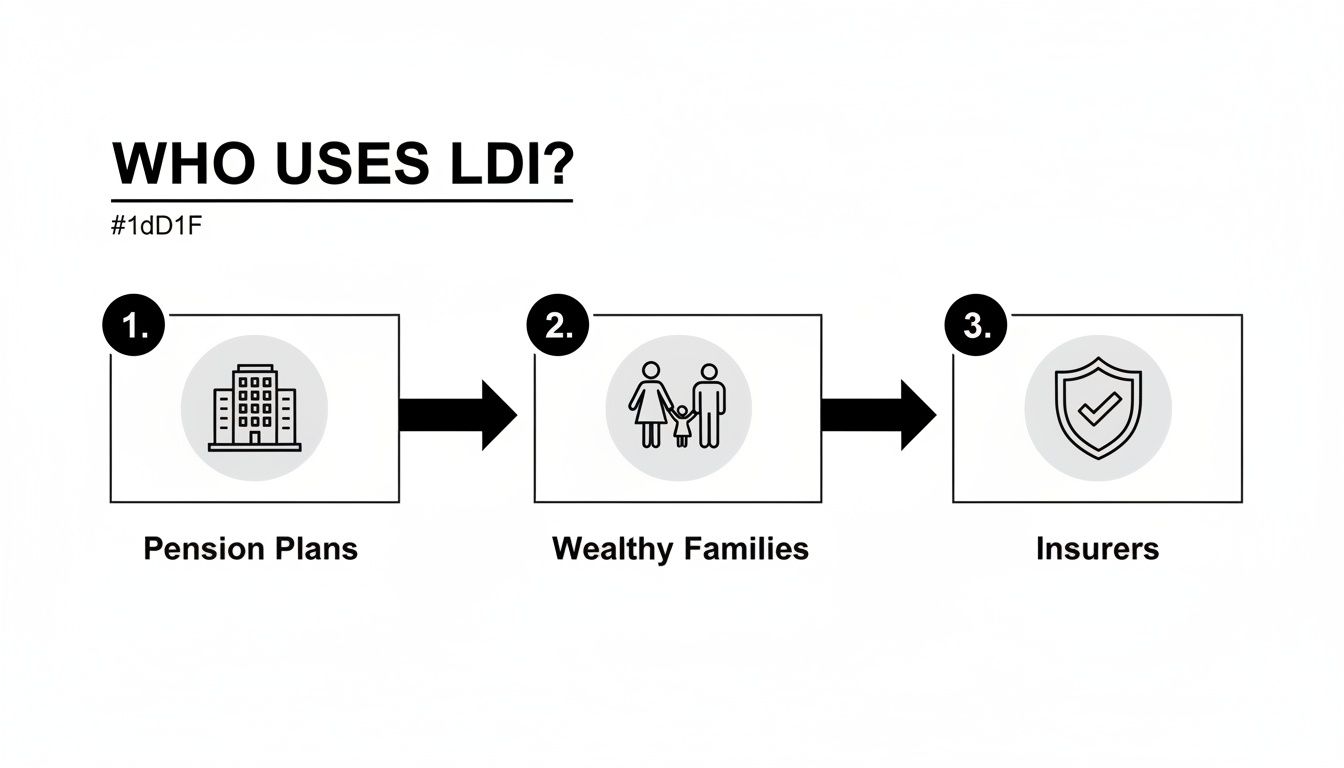
Whether you're managing a pension fund or a family's legacy, the core logic for building the portfolio stays the same. Let's walk through how it’s done.
Defining and Quantifying Liabilities
First things first: you have to get crystal clear on exactly what you owe and when it’s due. This isn't about ballpark figures; it's a detailed accounting of every single future obligation. For a pension plan, that means modeling every future benefit payment for every single member. For a wealthy family, it might mean mapping out a multi-year philanthropic pledge or planning for a specific inheritance.
This initial stage involves nailing down three things:
- Timing: The specific dates cash needs to go out the door.
- Size: The precise dollar amount of each future payment.
- Sensitivity: A deep understanding of how inflation and interest rates will affect each liability.
Without this detailed map of your liabilities, you're just guessing. This foundational work provides the blueprint for the entire LDI strategy.
An LDI portfolio is only as good as the liability analysis it's built upon. Precision at this stage is non-negotiable for success.
Setting Funding Goals and Risk Tolerance
Once you know exactly what you're up against, it's time to set a clear target. The single most important metric in the LDI world is the funding ratio—your total assets divided by the present value of your total liabilities. A funding ratio of 100% means you have exactly enough today to meet all future obligations.
The conversation here boils down to two key questions:
- What's our target funding ratio? Are we aiming for 100%, or do we want a cushion—say, 105%?
- How much risk are we willing to take with any capital that isn't locked down for hedging?
This is where the portfolio often gets split into two distinct piles: a hedging portfolio (the part that matches liabilities) and a return-seeking portfolio. The hedging piece is built with low-risk assets like high-quality bonds to neutralize the liability risk. Anything left over can then be invested in growth assets like stocks to generate extra returns.
Building the Hedging Portfolio
With the blueprint and goals in place, it’s time to construct the engine of the LDI strategy. The goal here isn't to shoot the lights out with returns; it's to eliminate risk. The assets are chosen specifically for their ability to behave just like your liabilities.
The most common tools in the toolbox include:
- Long-Duration Government and Corporate Bonds: These are the bedrock. They offer predictable cash flows and interest rate sensitivity that can be lined up perfectly with long-term obligations.
- Treasury STRIPS (Separate Trading of Registered Interest and Principal of Securities): Think of these as zero-coupon bonds carved out of U.S. Treasuries. They're perfect for cash flow matching because they deliver a single, lump-sum payment on a specific date in the future.
- Derivatives: Tools like interest rate swaps and inflation swaps allow for fine-tuning the portfolio's risk exposure with incredible precision, often more efficiently than just buying physical bonds.
This isn’t a simple stock-picking exercise. It's a highly technical process focused on matching the duration and convexity of the assets to the liabilities.
Ongoing Monitoring and Rebalancing
An LDI strategy is absolutely not a "set it and forget it" plan. It's a living, breathing process that requires constant attention. Markets move, interest rates fluctuate, and even the profile of your liabilities can change over time. For example, as a pension plan's members get older, the liability duration naturally gets shorter.
That's why continuous oversight is critical. This means:
- Regularly measuring the portfolio’s funding status.
- Watching for any drift between asset and liability duration.
- Rebalancing the portfolio to bring it back in line with the original goals.
This active management is what keeps the strategy effective through thick and thin. It’s this final, ongoing step that ensures the bridge you've built to your future obligations remains sturdy for the entire journey.
Navigating the Risks and Costs of LDI
While liability-driven investing is an exceptionally powerful tool for managing risk, it’s not a magic wand. Anyone considering an LDI strategy needs to walk in with a clear-eyed understanding of the potential challenges and real-world costs.
Think of it this way: the stability LDI provides isn't the result of a passive "set it and forget it" approach. It's the product of diligent planning and active oversight. Let's break down exactly what you should be aware of before diving in.
Understanding the Key Risks in LDI
An LDI portfolio is built to neutralize specific threats, but in doing so, it introduces its own set of risks that demand careful management. These aren't reasons to avoid the strategy, but they are critical factors that need an expert eye.
- Basis Risk: This is the classic "imperfect hedge" problem. It's the risk that the assets you buy to hedge your liabilities don't move in perfect lockstep with them. For example, say your liabilities are tied to high-grade corporate bond yields, but you hedge with government bonds. If the spread between those two widens, a gap can open up in your funded status.
- Counterparty Risk: To get the precise hedging needed, many LDI strategies lean on derivatives like interest rate swaps. This introduces counterparty risk—the chance that the other party in the deal (usually a major bank) can't hold up its end of the bargain. While this risk is generally low, it means you have to be incredibly diligent in vetting who you're doing business with.
- Liquidity Risk: The 2022 UK gilt crisis threw this risk into the spotlight. It’s the danger of not being able to sell assets quickly without taking a massive haircut on the price. If a sudden market shock forces you to post more collateral or raise cash fast, holding illiquid assets can turn a manageable problem into a crisis.
A core tenet of LDI risk management is acknowledging that perfect hedges are rare. The goal is to minimize tracking error and actively manage the imperfections that inevitably arise between your asset performance and liability behavior.
The Financial Costs of Implementation
That kind of precision doesn't come for free. Implementing a bespoke LDI strategy involves specific costs that you wouldn't see in a more traditional portfolio. Getting a handle on these expenses is crucial for a complete picture.
The average investment management fee for corporate funds, which are often driven by LDI, was around 30 basis points in 2024. This reflects the specialized expertise required to get it right.
Here’s a breakdown of where the money goes:
- Management Fees: You're paying for expertise. Specialized LDI managers charge fees for their work in liability modeling, duration matching, and ongoing risk oversight. These are naturally higher than what you'd pay for a simple passive bond fund because of the active management involved.
- Transaction Costs: Building and rebalancing a finely tuned hedging portfolio often means trading in less-liquid, long-duration bonds or executing derivative contracts. Every trade comes with costs, from bid-ask spreads to commissions.
- Advisory and Custodial Fees: A proper LDI implementation requires expert advice for the initial setup and continuous monitoring. On top of that, custodial fees, which cover the basic safekeeping of the assets, can range from a few basis points for large funds to more for smaller, more complex portfolios.
Planning for the Unexpected
Beyond the core risks and costs, a truly robust LDI plan has to account for the curveballs the market will inevitably throw. This is where stress testing becomes absolutely essential.
By modeling how your portfolio would perform under extreme scenarios—like a sudden interest rate shock or a deep recession—you can spot the weak points before they have a chance to break. This foresight separates a durable LDI strategy from a fragile one.
To get a better sense of this process, you can explore our guide on how to stress test your retirement portfolio. The principles detailed there are directly applicable to making sure any long-term financial plan is built to last, no matter what the market throws at it.
How We Build a Custom LDI Strategy at Commons Capital
Understanding the theory behind liability-driven investing is one thing. Putting it into practice for your family is something else entirely. At Commons Capital, we skip the generic models and translate LDI theory into a practical, personalized strategy built around your unique financial landscape and the promises you’ve made.
Our process always starts with a deep, collaborative discovery phase. We work right alongside you to meticulously map out every single future liability. This could be anything from ensuring a predictable retirement income, funding a multi-year philanthropic pledge, or meeting complex family business obligations.
A Process Tailored to Your Commitments
This initial analysis is absolutely critical—it becomes the blueprint for your entire LDI portfolio. We don't just look at the numbers on a spreadsheet; we want to understand the story behind them and the importance of each financial promise you intend to keep. This deep dive allows our team to build a sophisticated financial model of your future cash needs.
A successful LDI strategy isn't something you buy off the shelf. Think of it as a custom-engineered solution built to match the exact size, timing, and risk profile of your personal financial promises. This is the key to achieving real peace of mind.
With this detailed liability map in hand, we get to work constructing a dedicated hedging portfolio. This is not a one-size-fits-all bond fund. Instead, it’s a carefully curated selection of fixed-income instruments, chosen specifically to mirror the behavior of your liabilities. We have deep expertise in selecting just the right mix of government bonds, high-grade corporate debt, and other securities to get a precise duration and cash-flow match.
Active Management and Clear Reporting
Our job doesn’t end once the portfolio is in place. LDI is a dynamic process that demands active risk management and constant oversight. Markets shift, interest rates move, and your own financial situation can evolve. Our team provides ongoing monitoring, making strategic adjustments to ensure your plan stays perfectly aligned with your goals.
Throughout this entire journey, we make clear and transparent communication our top priority. You'll receive regular, straightforward reports that show you exactly how your assets are tracking against your liabilities. This gives you the confidence that comes from knowing your most important financial commitments are secure, freeing you up to focus on growing your wealth.
Common Questions About Liability Driven Investing
Even after you get the mechanics down, figuring out what liability driven investing actually means for your own portfolio can bring up a few questions. Let's tackle some of the most common ones to give you a clearer picture of how an LDI strategy really works in the wild.
This whole approach is about adding certainty to your most important financial promises, so it's critical to get the details right.
Is LDI Only for Large Pension Funds?
While LDI is absolutely a cornerstone for pension funds, its core ideas are incredibly valuable for high-net-worth individuals and families, too. The applications go way beyond the institutional world.
Frankly, anyone with significant, predictable future liabilities can build a stronger plan using an LDI framework. We often see it used for personal goals like:
- Funding a multi-year pledge to a favorite charity or foundation.
- Making sure a retirement income stream is stable and predictable, no matter what.
- Planning for a large, specific inheritance or wealth transfer down the road.
The goal is always the same: locking down specific future commitments so they aren't at the mercy of market swings.
Does an LDI Strategy Mean No Stocks?
Not at all. A well-built LDI portfolio is typically split into two distinct parts: a hedging portfolio and a return-seeking portfolio. The hedging piece is built with bonds and other fixed-income tools to perfectly match your liabilities, effectively taking that risk completely off the table.
The return-seeking part is where you can still invest in stocks and other growth assets. The idea is to secure your obligations first, then use the rest of your capital to chase higher returns with a level of risk you're comfortable with. This two-part approach gives you both security and the potential for growth.
How Does LDI Perform When Interest Rates Rise?
This is a great question, and it trips a lot of people up. It seems counterintuitive, but a properly designed LDI strategy is built to handle rising interest rates just fine. The common fear is that since it relies on bonds, it must be vulnerable to rate hikes. In reality, the opposite is true.
When interest rates climb, the present value of your future liabilities actually goes down. At the same time, because your hedging assets were designed with a similar interest rate sensitivity (duration), their market value will also fall.
The key takeaway: The two movements—the drop in your assets and the drop in your liabilities—should largely cancel each other out. This keeps your 'funded status' (the ratio of your assets to your liabilities) stable, which is the primary goal of any LDI strategy. It’s built for stability, regardless of where rates are headed.
Navigating your financial future requires a clear, disciplined approach. At Commons Capital, we specialize in creating personalized LDI strategies that align perfectly with your unique goals, providing the security you need to pursue your ambitions with confidence. Let us help you build a financial plan that stands the test of time.
Learn how we can secure your financial commitments by visiting https://www.commonsllc.com.