
For decades, you’ve played the long game, diligently socking away money in your tax-deferred retirement accounts. But there’s a catch: the IRS eventually wants its cut. That's where Required Minimum Distributions (RMDs) come in. Understanding the required minimum distribution rules is essential for every retiree.
Think of it as Uncle Sam’s bill coming due. After years of letting your investments grow without a tax bill, the government mandates that you start taking money out — and paying income tax on it — once you hit a certain age. This process ensures that tax-deferred savings don't remain untaxed indefinitely.
Your Guide to Navigating RMD Rules in 2026
These rules aren’t just a minor compliance headache; they are a central part of managing your wealth in retirement. Getting a handle on RMDs is critical, especially for high-net-worth retirees, because the timing and size of these withdrawals can create significant tax ripples across your entire financial picture, affecting everything from your annual tax bill to what your heirs eventually receive.
Who Is Affected by RMDs?
So, who needs to worry about this? The short answer is almost anyone who owns a tax-deferred retirement account. If you got a tax break on the money you put in, or if the earnings have grown tax-free, an RMD is almost certainly in your future.
These mandatory withdrawals apply to the usual suspects:
- Traditional IRAs
- SEP IRAs
- SIMPLE IRAs
- Most workplace plans, like 401(k)s, 403(b)s, and government 457(b)s
There's one major exception here, and it’s a big one: the Roth IRA. Because you fund a Roth with after-tax money, the original owner is never required to take RMDs. This unique advantage makes the Roth IRA an incredibly powerful planning tool for retirees who want to keep their money growing tax-free for as long as possible.
For many retirees, the idea of a forced withdrawal is a shock. Imagine hitting age 73 and being told you must start taking money out of the nest egg you've spent a lifetime building. That's the reality of RMDs, a system designed to ensure the government finally collects taxes on all that deferred growth.
Fortunately, Congress has given savers a bit more breathing room recently. Thanks to the SECURE 2.0 Act, the RMD age officially moved from 72 to 73 for anyone born between 1951 and 1959. For those born in 1960 or later, the starting age will be 75. For a deeper dive, Vanguard offers some great insights into these recent RMD changes.
To help you get a quick handle on things, we've put together a simple table summarizing the key rules for 2026.
RMD At a Glance: Key Information for 2026
Here’s a snapshot of the most important RMD components you need to know.
Think of this table as your starting point. While the rules may seem straightforward, the strategies for managing them efficiently can get complex, which we’ll explore next.
Calculating Your RMD Step by Step
Alright, you understand the basics of the required minimum distribution rules. Now for the important part: figuring out exactly how much you need to withdraw from your own accounts. The math itself isn’t complicated, but getting it right is crucial to avoid some hefty penalties.
The whole process starts by looking back at the previous year. You’ll need one key number: the total value of your RMD-subject accounts on December 31st. That number is the baseline for everything that comes next.
Once you have that balance, you need to find your life expectancy factor from the IRS. For most people, this comes directly from the Uniform Lifetime Table.
The Standard Calculation Method
The formula is just simple division:
Prior Year-End Account Balance ÷ Life Expectancy Factor = Your RMD for the Current Year
Let's put some real numbers to it. Say you're 73 and your IRA was worth $1 million at the end of last year. The IRS Uniform Lifetime Table gives you a life expectancy factor of 26.5.
Your first RMD would be $37,736 ($1,000,000 ÷ 26.5). It’s a straightforward calculation, but one that changes every single year as your age and account balance shift.
This is the core of the RMD process — once you hit that trigger age, withdrawals become mandatory.
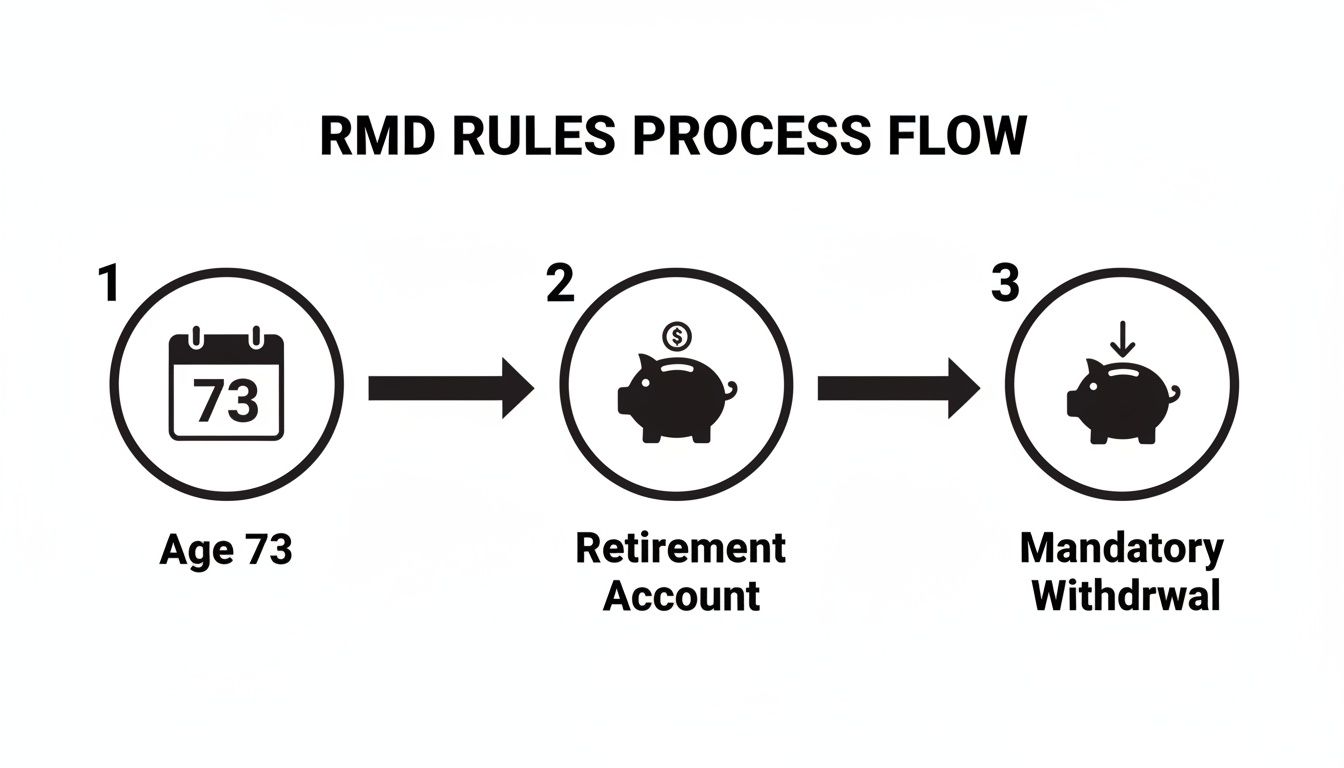
As you can see, hitting your RMD age kicks off a non-negotiable withdrawal schedule from your retirement funds. This is a key compliance checkpoint for every account holder.
An Important Exception for Spouses
While the Uniform Lifetime Table is the standard, there's a critical exception for retirees with a much younger spouse — and it can be a powerful planning tool.
If your spouse is your sole beneficiary and is more than 10 years younger than you, you get to use the Joint Life and Last Survivor Expectancy Table. This table uses a more favorable (larger) life expectancy factor.
Why does this matter? A larger life expectancy factor means a smaller required withdrawal. This allows more of your money to stay in the account, growing tax-deferred for longer, and it also lowers your taxable income for the current year.
Here’s how much of a difference it can make:
- Standard Method (Uniform Lifetime Table): A 73-year-old with a $2.5 million portfolio uses a factor of 26.5. Their RMD is $94,340.
- Spousal Exception (Joint Life Table): That same 73-year-old with a 60-year-old spouse uses a joint life factor of 28.5. Their RMD drops to just $87,719.
That’s a difference of over $6,600 in a single year, simply by using the correct table. It's a perfect example of how small details within the required minimum distribution rules can add up to significant savings. If you want to dive deeper into the mechanics, you can read our guide on how to calculate RMDs.
Critical RMD Deadlines and Penalties to Avoid
When it comes to your retirement savings, the calendar is king. With required minimum distributions (RMDs), timing isn't just important — it's everything. Missing a deadline creates more than a paperwork headache; it unleashes costly financial penalties that can take a serious bite out of your nest egg.
For anyone taking their first RMD, the most important date to circle is April 1 of the year after you reach your RMD age (currently 73 for most). The IRS gives you this one-time grace period, which offers a little extra time to get your ducks in a row for that very first withdrawal.
Your First RMD Is a Critical Decision
This initial RMD presents you with a strategic choice. You can take it by December 31 of the year you turn 73, or you can use that extension and wait until the April 1 deadline of the following year. Delaying might sound tempting, but there's a major catch.
If you push that first RMD into the next calendar year, you’ll have to take two distributions in the same year.
- Your first RMD (for the prior year), due by April 1.
- Your second RMD (for the current year), due by its usual December 31 deadline.
Doubling up on distributions can easily bump you into a higher tax bracket. This can trigger a cascade of other financial consequences, like higher Medicare premiums and a bigger tax bill on your Social Security benefits. For every year after your first, the deadline is firm: December 31.
Understanding the Penalties for a Missed RMD
Forgetting to take your full RMD used to come with one of the most brutal penalties in the entire tax code. Luckily, the SECURE 2.0 Act has softened the blow, but you still want to avoid it at all costs.
Not long ago, missing the deadline meant a staggering 50% excise tax on whatever amount you failed to withdraw. On a $37,736 shortfall, for example, the penalty would have been an eye-watering $18,868. The new rules, however, have cut this penalty down to 25%.
The Penalty Reduction Incentive: SECURE 2.0 also introduced a huge incentive to fix mistakes quickly. If you correct the shortfall within a "timely manner" — generally a two-year correction window — the penalty drops to just 10%.
Let's see how this plays out with a real-world example:
- RMD Amount: $40,000
- Amount Withdrawn: $10,000
- RMD Shortfall: $30,000
Under today's rules, the initial penalty would be $7,500 (25% of the $30,000 shortfall). But if you catch the error and make up the withdrawal within the correction window, the penalty falls to $3,000 (10% of $30,000). It’s a massive improvement, but it’s still an expensive and entirely avoidable mistake.
Knowing the rules is your best defense. You can learn more about general strategies on how to avoid tax penalties from a variety of tax experts, but simple diligence is what will ultimately protect your retirement funds from these preventable costs.
How the SECURE 2.0 Act Changed RMD Rules
Just when you think you have the rules down, Congress comes along and changes them. The SECURE 2.0 Act of 2022 is a perfect example, bringing some of the biggest updates to required minimum distribution (RMD) rules we've seen in decades.
These changes directly impact when retirees must start taking money out of their accounts. For high-net-worth investors, in particular, they open up new doors for strategy and wealth preservation. In simple terms, the government has pushed back the date it wants to start collecting taxes on your retirement savings.
The most significant change is the delay in the RMD starting age. For a long time, the magic number was 70½. The first SECURE Act nudged it to 72. Now, SECURE 2.0 rolls out a tiered system, giving many savers more time to let their nest eggs grow.
The New RMD Age Tiers
Instead of one single starting age for everyone, the law now uses a schedule based on your birth year. This extension is a valuable gift — more years of tax-deferred compounding for your retirement accounts.
Here’s how the new RMD starting ages break down:
- Age 73: If you were born between 1951 and 1959, your RMDs must start in the year you turn 73.
- Age 75: If you were born in 1960 or later, your RMDs don't kick in until the year you turn 75.
This is a huge deal. Someone born in 1960 now has a full decade longer for their funds to grow compared to the old rules that forced withdrawals at age 70½. That kind of delay can completely reshape a long-term financial plan, creating more room for strategic Roth conversions or just letting the market do its work.
This is just the latest chapter in a long story of legislative tweaks. RMDs first appeared at age 70½ under ERISA back in 1974, and the rules have been evolving ever since. The SECURE Act of 2019 first bumped the age to 72. For some early retirees, this newest delay to 73 or 75 could mean avoiding over $100,000 in premature withdrawals from a $1 million portfolio over a decade. If you want to dig deeper into the history, you can discover more insights about RMD facts from Morningstar.
Reduced Penalties for Missed RMDs
Another welcome change from SECURE 2.0 tackles the notoriously harsh penalty for missing an RMD. In the past, if you failed to take your distribution, the IRS could hit you with a 50% penalty on the amount you missed. It was one of the most severe penalties in the entire tax code.
The new law offers some much-needed relief:
- The base penalty for a missed RMD has been cut in half, from 50% down to 25%.
- It gets even better. If you fix the error in a "timely manner" — which usually means within a two-year window — the penalty drops to just 10%.
This change is a game-changer. It shifts the penalty from being purely punitive to something that encourages you to fix mistakes. The government is acknowledging that people make errors and is providing a clear, less painful path back to compliance.
This new penalty structure is a critical safety net. Of course, the goal is always to avoid penalties in the first place. But knowing that a quick correction can dramatically reduce the financial sting is a welcome development for investors and advisors alike. It really underscores why staying on top of these legislative changes is so crucial for your financial plan.
Advanced Strategies for High-Net-Worth Investors
Getting a handle on the basic rules for required minimum distributions is one thing. Putting them to work for you is another entirely. For high-net-worth investors, RMDs aren't just an annual compliance task — they're a pivotal moment for smart financial planning.
The real goal isn't just to take the withdrawal. It's to manage that distribution in a way that minimizes your tax bill, protects your legacy, and fits into your larger financial picture. Simply withdrawing the cash and paying the taxes is easy, but it's almost always the most expensive option. A little foresight can unlock significant savings over the long haul.
Use Qualified Charitable Distributions to Your Advantage
One of the most effective tools in the playbook is the Qualified Charitable Distribution (QCD). This strategy allows you to send money directly from your traditional IRA to a charity you care about, and the tax benefits are powerful.
The amount you give through a QCD counts toward your annual RMD, up to a maximum of $105,000 per person for 2026 (this limit is adjusted for inflation). But here’s the key benefit: that donated amount is completely excluded from your adjusted gross income (AGI).
This is a world away from simply taking a distribution and then writing a check to charity. When the funds go directly from your IRA to the non-profit, that money never technically hits your bank account — and more importantly, it never shows up as income on your tax return. This can be a huge help in avoiding higher Medicare premiums or preventing more of your Social Security benefits from becoming taxable.
Implement Strategic Roth Conversions Before RMDs Begin
The years between retirement and your RMD start date are a golden window for proactive tax planning. One of the smartest moves you can make is to systematically convert funds from a traditional IRA into a Roth IRA. You'll pay income tax on the amount you convert today, but the long-term payoff can be massive.
This strategy accomplishes two critical things:
- You shrink the balance of your traditional IRA, which directly reduces the size of your future RMDs since they’re calculated based on that account's value.
- You shift that money into a Roth IRA, where it can grow 100% tax-free and will not be subject to RMDs for you as the original owner.
This is especially powerful during what might be your "low-income" gap years — after you stop working but before Social Security and RMDs begin. You can strategically convert just enough each year to fill up the lower tax brackets without bumping yourself into a higher one. For a deeper dive, check out our guide on high-net-worth tax strategies.
Master the RMD Aggregation and Annuity Rules
Knowing how to combine — or "aggregate" — your distributions is another key area of expertise. The rules for IRAs give you a lot of flexibility. If you have several traditional, SEP, or SIMPLE IRAs, you have to calculate the RMD for each one, but you can then take the total required amount from just one of those accounts if you wish.
This flexibility, however, does not apply to workplace retirement plans. RMDs for your 401(k)s, 403(b)s, and 457(b)s must be calculated and taken from each plan separately. You can't pull from one 401(k) to satisfy the RMD for another.
Annuities held within IRAs also bring unique opportunities to the table. Thanks to the SECURE 2.0 Act, certain annuity payments can now be used to satisfy RMDs across your IRA accounts. A lifetime income stream from an annuity can automatically cover your RMD obligation, providing a hedge against outliving your money while also simplifying your distribution strategy. It’s an elegant way to turn a tax headache into a reliable retirement paycheck.
Inherited IRAs and Generational Wealth Transfer

The required minimum distribution rules don't just stop when you pass away; they cast a long shadow over the wealth you leave behind. How you plan for this has a massive impact on how efficiently your legacy gets to the next generation, and how much is lost to taxes along the way.
When someone inherits a retirement account, they don't just get the money — they get a brand-new set of withdrawal rules. The amount of freedom they have is almost entirely dictated by their relationship to you.
Spousal Beneficiaries: The Most Flexible Option
A surviving spouse who inherits an IRA gets the best deal, hands down. They have a unique option to essentially treat the inherited account as their own by rolling the funds into their personal IRA.
This is a game-changer. It lets them delay taking their own RMDs until they hit the required age, allowing the account to keep growing tax-deferred for years, or even decades. It’s a powerful strategy for keeping wealth consolidated and simplifying everything for the surviving spouse.
Non-Spouse Beneficiaries and the 10-Year Rule
For most other beneficiaries, like your children or grandchildren, things got a lot tougher after the SECURE Act. This law completely upended generational wealth transfer for retirement accounts by introducing the 10-year rule.
Under this rule, most of your non-spouse heirs must drain the inherited IRA completely by the end of the 10th year after your death. There are no annual RMDs to worry about during that decade — the only thing that matters is getting the account balance to zero by that final deadline.
This accelerated timeline can be a brutal tax trap. If your beneficiary inherits a large IRA right in the middle of their peak earning years, they could be forced to take huge distributions that get slammed by their highest tax bracket. The actual value of their inheritance could shrink dramatically.
Think about it: a child inheriting a $1 million IRA might have to withdraw large amounts annually, potentially getting taxed at rates of 35% or more. This is a world away from the old "stretch IRA" rules that let beneficiaries take small distributions over their entire lifetime. The tax consequences can be significant, following principles similar to the tax on an inherited 401(k).
Exceptions to the 10-Year Rule
Thankfully, not every non-spouse beneficiary is stuck with the 10-year countdown. The law carves out a special group known as Eligible Designated Beneficiaries (EDBs). These individuals can still use the old-school "stretch" rules and take distributions based on their own life expectancy.
This is a pretty exclusive club, however. It only includes:
- The surviving spouse (who already has better options).
- Your minor children (but only until they reach the age of majority, at which point their 10-year clock starts ticking).
- Anyone who is disabled or chronically ill.
- A beneficiary who is not more than 10 years younger than you (like a sibling or a partner).
These exceptions are a lifeline in certain situations, but for the vast majority of children and grandchildren, the 10-year rule is the new reality. This makes proactive planning on your part — like strategic Roth conversions during your lifetime — more critical than ever to shield your heirs from a sudden and costly tax bill.
Answering Your Top RMD Questions
Once you have a handle on the RMD fundamentals, the “what if” questions usually start popping up. It's one thing to know the rules, but it’s another to apply them when the market is dropping or when you’re dealing with different kinds of accounts.
Getting these details right is crucial for staying on the right side of the IRS and making smart moves with your money. Let's tackle some of the most common questions we hear from retirees navigating their distributions.
Do Roth IRAs Have RMDs?
This is a big one, and the answer is a cornerstone of smart retirement planning. For you, the original owner, a Roth IRA has a simple, powerful answer: no. You will never be forced to take a distribution from your Roth IRA as long as you live.
That single feature is what makes the Roth such an incredible tool for growing and preserving wealth. Your money can keep growing, completely tax-free, for your entire lifetime.
The game changes for your heirs, though. When someone inherits a Roth IRA, they do face distribution rules. For most non-spouse beneficiaries, this means the 10-year rule kicks in. While the withdrawals are still blessedly tax-free, the account has to be completely emptied within that decade.
What Happens If the Market Is Down When I Take My RMD?
This is a tough but critical scenario to plan for. The hard truth is that your RMD is mandatory, even if the market is in a slump. The calculation is based on your account balance from December 31 of the prior year, meaning a downturn in the current year doesn’t change the dollar amount you’re required to take.
Taking a required withdrawal during a market downturn means you're forced to sell more shares at lower prices just to meet the required dollar amount. This locks in your losses and is one of the biggest frustrations with RMDs — it can feel like you're selling at the absolute worst time.
While you can’t just skip the RMD, you aren't without options. One strategy is to take the distribution "in-kind." This means you transfer the shares themselves to a taxable brokerage account instead of selling them for cash. This satisfies the IRS requirement without forcing a sale, giving those investments a chance to recover.
Can I Just Put the Money Back Into My IRA?
The short answer is no. You cannot roll an RMD back into the same IRA or any other retirement account. The whole point of the required minimum distribution rules is to get money out of its tax-deferred status so the government can finally collect its taxes. Allowing you to put it right back would defeat the entire purpose.
Once the money is withdrawn, it's out of the tax-advantaged system for good. But that doesn't mean you have to spend it. After you've paid the income tax due on the distribution, you're free to reinvest the rest of the cash.
Here are the typical next steps for post-RMD funds:
- Reinvest in a Taxable Brokerage Account: This is the most common path. You can buy stocks, bonds, or funds and let the money keep growing. Just remember that future gains and dividends will be subject to capital gains taxes.
- Fund a Roth IRA: You can't roll the RMD money into a Roth, but you can use that cash to make your annual contribution, provided you have earned income and fall within the contribution limits.
- Cover Living Expenses: Of course, you can always use the money for its intended purpose — funding your retirement lifestyle.
Navigating the complexities of RMDs and integrating them into a cohesive financial strategy requires expert guidance. At Commons Capital, we specialize in creating personalized plans for high-net-worth individuals and families to optimize their wealth and secure their legacy. Contact us today to learn how we can help you achieve your financial goals.