
When a high-net-worth couple decides to divorce, it's not just the end of a marriage. It’s the dissolution of a complex financial partnership, and every single decision from here on out will have massive consequences for your future. This isn't the time for emotional reactions; it's the time for a calm, strategic approach to protect what you've built. Understanding the intersection of finance and divorce is the first step toward securing your long-term stability.
The Financial Crossroads of a High Net Worth Divorce
For affluent couples, divorce is less about dividing up the furniture and more like dismantling a major business. The stakes are sky-high. We're talking about complex assets, significant tax landmines, and the absolute necessity of preserving your wealth for the long term. This requires a fundamental shift in mindset—from an emotional one to a strategic, almost business-like one.
It helps to think of your marital estate as a joint venture that's now being unwound. Just like business partners, you need to identify every asset, figure out what it's worth, and then divide it all equitably. This methodical, detached perspective is your best defense against making costly mistakes driven by emotion. The goal isn’t just to split things down the middle—it’s to emerge from this process with your financial independence and long-term stability firmly intact.
Your Strategic Roadmap
This journey has several distinct phases, each with its own objective. Knowing the roadmap from the beginning can save you from expensive missteps and lead to a much smoother negotiation.
The primary stages really boil down to this:
- Asset Identification: First, you need a complete and total inventory of everything—all marital property and all separate property. No stone left unturned.
- Asset Valuation: This is where it gets tricky. You have to accurately appraise everything, from cash in the bank to complex, hard-to-value holdings like a stake in a private equity fund or a valuable art collection.
- Strategic Division: Finally, you negotiate a settlement. The aim is a deal that's not only fair but also tax-efficient and perfectly aligned with your financial goals for the next chapter of your life.
Let's be honest: money is a huge source of conflict in marriages. The data doesn't lie. Couples who fight about money at least once a week are 30% more likely to divorce. And if one spouse feels the other is reckless with spending, that can increase the risk of divorce by a staggering 45%. You can learn more about the financial causes of divorce and see how these tensions often set the stage for a messy split.
To get a clearer picture of the financial journey ahead, it's helpful to break down the process into key stages. Each phase has a distinct purpose and requires specific actions to protect your interests.
Key Financial Stages of the Divorce Process
Understanding these stages provides a framework that helps demystify the process, allowing you to focus on making smart, strategic decisions at every turn.
A successful outcome in a high-net-worth divorce hinges on one key principle: Treat the process like a strategic financial negotiation, not an emotional battle. Your objective is to emerge with your financial foundation not just intact, but poised for future growth.
This guide will give you the framework to navigate these challenges, making sure you are fully prepared to make informed decisions that protect your wealth and set you up for a prosperous future.
Drawing the Line Between Marital and Separate Property
One of the first, and most critical, hurdles in any divorce is drawing a clear line in the sand between “marital” property and “separate” property. This classification is the foundation your entire settlement will be built on. Think of it like sorting out the inventory of a jointly owned business before dissolving a partnership; you have to agree on what belongs to the business versus what belongs to each partner individually.
Generally speaking, marital property is anything of value acquired by either of you during the marriage, from income and investments to the family home. It doesn't matter whose name is on the title. On the flip side, separate property typically includes assets one spouse owned before the marriage, along with specific gifts or inheritances received by that spouse alone.
But in the real world, this distinction is rarely that simple. The lines blur easily, and that’s where things get financially complicated—and fast.
The Danger of Commingling Assets
The most common way separate property loses its protected status is through commingling. This is just a legal term for what happens when you mix separate assets with marital assets to the point where they can no longer be told apart. It’s the financial equivalent of pouring a bottle of fine, aged scotch into a big punch bowl at a party; once it's mixed, you can’t get it back out.
For example, say you deposit a $100,000 inheritance (which is classic separate property) into a joint checking account that you and your spouse use for bills and groceries. That money has almost certainly become commingled. A court is very likely to see the entire account as marital property, now subject to division.
To keep that from happening, separate property has to be treated like a protected specimen in a lab—it can't touch anything else.
- Keep Separate Accounts: An inheritance or funds from before your marriage should go into an account that is solely in your name and stay there.
- Avoid Using Marital Funds for Upkeep: Don't use your joint account to pay property taxes, maintenance fees, or the mortgage on a property you owned before the marriage. That creates a link.
- Maintain Meticulous Records: You must be able to trace the asset back to its origin. Keep every document that proves where it came from and that it was never mixed with marital funds.
Slipping up on this strict separation can turn what was a clear-cut separate asset into a hotly contested marital one. That mistake can complicate negotiations and potentially cost you a huge piece of what was rightfully yours.
Community Property vs. Equitable Distribution States
Where you live plays a massive role in how the pie gets sliced. The U.S. is split into two different legal camps for property division, and you absolutely must know which rules apply to you.
The legal framework of your state—whether it’s a community property or equitable distribution jurisdiction—is one of the most powerful factors shaping your divorce settlement. It's not a minor technicality; it’s the rulebook for the entire game.
Community Property States: In a handful of states like California, Texas, and Arizona, the starting point is simple. Nearly all assets acquired during the marriage are considered owned 50/50 by both spouses. The division is meant to be straightforward and equal.
Equitable Distribution States: Most states follow this model. Here, property is divided "fairly" or "equitably," which does not always mean a 50/50 split. A judge looks at a whole host of factors: the length of the marriage, each spouse's income and future earning potential, and their contributions—including non-financial ones like raising children or managing the household. This system gives judges a lot more discretion, which also makes the outcome far less predictable.
Knowing your state's laws is the first, non-negotiable step in creating a realistic picture of your estate and anticipating how a court will view your assets. This knowledge gives you a practical framework for building a strong negotiating position and, ultimately, protecting your financial future.
Accurately Valuing Complex and Illiquid Assets
In a high-net-worth divorce, the real financial battlefield isn’t over the cash in the bank or the blue-chip stocks. The true challenge—where fortunes can be won or lost—is in the complex, illiquid assets that form the backbone of a significant estate.
These are the items that don’t have a ticker symbol flashing their value every second. We're talking about the family business, a carefully curated art collection, private equity holdings, or a portfolio of commercial real estate. Each one demands a specialized approach to figure out its actual worth, a process that is as much an art as it is a science. Just guessing or using a quick, superficial appraisal can throw the entire settlement out of balance, a mistake that could easily cost you millions.
Beyond the Balance Sheet
Valuing a private business is a perfect example of this complexity. You can't just tally up the book value of its equipment and inventory. The real value is often tangled up in intangibles—things like brand reputation, customer goodwill, proprietary technology, and its potential to generate cash in the future. Two companies that look identical on paper can have dramatically different valuations because of these hidden factors.
To cut through the fog, professional appraisers lean on a few core methodologies:
- Market-Based Approach: Think of this like pulling "comps" for a house. An appraiser will look at recent sales of similar businesses to set a benchmark. This works best when there’s a healthy market of comparable assets to analyze.
- Income-Based Approach: This method is all about the future. It values an asset based on the cash flow it's expected to produce. It’s like buying a rental property not for the cost of the bricks and mortar, but for the steady income it will generate.
- Asset-Based Approach: This is the most straightforward calculation, adding up the fair market value of all tangible assets and subtracting liabilities. It provides a solid floor for valuation but often misses the bigger picture of a company’s true earning power.
Before any valuation can even get started, you have to know what’s on the table. The concept map below shows how an estate is categorized, which is the foundational first step.
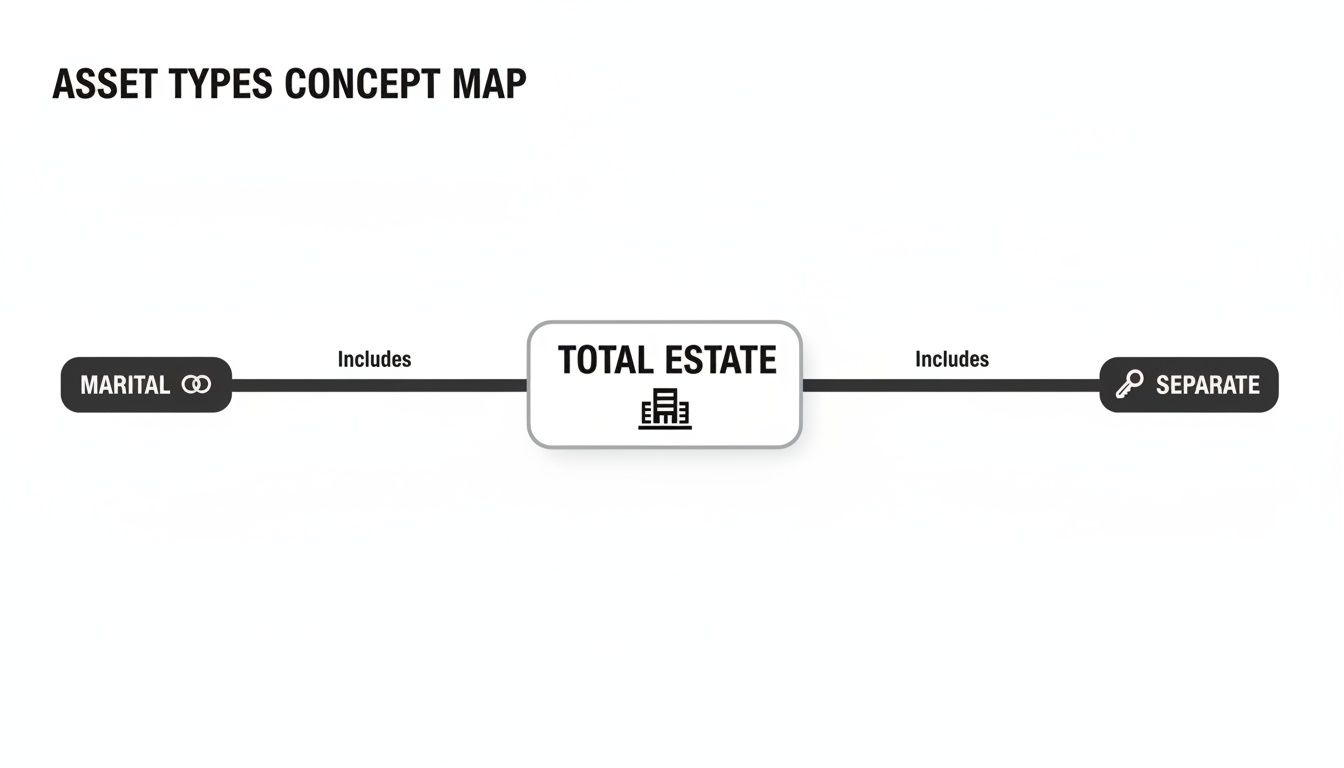
This distinction between what’s marital property and what’s separate is absolutely critical. It defines which assets are actually subject to division in the first place.
The Role of Specialized Experts
Let’s be clear: this is not a do-it-yourself project. Getting an accurate number on these holdings demands a team of highly specialized professionals.
You’ll need Certified Valuation Analysts (CVAs) and forensic accountants. A CVA is an expert in determining the true economic value of a business or asset, producing a defensible figure that will hold up under scrutiny in court.
A forensic accountant, on the other hand, is your financial detective. They dive deep into the books, hunting for hidden assets, spotting inconsistencies in reported income, and making sure every financial disclosure is buttoned up and accurate. Their work is essential for transparency, especially in situations where one spouse has managed the finances exclusively.
When you're dealing with these kinds of assets, a deep understanding of business valuation for divorce is non-negotiable. A credible, third-party appraisal isn't just a good idea; it's the bedrock of a fair negotiation and your best defense against endless, expensive court battles over "he said, she said" valuations.
A Tale of Two Businesses A Case Study
Imagine two specialty manufacturing companies. On the surface, they look like twins, each pulling in $5 million in annual revenue with similar physical plants and equipment.
But dig a little deeper. Business A has a broad, diverse client base, solid long-term contracts, and patented technology. Business B, however, gets nearly all its revenue from one major client and relies heavily on the owner's personal connections.
A valuation expert would see this immediately and assign a much higher value to Business A because of its stability and lower risk. Without that expert eye, a divorce settlement might have treated these two vastly different assets as equals. It’s a perfect example of how crucial expert valuation is to the outcome of your finance and divorce proceedings.
Navigating Retirement Accounts and Executive Compensation
For many high-net-worth couples, retirement accounts and executive compensation aren't just line items on a spreadsheet. They represent a lifetime of work, savvy investing, and strategic career moves. In a divorce, these assets often become the most challenging—and valuable—pieces of the entire financial puzzle.
Trying to untangle 401(k)s, pensions, and complex executive benefits without triggering a tax catastrophe requires a level of precision and specialized knowledge that goes far beyond typical asset division.
The financial fallout from a divorce can be devastating if not handled correctly. Consider this: working-age divorced Americans hold a median household wealth of just $98,700. That's a tiny fraction of the $326,900 held by couples in their first marriage. This stark difference underscores just how critical it is to divide major assets with surgical precision to protect your long-term security.
Simply writing a check to split a retirement account is a rookie mistake, and a costly one at that. It takes specific legal tools and a real-world understanding of tax law to sidestep the pitfalls that could gut your financial future.
The Role of the Qualified Domestic Relations Order
When you’re dealing with employer-sponsored retirement plans—think 401(k)s, 403(b)s, or defined-benefit pensions—your divorce decree alone won't cut it. To split these accounts, you need a special court order called a Qualified Domestic Relations Order, or QDRO (pronounced "kwah-dro").
Think of a QDRO as a specific set of instructions for the plan administrator. Its only job is to direct them on how to divide the retirement funds between the employee and their ex-spouse (known as the "alternate payee"). A well-drafted QDRO allows this transfer to happen without triggering immediate income taxes or the dreaded early withdrawal penalties.
A properly executed QDRO is the only legally sanctioned way to move money out of a qualified retirement plan to a former spouse during a divorce. If you try to simply withdraw the funds yourself to hand them over, you'll almost certainly get hit with a massive tax bill and penalties, eating away at the very asset you worked so hard to secure.
Drafting a QDRO is not a DIY project. It’s a technical legal document that has to meet the strict requirements of both federal law and the specific rules of that particular retirement plan. One tiny error or omission can get the order rejected, leading to frustrating delays and potential financial harm. This is precisely why you need an attorney or a dedicated QDRO specialist to handle it.
Untangling Executive Compensation
For executives and founders, compensation is rarely just a paycheck. It’s a complex package of stock options, restricted stock units (RSUs), and deferred compensation plans. These elements bring a whole new layer of complexity to the finance and divorce equation. We're not talking about simple cash; these assets represent future value, tied directly to vesting schedules and the company's performance.
Valuing and dividing these benefits is more art than science, and it requires a sophisticated approach:
- Stock Options: The critical question is determining which options were granted as compensation for work performed during the marriage. This gets tricky because some grants reward past performance, while others are designed as incentives for future work.
- Restricted Stock Units (RSUs): Just like options, RSUs come with vesting schedules. The marital portion is usually calculated by looking at the time between the grant date and the separation date as a fraction of the total vesting period.
- Deferred Compensation: These plans let an executive push a portion of their income into the future, often until retirement. Any amount accrued during the marriage is a marital asset that needs to be valued and divided, frequently requiring its own QDRO-like order to accomplish the split.
Putting a hard number on these assets isn't always easy. For instance, figuring out the present-day value of unvested stock options requires some pretty advanced financial modeling. Getting this part right is absolutely essential to reaching a fair settlement that truly reflects the value of these sophisticated assets.
Structuring Support Payments and Their Tax Implications
When you start talking about alimony and child support, it’s easy to get fixated on the monthly number. But the real story—especially in a high-net-worth divorce—is much deeper. It's about a complex financial web where every dollar paid or received is tangled up in the tax code.
How you structure these payments can dramatically shift the real value of a settlement. A seemingly fair agreement can quickly become a financial windfall or a long-term headache if you don’t get the tax part right. One wrong move here can trigger unexpected liabilities, either shrinking the money you receive or bloating the true cost of what you pay. You have to walk into these talks with your eyes wide open to the rules.
The Great Divide: Alimony vs. Child Support
First things first: the IRS sees alimony and child support as two completely different animals. They aren't interchangeable, and their tax treatments are polar opposites. This is a critical distinction that heavily influences negotiations for both the payer and the recipient.
Child support is considered tax-neutral. What that means is pretty straightforward:
- The parent paying child support gets no deduction for those payments.
- The parent receiving the money does not count it as taxable income.
Think of it as simply a transfer of after-tax money to directly support the kids. The government’s view is that this is a core parental duty, not income for the other parent to spend.
Alimony is a different beast entirely, thanks to a major overhaul from the Tax Cuts and Jobs Act of 2017. This change completely flipped the script on divorce finance, and it’s something you absolutely need to understand.
For any divorce agreement signed after December 31, 2018, alimony is now treated just like child support. Payments are no longer tax-deductible for the person paying, and they aren’t considered taxable income for the person receiving them.
This stripped away a huge negotiating lever that used to exist. Before, a higher-earning spouse could agree to larger payments knowing they'd get a tax break. Now, a dollar of alimony costs the paying spouse a full dollar, making those negotiations much tougher. For the recipient, though, what you see is what you get—no tax bill attached.
What About When Income Isn't Fixed?
For entrepreneurs, executives with large bonuses, or anyone with fluctuating compensation, a standard monthly support payment just doesn't work. Income can swing wildly from one year to the next, making a fixed number feel either unfair or insufficient.
The common solution is a two-part formula written directly into the settlement:
- A Base Amount: This is a fixed monthly payment, calculated from the predictable, steady part of the payer's income.
- A "True-Up" or Supplemental Amount: This is a percentage-based payment that kicks in when extra income comes through. For example, an agreement might specify that the recipient gets 15% of any annual bonus over a certain amount or 10% of partnership distributions.
This kind of structure offers a safety net for the recipient while keeping the support obligation fair and tethered to the payer's actual earnings. The key is to have the agreement drafted with surgical precision, clearly defining what counts as "income" and the mechanics of how and when it gets calculated and paid out.
Don't Overlook These Key Tax Issues in Your Settlement
Beyond how support itself is taxed, a few other big-ticket tax items need to be spelled out in your divorce decree. If you leave them ambiguous, you’re just inviting a future fight with your ex or a nasty surprise from the IRS.
Here’s a quick checklist to make sure you’ve covered the bases:
- Who Claims the Kids? Your agreement must explicitly state which parent gets to claim the children as dependents. This is a huge bargaining chip, as it unlocks the child tax credit and other valuable breaks. You can assign it to one parent permanently or agree to alternate years.
- The Marital Home and Capital Gains: Selling the family home can create a massive tax bill. Married couples can exclude up to $500,000 of capital gains from the sale of their primary residence. An individual gets only a $250,000 exclusion. The timing of the sale—before or after the divorce is final—can literally save (or cost) you six figures.
- Transferring Assets: Moving stocks, real estate, or other property between spouses during a divorce is typically a non-taxable event. But there's a catch: the person receiving the asset also inherits its original cost basis. That means when they eventually sell it, they’ll be on the hook for the capital gains tax on the entire appreciation, all the way back to when it was first bought.
Thinking through these tax angles from the start is what separates a good settlement from a great one. It ensures the agreement is not just fair on paper, but smart in practice, protecting the wealth you've both worked to build.
Assembling Your Expert Financial Divorce Team
Navigating the financial complexities of a divorce isn't a solo mission, especially when you have significant assets on the line. Trying to handle it all yourself is like performing your own surgery—it’s incredibly risky and almost never ends well. Frankly, the single best investment you can make in your financial future is building a specialized team dedicated to protecting your interests.
This isn’t about just hiring a lawyer and hoping for the best. It's about creating a cohesive unit where each expert plays a distinct, critical role. Think of it as assembling a board of directors for the dissolution of your marriage; every member brings a unique skill set to the table to secure a sound, strategic outcome.
The Core Players on Your Financial Divorce Team
Your team should be built around a few key roles, each with a clear purpose. Knowing what each professional actually does is the first step toward building a powerful advisory group that prevents expensive mistakes.
- The Family Law Attorney: This is your legal quarterback. They manage the overall process, file court documents, and fight for you in negotiations or, if it comes to it, in court. Their main job is to make sure the final settlement is legally solid and enforceable.
- The Certified Divorce Financial Analyst (CDFA®): A CDFA® is your financial strategist. While the attorney is focused on the legal side, the CDFA® is busy modeling the short- and long-term financial impact of different settlement proposals. They answer the most important question: "What will my life actually look like financially in five, ten, or twenty years with this agreement?"
A multidisciplinary team is non-negotiable for protecting complex assets. The attorney provides the legal framework, but the financial experts provide the data-driven insights needed to make truly informed decisions about your future.
Specialized Experts for Complex Situations
Beyond the core legal and financial strategists, a high-net-worth divorce often demands experts with deep, niche knowledge. These specialists bring the hard data needed to make sure every asset is accounted for and valued correctly.
The Forensic Accountant: Think of this person as your financial detective. Their job is to dig deep into the numbers to uncover hidden assets, trace funds to figure out what's marital versus separate property, and spot any financial discrepancies. They are essential for ensuring the complete transparency that a fair settlement is built on.
The Valuation Expert: When your estate includes a privately held business, commercial real estate, or other hard-to-value assets, a Certified Valuation Analyst (CVA) is indispensable. They provide an objective, defensible appraisal of what these assets are truly worth, preventing you from settling based on guesswork or incomplete information.
Choosing Your Advisors Wisely
Building this team takes real diligence. You're hiring people who will have a profound impact on your financial well-being, so you have to vet them carefully. Finding the right fit is about more than just credentials; it’s about finding experts you trust who can work together as a unit.
As you start your search, it helps to know what to look for in a financial advisor and other professionals. Ask potential team members about their experience with cases like yours, how their fees are structured, and how they collaborate with other experts. This careful selection process ensures your team is aligned and focused on one goal: securing the best possible outcome for your financial future.
Your Top Financial Questions About Divorce, Answered
Going through a divorce brings up a whirlwind of financial questions. It's a complex landscape, especially when significant assets are involved. Here are some straightforward answers to the questions we hear most often from our clients.
How Can I Protect My Separate Assets During a Divorce?
The key is to keep what's yours truly separate. If you came into the marriage with property or received an inheritance, you have to avoid "commingling" it with marital assets. That means keeping those funds in their own accounts and never using joint money for their upkeep or improvement.
Your strongest line of defense is a prenuptial or postnuptial agreement. These legal documents clearly define what belongs to you alone, taking the guesswork out of it later. Just as important is keeping meticulous records—you'll need a clean paper trail to prove an asset's non-marital origin if it's ever challenged.
What Is the Biggest Financial Mistake People Make?
Hands down, the most damaging mistake is focusing on the wrong prize. It's easy to get emotionally fixated on keeping one particular asset, like the family home, without thinking through the long-term consequences. A house comes with a mortgage, property taxes, and constant upkeep, and you can't exactly use a piece of it to pay for groceries.
A smart settlement isn't just about what you get today; it's about securing your financial stability for tomorrow. You need a balance of assets that provides stable cash flow and protects your retirement. A Certified Divorce Financial Analyst (CDFA) is invaluable in helping you see the full picture and avoid this all-too-common pitfall.
Do I Have to Split My Retirement Accounts?
Yes, almost always. Any portion of your retirement funds accumulated during the marriage is generally considered marital property and has to be divided. How it gets split depends on where you live—your state will follow either equitable distribution (fair, but not necessarily 50/50) or community property (typically a 50/50 split) rules.
Splitting these accounts correctly is critical. For 401(k)s and pensions, you’ll need a specific court order called a Qualified Domestic Relations Order (QDRO) to divide the funds without triggering early withdrawal penalties and taxes. IRAs use a different mechanism, usually a "transfer incident to divorce," which is spelled out in your settlement. Getting the details right on retirement funds is a cornerstone of successfully navigating your finance and divorce.
Sorting through the complexities of wealth division isn’t something you should do alone. The team at Commons Capital specializes in private wealth management, providing the financial guidance high-net-worth individuals need to protect their assets and build a secure future, both during and after a divorce. Learn how we can help you secure your financial future.