
Tactical asset allocation is a dynamic investment strategy that actively adjusts your portfolio's mix of assets—like stocks, bonds, and commodities. The primary goal is to capitalize on short-term market opportunities and sidestep potential risks. This guide will explore what tactical asset allocation is and how it involves making deliberate, temporary shifts away from your long-term strategic plan to gain an edge as market conditions change.
What Is Tactical Asset Allocation?
Imagine you are the captain of a large sailboat on a long journey. Your ultimate destination is retirement, and your map is your strategic asset allocation—a fixed plan designed to get you there safely over many years. This long-term plan dictates that you keep your sails (your assets) positioned in a specific way, say, 60% in stocks and 40% in bonds.
However, a rigid, "set-it-and-forget-it" approach ignores the changing weather. What happens when a strong tailwind—a booming market sector—suddenly appears? Or when a storm—a potential market downturn—starts brewing on the horizon?
This is where tactical asset allocation comes into play. It’s the active captaining of your portfolio.
Instead of rigidly holding your course, you make calculated, short-term adjustments. You might tilt your sails to catch that favorable wind or reef them to brace for an approaching storm.
Tactical Asset Allocation (TAA) is a portfolio management strategy that temporarily deviates from a long-term asset mix to capitalize on short-term market opportunities or minimize losses during periods of volatility.
The Real Goal of TAA
The primary objective of TAA isn't to rip up your long-term map but to enhance the journey. By making these calculated shifts, investors are trying to achieve a few key outcomes:
- Capitalize on Opportunities: Actively overweighting asset classes that show strong short-to-medium-term potential can add valuable, incremental returns to your portfolio.
- Mitigate Downside Risk: Proactively reducing exposure to asset classes that appear overvalued or are facing headwinds can help preserve your capital when markets get choppy.
- Improve Risk-Adjusted Returns: At the end of the day, it's not just about chasing higher returns, but better returns for the amount of risk you’re taking. TAA seeks to smooth out the ride and improve your overall performance across a full market cycle.
How It’s Different from a Static Plan
The core difference between a tactical and strategic approach boils down to its active nature. A strategic, long-term plan is the bedrock. It’s typically rebalanced periodically to bring it back to its original targets.
A tactical approach, on the other hand, is about making dynamic adjustments. Think of it as an active overlay on top of your strategic foundation. These are shorter-term shifts, often playing out over 3 to 12 months, designed to react to what the market is doing right now.
This hands-on method requires a disciplined framework. It cannot be based on gut feelings or emotional reactions to market news. Instead, it relies on solid economic forecasts, market indicators, or valuation metrics to guide decisions. By understanding how this active layer works, you can better appreciate how it complements a stable, long-term financial plan.
Tactical vs Strategic Asset Allocation A Comparison
To make the distinction crystal clear, it helps to see the two approaches side-by-side. The table below breaks down the fundamental differences between the dynamic, hands-on nature of TAA and the more traditional, set-and-forget model of Strategic Asset Allocation (SAA).
Ultimately, TAA is not a replacement for a sound strategic plan; it's a potential enhancement. It’s a tool for investors who believe that with the right analysis and discipline, it’s possible to add value by actively navigating the market's ever-changing currents.
So, How Does This Actually Work?
To really understand what tactical asset allocation is about, you have to look under the hood. This isn't about gut feelings or chasing the latest news cycle. It's a structured game plan for tilting the odds in your favor by making smart, temporary shifts away from your core portfolio.
At its heart, tactical asset allocation is about spotting when the market environment is favoring one type of investment over another. A TAA manager will then deliberately step away from their long-term, strategic asset mix to put more chips on promising assets and pull back from the ones that look weak.
This whole process boils down to two distinct ways of thinking.
The Two Flavors of TAA
Every tactical strategy falls into one of two buckets, each with its own philosophy for pulling the trigger on a trade. The one you choose usually comes down to your investment beliefs and what resources you have to actually make it happen.
- Rules-Based (Quantitative): This is the systematic, data-driven approach. It uses pre-set signals to automatically trigger portfolio changes, taking human emotion completely out of the picture.
- Discretionary: This approach relies on the seasoned judgment and experience of a portfolio manager or an investment committee to read the tea leaves and decide when to make a move.
Let's break down how each of these plays out in the real world.
Rules-Based TAA: Flying on Instruments
Think of the rules-based, or quantitative, approach like a modern pilot flying a commercial jet. They rely on their instruments, not just what they see out the window. The strategy is built on specific, back-tested market indicators that act as triggers for buying or selling.
These triggers are the "rules of the road," and they can be based on all sorts of data. Some of the most common signals include:
- Momentum: A classic one. This rule tracks an asset's price trend over a set period, like its 10-month moving average. If an asset is trading above that long-term average, the model says "buy." If it dips below, it’s a signal to get out or reduce exposure.
- Valuation: The model might watch metrics like price-to-earnings (P/E) ratios. For instance, a rule could be to trim your stock holdings when P/E ratios get historically frothy and add more when they look cheap.
- Economic Clocks: You can also tie signals to big-picture economic data—things like inflation, unemployment numbers, or manufacturing output. A model might shift into more defensive assets if key indicators start flashing recession warnings.
The big win here is discipline. By sticking to the rules no matter what, you sidestep classic investor mistakes like panic-selling in a crash or piling into a bubble at the top. The decisions are purely objective.
Discretionary TAA: The Human Touch
If the rules-based approach is a pilot, the discretionary style is more like an old-school ship captain navigating by reading the winds, the currents, and the stars. It leans heavily on human expertise to connect the dots between all sorts of data and qualitative insights.
Managers using this method aren't tied to a rigid, automated script. Instead, they’re doing deep-dive analysis, weighing a whole host of factors.
A discretionary manager is constantly asking, "What's the absolute best use of my next dollar?" They're sizing up everything from public stocks to private infrastructure, trying to pinpoint the best risk-adjusted opportunity in the current climate.
This often means grappling with complex, forward-looking information that a purely quantitative model would miss—things like geopolitical chess moves, a shift in Federal Reserve policy, or the ripple effects of a new technology. Of course, the success of this whole approach rests squarely on the skill and foresight of the manager making the calls. It’s far more flexible, but it also brings human bias back into the equation, which makes picking the right manager absolutely critical.
Using Rules-Based Models for TAA
While some tactical asset allocation (TAA) relies on a manager’s gut feel, the rules-based approach is all about discipline. It’s a systematic, quantitative method that takes emotion completely out of the picture, using predefined market signals to tell you when and where to shift your portfolio.
Think of it as investing with a clear, unemotional playbook. The whole idea is to let data drive your decisions, not fear or greed. These models are built on specific, back-tested triggers that signal exactly when to buy, sell, or rotate between different asset classes. This structure is what helps you stick to the plan, especially when markets get choppy.
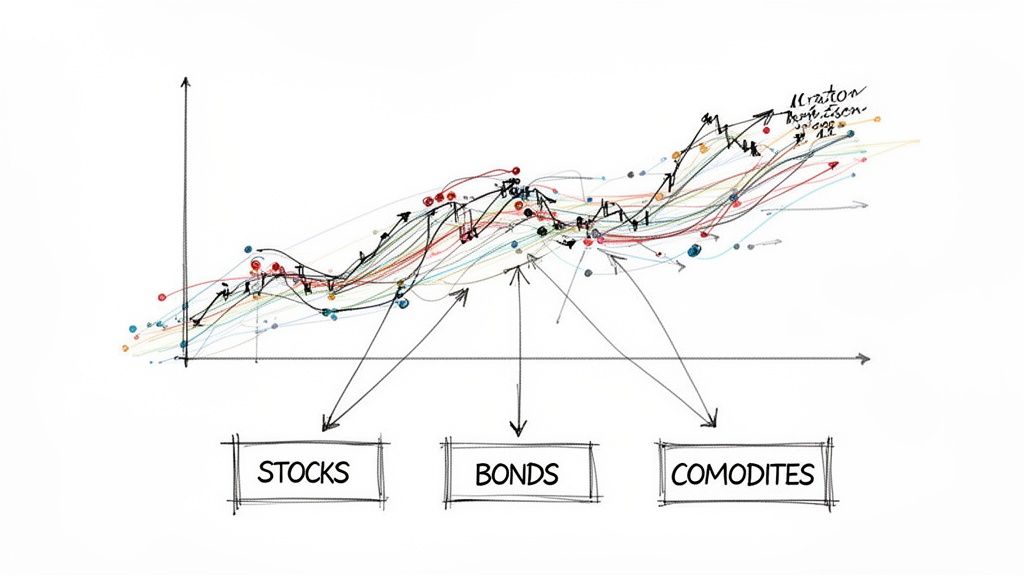
The Power of Momentum Indicators
One of the most common—and effective—signals used in rules-based TAA is momentum. It's a simple concept that you've probably seen play out: assets that have been performing well tend to keep performing well for a while, and underperformers often continue to struggle.
A popular tool for measuring this is the simple moving average (SMA). For instance, a model might look at an asset's price relative to its 10-month (or 200-day) SMA. The rule is dead simple: if the price is above its 10-month average, it's in an uptrend, and the model says to buy or hold. If it dips below that line, it’s signaling a downtrend, prompting a move to something safer, like cash or bonds. It’s a clean, objective trigger for action.
By relying on a timing model like a moving average, investors can systematically rotate into assets showing strength and exit those showing weakness, aiming to capture upside while sidestepping major downturns.
This data-first methodology is the backbone of many successful quantitative strategies and shows just how powerful TAA can be over a full market cycle.
A Real-World Example: Meb Faber's Model
To see this in action, just look at the influential work of Meb Faber. His research lays out a simple yet potent quantitative approach to TAA that has been tested across decades of market data.
The core of his strategy is a momentum-based timing model. It invests only in assets trading above their long-term trend, typically the 10-month simple moving average. When an asset class falls below that trendline, the capital gets parked in a safe-haven asset like short-term treasury bills to protect it.
One of his landmark studies, "A Quantitative Approach to Tactical Asset Allocation," produced compelling results. The strategy rotated into the top-performing assets based on momentum signals while steering clear of the laggards. Between 1973 and 2025, this approach generated annualized returns around 10-12% with Sharpe ratios topping 0.6—handily outperforming a static 60/40 portfolio. You can dig into the updated findings of this tactical model in the 2025 SSRN research paper.
Faber's work really highlights the key benefits of rules-based TAA:
- Discipline: The model forces you to sell assets in a downtrend and buy into uptrends, which is the exact opposite of what our emotional instincts often tell us to do.
- Diversification: It works across a wide range of asset classes—from U.S. stocks and international equities to real estate and commodities.
- Risk Management: A huge part of the strategy is capital preservation. By moving to cash or bonds during downturns, the model’s primary goal is to avoid the deep, painful losses that can wreck a portfolio.
The system’s objective nature, backed by its historical track record, makes it a powerful case study for any high-net-worth investor exploring what TAA can do for them. Of course, integrating these kinds of systematic approaches often involves sophisticated tools. To see how technology is pushing these strategies even further, you can learn more about the role of artificial intelligence and machine learning in finance.
Ultimately, rules-based models offer a structured path to navigating markets that are anything but simple.
Expanding Your Horizons with Global TAA
The tactical models we’ve looked at so far are powerful, but they tend to play in a familiar sandbox—usually a single, domestic market. But what happens when you take those same dynamic principles and apply them on a global scale?
You get Global Tactical Asset Allocation (GTAA). This is a strategy that blows the doors off your investment universe, bringing in countries, currencies, and asset classes from every corner of the world.
Think of it like this: if standard TAA is like being an expert fisherman who knows every nook and cranny of the local lake, GTAA is like captaining a deep-sea trawler with access to all the world's oceans. The goal is the same—find the best catch and avoid the treacherous storms—but your fishing grounds are exponentially larger. This global mindset is a huge part of understanding what tactical asset allocation means at an institutional level.
And that expansion delivers one of the most potent benefits in all of finance: true diversification of both risk and opportunity. By refusing to be tethered to a single economy, you can build a far more resilient portfolio.
Why a Global View Changes Everything
Here's a simple truth: the world's economies rarely march in lockstep. While one country's market is hitting a wall, another might be in the middle of a massive growth spurt. A global tactical approach is built to capitalize on precisely these disconnects.
A few key advantages immediately jump out:
- Different Economic Cycles: You can deliberately shift capital toward regions showing stronger vital signs, like higher GDP growth or a more business-friendly climate.
- Clashing Monetary Policies: While one central bank is hiking interest rates to tame inflation, another might be slashing them to kickstart growth. This creates completely different opportunities in their respective bond and equity markets.
- Targeting Regional Booms: GTAA lets you zero in on specific megatrends you'd otherwise miss, like the explosion of the middle class in emerging markets or a tech revolution happening in one specific part of the world.
By adopting a global mandate, you’re actively hunting for returns that don't depend on what’s happening in your home market. This means that when your domestic stocks are in a slump, gains from your international plays can help absorb the shock, smoothing out your portfolio's ride over the long haul.
How the Big Institutions Play the Global Game
This isn't some new, untested theory. Large institutional players—think massive pension funds and university endowments—have been using GTAA for decades to generate steady, uncorrelated returns. They have entire teams dedicated to crunching complex global macroeconomic data, spotting the subtle shifts that signal a major opportunity or a looming threat.
Their objective isn't just to chase the highest number. It's to construct portfolios that are tough enough to weather a whole menu of potential global economic shocks.
Global Tactical Asset Allocation takes TAA to the next level by building a strategy around cross-border and cross-asset rotations. It's a sophisticated way for managers to systematically exploit market quirks and inefficiencies on a worldwide scale, leading to a more diversified and potentially more profitable portfolio.
This is exactly how some of the world's largest money managers operate. For instance, a giant like BlackRock has shown how a dedicated GTAA platform can add real, incremental returns over time. They dig into macro data, investor behavior, and pricing differences across global markets to systematically tilt their portfolios toward the most attractive international opportunities.
The good news? This institutional-grade strategy is no longer just for the multi-billion-dollar funds. With the explosion of globally-focused ETFs and mutual funds, the tools to build and run a smart GTAA strategy are more accessible than ever. By bringing a global perspective into your own planning, you can build a portfolio that's far better equipped to handle our interconnected world—turning global shifts from a source of risk into a field of opportunity.
Putting TAA into Practice in Your Portfolio
Okay, let's move from theory to reality. A strategy is just an idea until you actually put it to work in a real portfolio. So, how do you do it?
Implementing tactical asset allocation isn't about tearing up your long-term financial plan. Far from it. Think of it as adding a disciplined, active layer right on top of your core strategic portfolio. This is all about making deliberate, measured decisions based on clear signals—not gut feelings or speculation.
The very first step is to set the guardrails. You need to define the boundaries for your tactical shifts, often called deviation bands or tolerance ranges.
For example, say your long-term strategic target for U.S. stocks is 50%. You might set a tactical band of +/- 10%. This gives you the flexibility to adjust your allocation anywhere between 40% and 60% depending on what the market is telling you, all without veering off your core, long-term path.
Determining the Size of Your Tilts
Once you’ve got your bands established, the next question is how much to actually shift. These adjustments are called "tilts"—the specific percentage you move toward or away from an asset class.
The size of these tilts really depends on two things: how strong your conviction is in a particular market view and your personal comfort with risk. A smaller, more conservative tilt might be a 5% move. If you're feeling more aggressive and the data is compelling, you might make a 10-15% shift.
Sizing these moves correctly is a huge deal. Go too big, and you could introduce risks you never intended to take. Go too small, and the tilt might not have any meaningful impact on your performance. The goal is to make every adjustment purposeful and fully aligned with your bigger financial picture.
This whole process can be scaled up, starting with opportunities right here at home and expanding to a global view, as this flowchart shows.
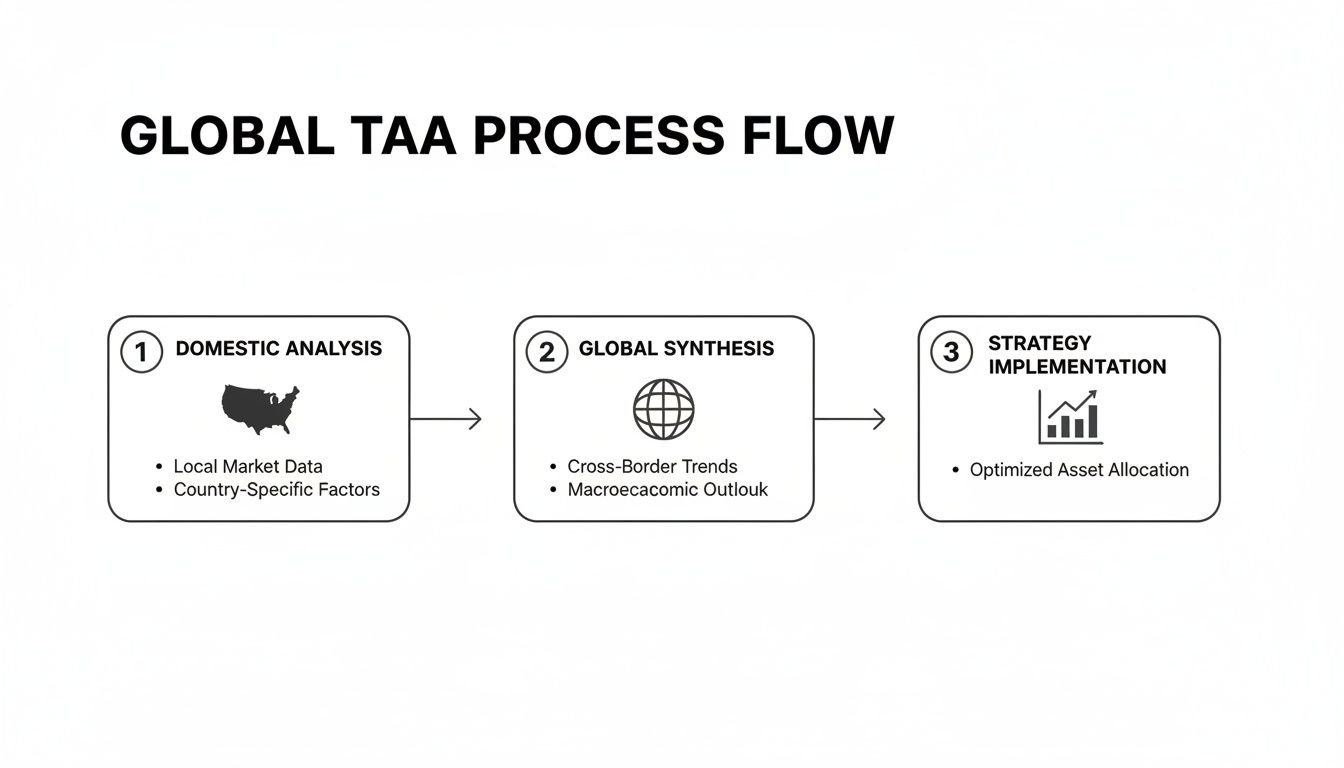
It’s a great illustration of how a tactical approach can start simple and grow into a more sophisticated framework for capturing a wider range of opportunities.
Choosing the Right Investment Vehicles
With a plan in hand, it’s time to execute. How do you actually make these portfolio adjustments efficiently? For most high-net-worth investors, the best tools for the job are Exchange-Traded Funds (ETFs) and mutual funds.
- ETFs: These are the go-to for many TAA strategies. Why? They’re generally low-cost, easy to trade throughout the day (liquid), and tax-efficient. They let you gain or shed exposure to very specific asset classes—like international stocks, tech stocks, or commodities—in a single, quick transaction.
- Mutual Funds: Certain actively managed mutual funds can work well here, too, especially those that already have a mandate to make tactical shifts themselves.
For many investors, knowing how to invest in ETFs is a fundamental skill for putting a TAA strategy into motion.
Key Considerations for High-Net-Worth Investors
But implementing TAA is more than just buying and selling. For high-net-worth individuals, two factors can make or break the strategy: transaction costs and taxes.
Tactical shifts inherently lead to more frequent trading than a simple buy-and-hold strategy. Therefore, managing transaction costs and understanding the tax implications of realizing short-term capital gains is essential to ensuring the strategy adds net value to your portfolio.
If you don't keep a close eye on these costs, they can easily eat away at the very returns your TAA strategy was designed to capture. This is where professional guidance can be invaluable, helping to place trades in tax-advantaged accounts or using techniques like tax-loss harvesting to offset gains.
This is all closely related to the discipline of portfolio rebalancing, which is crucial for keeping your overall asset mix on track. By carefully managing these practical details, TAA can become a powerful tool for enhancing returns and managing risk.
When to Use Tactical Asset Allocation
No investment strategy is a silver bullet, and tactical asset allocation (TAA) is no exception. Its effectiveness really depends on the market's personality at any given time. Knowing when TAA is most likely to add value—and when it might struggle—is the key to using it wisely.
Think of it like a sailor. A sailor needs wind to make any real progress. In the same way, a tactical strategy needs market trends and volatility to do its best work. It’s not built for stagnant, directionless markets.
The Ideal Environment for TAA
Tactical asset allocation really shines when markets have clear, sustained trends and a healthy dose of volatility. This is when the opportunity to generate "alpha," or excess returns, is greatest. In these conditions, the signals TAA models rely on—whether they're based on momentum, economic data, or valuation—tend to be much more reliable.
TAA is a great fit for investors focused on two specific outcomes:
- Capital Preservation and Downside Protection: During a downturn, a tactical approach can proactively shift your portfolio away from riskier assets like stocks and into safer havens like bonds or cash. This can dramatically cushion the blow of a market drop, which is a massive benefit for anyone near or in retirement.
- Capturing Clear Market Trends: When a specific asset class, like tech stocks or commodities, catches fire and starts a strong uptrend, TAA is designed to overweight that area and ride the wave. It lets you participate more fully in the market's biggest upward moves.
TAA is most powerful when it's used to navigate the big market cycles. Its real strength is managing risk by sidestepping the worst of a bear market and then reallocating to catch the upside when a clear bull run begins.
Look at the market crash in 2008 or the nosedive in early 2020. In both situations, disciplined TAA models signaled a move out of stocks, preserving capital while passive, buy-and-hold strategies were getting hammered.
When TAA Can Underperform
On the flip side, a tactical strategy can run into headwinds. Its biggest challenge is a choppy, sideways market that isn't really going anywhere. In these "whipsaw" environments, market signals get noisy and unreliable, often leading to frequent trades that don't end up making any money.
A model might tell you to jump into an asset class right before it reverses, forcing you to sell at a small loss. This can lead to underperformance compared to just buying and holding, as transaction costs and these small, ill-timed trades start to add up. This is one of the primary risks that tactical asset allocation involves.
It's absolutely critical to remember that TAA is a long-term overlay on top of your core financial plan. You measure its value over a full economic cycle—not in a single month or quarter. Judging it based on short-term performance completely misses the point. At the end of the day, TAA is all about improving your risk-adjusted returns over the long haul.
Common Questions About Tactical Asset Allocation
Let's pull all these concepts together and tackle the questions I hear most often from investors when they're first exploring this kind of dynamic strategy. The goal here is to give you direct, clear answers that show how tactical asset allocation works in the real world.
Is Tactical Asset Allocation the Same as Market Timing?
This is a big one. While they both involve making active choices, they're fundamentally different beasts.
Market timing, in its classic sense, is a speculative game of trying to call the absolute tops and bottoms of the market. It's an all-or-nothing bet that's incredibly difficult—if not impossible—to get right consistently.
Tactical Asset Allocation, on the other hand, is a disciplined, systematic process. It doesn't rely on a gut feeling. Instead, it follows predefined signals and data over a medium-term horizon, usually somewhere in the three to twelve-month range. You're not trying to be a hero; you're just trying to tilt the odds in your favor based on evidence.
How Does TAA Fit with a Long-Term Strategic Portfolio?
TAA is meant to work with your long-term Strategic Asset Allocation (SAA), not replace it. Think of your SAA as the foundational blueprint for your wealth—the sturdy hull of your financial ship, built specifically for your goals and risk tolerance.
TAA is the rudder and sails. It acts as a dynamic overlay, allowing for modest, calculated shifts away from that core plan to either seize a timely opportunity or sidestep a looming risk. It adds a crucial layer of adaptability to an otherwise stable, long-term portfolio.
What Are the Primary Risks of Using TAA?
The biggest risk is getting "whipsawed." This happens in choppy, sideways markets where there are no clear trends to follow. A strategy might signal a move into an asset right before it reverses course, leading to a string of small losses and causing you to lag a simple buy-and-hold approach.
The other major concern is model risk. The economic indicators or momentum signals that worked beautifully in the past might not be as effective in the future. Markets evolve. This is exactly why it's so important to work with an advisor who truly understands the models, manages the costs of implementation, and keeps a close eye on the tax implications of every move.
Can I Implement a TAA Strategy Myself?
You certainly can, but it’s a serious commitment. While the concepts are straightforward enough, putting them into practice effectively demands a ton of discipline, continuous research, and an almost obsessive attention to detail. For most people, managing the trades, monitoring the signals without fail, and doing it all in a tax-efficient way can quickly become a second job.
Partnering with a professional ensures the strategy is executed systematically and integrated properly within your overall financial plan, helping you avoid the emotional decision-making that can derail even the best-laid plans. An expert can provide the objective oversight needed to stick with the strategy through full market cycles.
At Commons Capital, we specialize in designing and implementing sophisticated investment strategies like tactical asset allocation for high-net-worth individuals and families. If you're looking for a more proactive approach to growing and protecting your wealth, we're here to help. Contact us today to learn how we can build a plan that aligns with your financial goals.