

Artificial Intelligence and Machine Learning are fundamentally transforming data analysis and decision-making for investors. We've progressed beyond simple automation to intelligent systems that can learn from data, adapt to market changes, and predict future outcomes. This evolution offers powerful tools for sophisticated investment strategies.
For high-net-worth investors, this technology unlocks analytical power that was once science fiction. Imagine processing global market data in real-time to identify the subtle patterns that fortify a portfolio against unforeseen risks. This isn't about replacing human expertise. It’s about amplifying it with incredible speed and scale, providing a significant edge in today's complex financial landscape.
Demystifying AI and Machine Learning in Finance
Let's cut through the jargon. At its heart, Artificial Intelligence (AI) is the broad field of creating smart machines capable of tasks that normally require human intellect. Think of AI as the strategic "brain" of the operation—the system that can determine the optimal asset allocation for a given risk appetite.
Within this field lies Machine Learning (ML), the engine driving modern AI. ML algorithms aren't explicitly programmed for every scenario. Instead, they learn directly from data, making them highly adaptive.
For instance, by feeding a model decades of market data, news reports, and economic indicators, it can teach itself to spot incredibly complex relationships between thousands of variables—far more than any human team could track—to forecast market movements or identify undervalued assets.
This ability to continuously learn is what makes ML so potent in the fast-moving world of finance. It’s not a static tool; it's an adaptive partner that sharpens its insights with every new piece of information. The market reflects this impact, with the global AI industry valued at approximately USD 294.16 billion in 2025 and projected to explode to USD 2,480.05 billion by 2034.
The Practical Application in Wealth Management
So, how does this technology actually benefit your portfolio? Financial institutions are already leveraging Artificial Intelligence and Machine Learning to build a smarter, more responsive investment world.
Here’s how it creates value:
- Smarter Decision-Making: AI systems can digest billions of data points—from earnings call transcripts to satellite images of shipping ports—to provide a much richer, more textured view of an investment opportunity.
- Predictive Analytics: ML models excel at identifying early warning signs of market volatility or economic shifts, allowing for proactive portfolio adjustments rather than reactive responses.
- Truly Personalized Strategies: Moving beyond one-size-fits-all advice, AI can craft investment strategies tailored to an individual’s unique financial situation, goals, and even behavioral patterns.
A compelling real-world example of AI's impact is detailed in this case study on Citibank HK's AI-Powered Wealth Revolution. This isn't a distant future; it's happening now, providing savvy investors with the tools needed to navigate complexity and uncover new sources of value.
Unlocking Alpha with AI and Machine Learning Strategies
Beyond mere number-crunching, how does Artificial Intelligence and Machine Learning actually provide investors with a competitive advantage? The answer lies in its ability to operate at a scale and speed that is simply beyond human capability. This opens up entirely new avenues for generating alpha—the excess return of an investment relative to its benchmark.
The tangible impact of AI on investment strategies is happening right now, fundamentally changing how portfolios are constructed, managed, and protected. It allows for a more dynamic and insightful approach to navigating today's markets.
Quantitative Strategies on a New Scale
Quantitative investing has always relied on mathematical models, but AI and Machine Learning elevate this to a new level. Sophisticated algorithms can now sift through petabytes of information, including traditional market prices and alternative data like satellite imagery, social media sentiment, and global supply chain logistics.
This immense processing power enables models to spot subtle, non-linear patterns invisible to human analysts. For example, an AI might detect a faint correlation between weather patterns in Brazil, shipping traffic in the South China Sea, and the future stock price of a commodity producer. By identifying these weak signals before they become obvious market trends, these systems can execute trades with incredible precision, capturing value from market inefficiencies that may only exist for moments.
Predictive Risk Modeling for Portfolio Resilience
One of the most powerful applications of AI in wealth management is predictive risk modeling. Traditional risk models often rely on historical volatility and past correlations, which can fail dramatically during unprecedented market events when old patterns no longer apply.
AI-driven models work differently. They can run thousands of complex simulations to stress-test a portfolio against a vast range of potential future scenarios, not just historical ones.
This forward-looking approach to risk is a game-changer. It shifts the focus from reacting to past events to anticipating potential vulnerabilities, allowing managers to make proactive adjustments and safeguard capital before a crisis hits.
This capability is essential for long-term wealth preservation. It provides a much stronger defense against "black swan" events that can devastate unprepared portfolios.
Creating Hyper-Personalized Investment Strategies
The days of categorizing investors into broad, standardized portfolio buckets are fading. Artificial Intelligence and Machine Learning are ushering in an era of true hyper-personalization. Algorithms can analyze an individual's complete financial picture—assets, liabilities, income, long-term goals, and even behavioral biases gleaned from past decisions.
This deep, holistic understanding allows for a truly bespoke wealth management experience. The result is a strategy that isn’t just aligned with a stated risk tolerance but one that dynamically adjusts to an investor's evolving life and financial objectives.
For example, an AI system can:
- Optimize for specific tax implications, structuring investments to minimize liabilities based on a client's unique situation.
- Incorporate personal values, building portfolios that meet specific Environmental, Social, and Governance (ESG) criteria without sacrificing return potential.
- Adapt to life events, automatically suggesting strategy adjustments in response to a business sale, inheritance, or changing retirement timeline.
This level of customization ensures every component of an investment strategy is meticulously aligned with the client’s unique journey.
To make the contrast clearer, the table below highlights the key differences between these modern techniques and more conventional methods.
Comparing Traditional vs AI-Enhanced Investment Approaches
This table contrasts the conventional methods of wealth management with modern, AI-driven techniques to highlight the key advantages of adopting this technology.
As you can see, the shift isn't just incremental; it represents a fundamental change in capability across the board, from analysis all the way through to execution.
Streamlining Wealth Management with Intelligent Operations
Beyond chasing investment returns, Artificial Intelligence and Machine Learning are revolutionizing the operational backbone of wealth management. This technology adds a powerful layer of efficiency, accuracy, and security to the critical tasks that keep an advisory practice running smoothly.
This isn't about replacing people; it's about freeing up your advisor's time. When automation handles routine administrative work, they can focus on what really matters: high-level strategic advice and building a stronger relationship with you. This operational enhancement makes the entire wealth management experience sharper and more responsive.
Automating Compliance and Portfolio Management
One of the biggest operational wins for AI is in compliance. Wealth management is governed by a complex and ever-changing set of regulations. AI systems can monitor portfolios and transactions 24/7, automatically flagging anything that might violate an investment mandate or regulatory guideline. This constant digital oversight significantly reduces human error and ensures consistent compliance.
The same principle applies to portfolio rebalancing. Instead of waiting for periodic manual reviews, machine learning algorithms can monitor asset allocations in real time.
When market movements cause a portfolio to drift from its target mix, the system can automatically trigger the necessary trades to bring it back into alignment. This is not only faster but also more precise, ensuring the investment strategy remains consistently aligned with your financial goals.
This type of smart automation is becoming prevalent across the financial industry. For instance, impressive results are already seen with AI in insurance claims processing, demonstrating the power of these tools for operational tasks. To see how this trend is playing out across the industry, read our insights on decoding the future of wealth management.
Enhancing Due Diligence with Deeper Insights
Due diligence is where machine learning truly shines. Traditionally, this process relied heavily on structured financial data from spreadsheets and analyst reports. However, this approach can easily miss subtle risks and opportunities hidden in unconventional information.
AI transforms due diligence by analyzing huge volumes of unstructured data. This includes information that doesn't fit neatly into a spreadsheet, such as:
- News Sentiment: Algorithms can sift through thousands of news articles, press releases, and social media posts globally to gauge public and market sentiment toward a company. A sudden downturn in sentiment could be an early warning sign.
- Legal and Regulatory Filings: Machine learning can rapidly parse complex legal documents, identifying potential risks, pending lawsuits, or unusual clauses that a human review might overlook.
- Supply Chain Data: By analyzing alternative data like shipping manifests or satellite images of factories, AI can provide real-time clues about a company's operational health, potentially spotting disruptions long before they appear in an earnings report.
By integrating this diverse information, machine learning adds a crucial qualitative layer to standard quantitative analysis. This deeper, more holistic approach to due diligence leads to smarter investment decisions and a more resilient portfolio.
Finding Investment Opportunities in the AI Revolution
So far, we’ve covered how Artificial Intelligence and Machine Learning can be used to build and protect a portfolio. Now, let's pivot from using AI to investing in the companies powering this massive technological shift. For those seeking significant growth, understanding where capital is flowing within the AI market is essential.
This isn’t about chasing the latest hot stock. It's about identifying the foundational players—the ones building the infrastructure, platforms, and specialized tools that will fuel innovation for years to come. By mapping out this landscape, investors can position themselves to benefit as AI becomes a core component of nearly every industry.
The Core Pillars of the AI Ecosystem
To invest intelligently in AI, it helps to view the market in layers. Each layer presents its own set of opportunities and risks, from the physical hardware that enables AI to the software that applies it.
Here’s a simple breakdown of the key areas:
- Semiconductors and Hardware: This is the bedrock. These companies design and manufacture high-performance chips (like GPUs) required to train and run complex AI models. An investment here is a bet on the ever-growing demand for raw computing power.
- Cloud Infrastructure and Platforms: Major cloud providers are the landlords of the AI economy, offering the scalable infrastructure and AI-as-a-service platforms that enable other companies to adopt AI without building costly data centers.
- Specialized AI Software (SaaS): This segment is exploding with companies using AI to solve specific business problems—from AI-powered cybersecurity and drug discovery to financial modeling and customer service bots.
- Data and Analytics Providers: AI is data-hungry. This category includes companies that gather, clean, and manage the enormous datasets needed to train effective machine learning models.
Identifying Strategic AI Investments
Beyond these foundational layers, savvy investors look for companies that are not just using AI but are weaving it into their core business to create a sustainable competitive advantage. This requires careful analysis to distinguish true innovators from those merely using "AI" as a marketing buzzword.
Consider companies in healthcare using AI to accelerate drug discovery or in finance developing fraud detection systems that are light-years ahead of older methods. The chart below illustrates how AI is transforming core business operations, from automation to compliance.
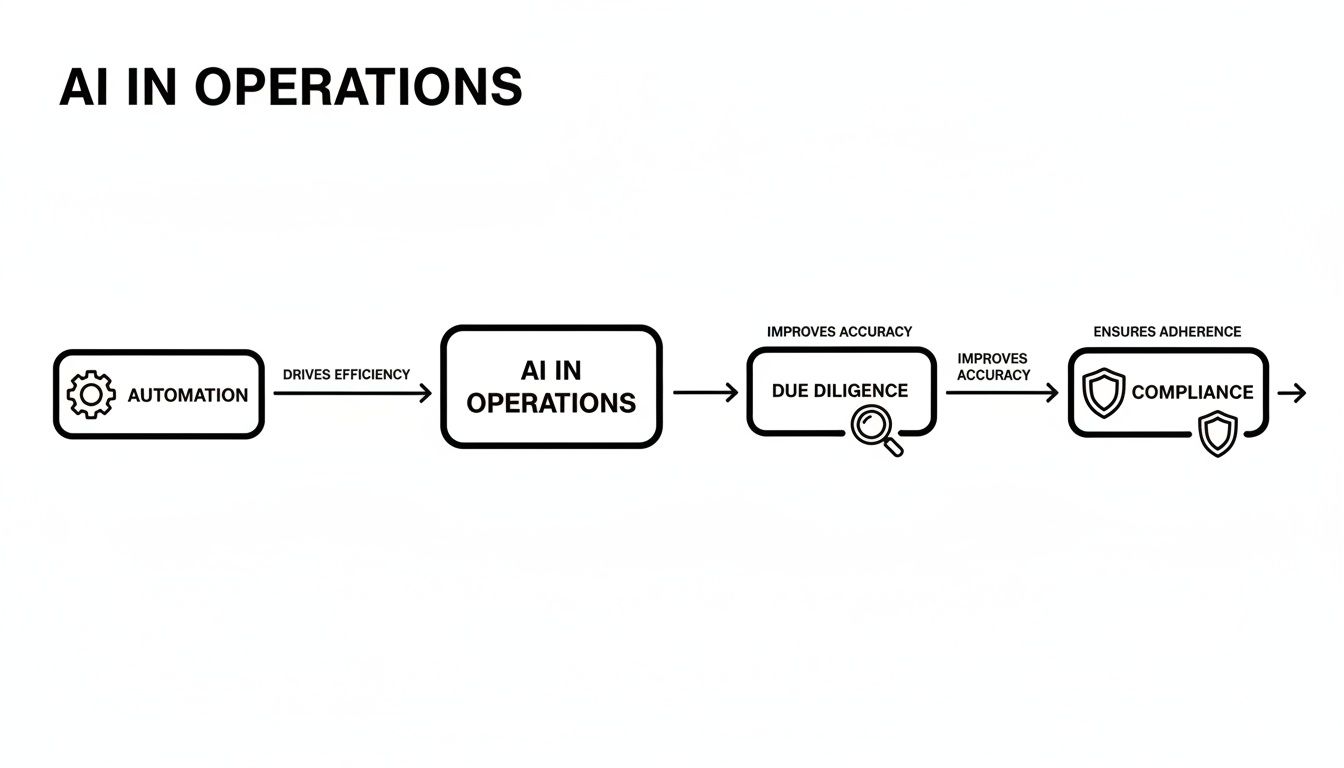
This deep integration shows how AI is becoming a core driver of efficiency and insight, making companies that master it potentially fantastic long-term investments.
A Framework for Portfolio Positioning
Picking individual AI stocks can be a high-risk endeavor. It requires extensive research and involves concentrated risk. For many high-net-worth investors, a more prudent approach is to gain diversified exposure across the entire AI ecosystem.
This strategy allows you to participate in the overall growth of the Artificial Intelligence and Machine Learning sector without the pressure of selecting the next single big winner—a notoriously difficult task in such a rapidly evolving field.
One of the most effective ways to achieve this is through specialized investment vehicles. These can provide a ready-made, balanced portfolio of companies across all the sub-sectors we've discussed. For a closer look at this strategy, check out our guide on finding the best AI ETF for 2025. This approach gives you broad access to the key players in the AI revolution, from chip makers to software innovators, creating a more resilient position.
The Ethical and Practical Risks of AI in Investing
For all the opportunities Artificial Intelligence and Machine Learning present, any serious investor must approach this technology with a clear-eyed perspective. Implementing these tools requires a responsible framework to manage inherent risks, from the opacity of complex algorithms to the subtle biases baked into the data they learn from.
An ethical framework is non-negotiable. It is the only way to ensure technology supports—rather than undermines—the fiduciary duty at the heart of wealth management. Leading firms are not just adopting AI; they are building robust governance frameworks around it to protect their clients.
The "Black Box" Problem
One of the biggest challenges in AI is the "black box" problem. This occurs when a machine learning model becomes so complex that even its creators cannot definitively explain how it reached a specific conclusion. For investment decisions involving millions of dollars, such opacity is a significant risk.
This has led to the development of Explainable AI (XAI), a field focused on building models that can justify their recommendations in understandable terms. This is not merely a technical exercise; it's about establishing trust and accountability. For investors and advisors, the ability to interpret a model's logic is essential for responsible oversight.
Waking Up to Algorithmic Bias
An AI model is only as good as the data it's trained on. If that data contains historical biases related to gender, race, or economic status, the algorithm will not only learn these biases but may also amplify them. The result is skewed, unfair, and ultimately, poor decisions.
For example, a loan-approval model trained on decades of biased application data could systematically discriminate against entire demographics. In investing, a model trained solely on past market data might overlook new, disruptive sectors that don't fit historical patterns.
Mitigating this requires a proactive approach. It involves meticulously cleaning training data, continuously auditing models for biased outputs, and building systems where fairness is as important as performance. This is not just an ethical imperative; it is a critical regulatory demand.
Keeping Up with Regulators and Data Privacy
The regulatory landscape for AI is evolving rapidly. Regulators worldwide are scrutinizing algorithms to protect consumers and maintain market stability. A crucial aspect of this is ensuring that AI-powered advice is held to the same strict fiduciary standards as human advisors.
Simultaneously, data privacy has become a top-tier concern. Machine learning models require vast amounts of data, and protecting the sensitive client information they consume is paramount.
Leading wealth management firms are addressing this through:
- Airtight Data Governance: Implementing strict rules for how client data is handled, from collection and storage to anonymization and use in model training.
- Regulatory Compliance: Adhering to standards like GDPR and other local data protection laws to ensure client privacy is secure.
- Radical Transparency: Being clear with clients about how their data is used to generate insights and improve services.
By prioritizing ethics, transparency, and security, responsible firms are managing AI's complexities and ensuring this powerful technology is used to build trust and deliver real value.
How to Look Under the Hood of an AI-Driven Investment Firm
As Artificial Intelligence and Machine Learning become more prominent in wealth management, it's increasingly difficult to distinguish real innovation from marketing hype. Not all AI is created equal. Asking the right questions is the only way to determine if a firm is genuinely using technology to achieve better results.
Choosing an advisor is a significant decision, and the addition of complex technology requires even greater diligence. It's essential to ensure that a firm's high-tech pitch is backed by solid, time-tested investment principles. For a refresher on the basics, our guide on what to look for in a financial advisor is a great place to start.
Probing the Tech and the Talent
Your initial questions should focus on what a firm is actually doing with technology and who is managing it. Vague answers are a major red flag for “AI-washing”—when a firm uses buzzwords without substantive backing. A firm with genuine expertise will be open about its systems.
Get ready to dig into the details:
- Data Sources: Ask about the types of data their models use. Is it standard market data, or are they incorporating alternative datasets to find a unique edge?
- Team Expertise: Who builds and manages their AI systems? Look for a team that combines quantitative skills with traditional finance experience—data scientists who understand investing and investment professionals who understand technology.
- Track Record: Request performance data. How have their AI-driven strategies performed? While past performance doesn't guarantee future results, you need to see how their models have held up through various market cycles.
If a firm can answer these questions with confidence and detail, it’s a good indication they have made a serious investment in their technology.
Understanding the Human Element and Model Transparency
Even the most advanced AI requires human oversight. It's crucial to understand how a firm balances algorithmic decisions with human judgment. Allowing an algorithm to operate without supervision is a recipe for disaster.
A great question to ask is, "When does your team intervene or override the AI's recommendations?" Their answer will reveal their risk management philosophy and the value they place on human experience. You want collaboration, not blind faith in a machine.
This also relates to transparency. You don't need a computer science degree, but your advisor should be able to explain the logic behind the AI's recommendations in plain English. If they cannot explain why a model is suggesting a particular move, you are dealing with a dangerous "black box" approach.
Assessing Security and Ethical Guardrails
Finally, robust security protocols are non-negotiable. Firms using AI and ML handle vast amounts of sensitive financial and personal data. You must be certain your information is secure.
Ask direct questions about their data handling and security practices:
- How do you encrypt and store client data?
- What is your plan to prevent a data breach?
- How do you ensure your models are not biased in a way that could lead to unfair or skewed outcomes?
A trustworthy firm will welcome these questions and provide clear, reassuring answers. They should demonstrate a commitment to protecting your privacy that is as strong as their commitment to growing your wealth. This due diligence will help you find a partner who uses AI as a powerful tool, not just a gimmick.
A Few Common Questions About AI in Wealth Management
As investors explore what Artificial Intelligence and Machine Learning can do for their portfolios, a few key questions consistently arise. Here are straightforward answers to the most common inquiries.
Is AI Going to Replace My Financial Advisor?
Not at all. Think of AI as a powerful co-pilot for your trusted advisor, not a replacement. An AI system can analyze market data and identify patterns at a scale and speed no human could match.
However, that is only half of the equation. Your advisor brings wisdom, strategic oversight, and a deep understanding of your life, family, and long-term goals. Their judgment is what transforms raw data into a sound financial plan. The best outcomes are achieved by combining powerful technology with experienced human insight.
How Safe Is My Data in an AI-Powered System?
This is a critical concern. Any credible firm places data security at the highest priority. This includes deploying advanced encryption, maintaining strict access controls, and using anonymization techniques to protect client information.
During model training, data is almost always stripped of personal identifiers. This ensures your privacy is protected while allowing the system to perform its analytical work.
A good rule of thumb: always ask a firm about their specific data governance and cybersecurity policies. They should be able to explain exactly how your data is stored, protected, and used to generate the Artificial Intelligence and Machine Learning insights they provide.
How Would I Even Get Started with an AI-Assisted Strategy?
The process is simpler than you might think and always begins with a conversation. The first step is meeting with an advisor who utilizes these tools to discuss your financial situation and long-term goals. They can identify precisely where and how this technology could benefit your specific circumstances.
From there, the process typically involves:
- A Deep-Dive Consultation: You’ll cover your financial objectives, risk tolerance, and what you want your money to achieve for you and your family.
- Building the Strategy: The advisor will then use AI-powered analytics to stress-test different scenarios and develop a truly personalized investment plan.
- Smart, Ongoing Management: Your portfolio will benefit from continuous, AI-assisted monitoring and adjustments, all guided by your advisor's hands-on expertise.
At Commons Capital, we believe the best outcomes happen at the intersection of advanced technology and personal guidance. Let’s talk about how our approach can work for you.


