A thorough wealth management fees comparison reveals that the true cost of managing your assets extends far beyond the advertised rate. Most wealth advisors utilize one of three primary models: a percentage fee based on your Assets Under Management (AUM), a predictable flat annual fee, or an hourly rate for specific services. Understanding how each of these fee structures compounds over time is crucial for safeguarding your capital and achieving your expected returns.
Understanding the True Cost of Your Investments
Selecting a wealth manager is one of the most significant financial decisions you will ever make. The fees are not merely a line item on your quarterly statement; they are a powerful force that directly influences your portfolio's growth trajectory over decades. Seemingly minor differences in percentage points can snowball into substantial sums, potentially eroding hundreds of thousands of dollars from your net worth over a lifetime.
That's why a detailed wealth management fees comparison isn't just a prudent measure—it's an essential discipline for any serious investor. This process is not about chasing the lowest possible price. It's about ensuring the cost aligns directly with the value, expertise, and comprehensive service you are receiving.
The Evolving Fee Landscape
The wealth management industry is undergoing a significant transformation. Fee compression has become the new industry standard, driven by intense competition and the rise of technology-driven advisory platforms. This "fee war" is a primary catalyst for the rapid consolidation in the sector, with a record 273 US RIA M&A deals recorded by October 2025 alone.
For investors, this shift presents both opportunities and challenges. It creates an environment to secure more favorable terms, but it also increases the need to understand the new, low-cost models powered by AI and automation.
Grasping the nuances of professional service fees is a critical skill for any high-net-worth individual. The core principles of transparency and value for money apply universally, from your financial advisor to your legal counsel.
Core Fee Structures at a Glance
To navigate this landscape effectively, you must first understand the fundamental ways advisors are compensated. Interestingly, the need for fee clarity is universal across professional services. To see how another field handles it, you can check out this guide on how accident lawyers charge and their fee breakdown. While the industries differ, the core principle—knowing what you're paying for—remains the same.
Here are the main models we will break down:
A Look Under the Hood: Common Wealth Management Fee Models
To conduct a meaningful comparison of wealth management fees, you must first understand the different ways advisors are compensated. It's more than just knowing the definitions; it's about comprehending how each model will impact your portfolio year after year and selecting the one that aligns with your financial journey.
The most common model, particularly with traditional firms, is the Assets Under Management (AUM) fee. On the surface, it’s straightforward: your advisor charges a percentage of the total assets they manage for you.
The AUM Percentage Model
The AUM model is popular because it ties your advisor's compensation directly to your portfolio's performance. When your investments perform well and your account value increases, their revenue grows. Conversely, if the market declines and your portfolio shrinks, so does their fee. This structure creates a clear incentive for them to grow your wealth.
However, this simplicity can be deceiving. A typical wealth management fee can range from 0.5% to 2% of your assets annually. While the industry has experienced a race to the bottom on fees, this range serves as a solid benchmark. Consider the mutual fund space, where average expense ratios have plummeted from 1.04% in 1996 to just 0.40% in 2024—a massive 61% drop, illustrating how competition is driving costs down across the board. You can discover more insights about wealth management statistics and trends to see how this is reshaping the industry.
The true impact of an AUM fee isn't the percentage on paper. It's the compounding effect that erodes your returns over decades. A 1% fee on a growing multi-million dollar portfolio can easily amount to hundreds of thousands of dollars over an investor's lifetime.
Most AUM schedules are not a single flat rate. They are typically tiered, with breakpoints that lower the percentage as your portfolio value increases.
- 1.00% on the first $1 million
- 0.80% on the next $4 million
- 0.60% on assets over $5 million
This structure rewards clients with larger accounts, but remember that as your wealth grows, the total dollar amount you pay in fees can still increase significantly, even if the percentage rate decreases.
Flat Annual Fees
In stark contrast to the AUM model is the flat annual fee, which offers complete predictability. With this arrangement, you pay a fixed dollar amount for services each year, regardless of market fluctuations or portfolio growth.
This model has gained significant traction, especially among high-net-worth individuals who recognize how expensive a percentage-based fee becomes on a large asset base. For an individual with a $10 million portfolio, a $40,000 flat fee is far more appealing than a 1% AUM fee that would cost $100,000 annually. For a closer look at these calculations, our guide on investment management fees breaks it down further.
- Who It's For: This is often the best fit for investors with substantial assets (e.g., $3M+) who want to know exactly what they're paying and prefer not to be penalized with higher fees simply because their portfolio is growing.
- The Key Question to Ask: "Is your flat fee all-inclusive? Does it cover everything from financial planning and tax strategy to coordinating with my estate attorney, or will I incur other charges?"
Hourly and Project-Based Fees
For those who do not require or desire constant, hands-on portfolio management, paying by the hour or for a specific project is an excellent alternative. It functions like hiring any other professional consultant—you pay for their time and expertise to accomplish a specific task.
This à la carte approach is ideal for situations such as:
- Building a comprehensive financial plan from scratch.
- Obtaining a second opinion on an existing investment strategy.
- Needing advice on a single major financial decision, like selling a business or managing a large inheritance.
Hourly rates can range from $250 to $500+, depending on the advisor's credentials and the complexity of the request. It’s an effective way to avoid long-term fee drag, but it is not designed for someone seeking continuous oversight and an advisor who can react to market shifts.
Commission-Based and Performance Fees
Finally, there are a couple of compensation models that warrant caution. Every investor should approach these with a critical eye because they can introduce significant conflicts of interest. Commission-based advisors earn their income by selling specific financial products, such as a particular mutual fund or insurance policy. This setup creates a powerful incentive to recommend whatever pays the highest commission, not necessarily what is in your best interest.
Similarly, performance-based fees (sometimes called "incentive fees") allow an advisor to take a percentage of the investment profits they generate, typically above a certain benchmark. While it sounds appealing—pay for performance!—it can encourage advisors to take on excessive risk to chase higher returns, which translates to a larger fee for them. These models are less common today in the fiduciary world, but it is still crucial to know how to identify them.
Comparing Fee Structures Side-By-Side
Examining fee models on paper is one thing, but observing how they play out over a decade or two is where the true impact becomes clear. This is where a direct, scenario-based wealth management fees comparison demonstrates the real-world effect on your portfolio. The numbers tell a powerful story of how your choice can either preserve your wealth or gradually erode it.
To illustrate this, we will model the total fees paid on a hypothetical high-net-worth portfolio over different time horizons. This is the most effective way to see the inflection points where one model becomes significantly more advantageous than another.
Modeling the Long-Term Cost Impact
Let's begin with a $2 million portfolio experiencing steady, modest growth of 6% per year. We will compare three common fee arrangements to see how the costs accumulate over 5, 10, and 20 years.
- Scenario 1: The 1% AUM Fee: The classic model. The advisor’s fee is 1% of your portfolio's value, recalculated annually.
- Scenario 2: The $20,000 Flat Fee: A predictable fixed annual fee. The fee remains constant whether your portfolio grows to $3 million or $5 million.
- Scenario 3: The Hourly Model: This is a hypothetical for someone needing pointed, strategic advice but not constant oversight. Imagine 40 hours of planning in year one at $400/hour ($16,000), followed by 10 hours a year for check-ins ($4,000 annually).
Now, let's run the numbers and see the results.
This table breaks down the cumulative fees paid under each model. Notice how the gap widens significantly over time.
Long-Term Cost Impact of Different Fee Models on a $2M Portfolio
As you can see, what starts as a small difference becomes a massive chasm. The AUM fee balloons as the portfolio grows, while the flat and hourly models offer predictability and significant long-term savings.
Interpreting the Scenarios
The numbers speak for themselves. In the initial years, the difference between a 1% AUM fee and a $20,000 flat fee on a $2 million portfolio seems almost negligible. But the power of compounding is a double-edged sword—it works on fees just as relentlessly as it does on your returns.
As your portfolio grows, the AUM fee grows with it, becoming a significant drag on your performance. After 20 years, the AUM model has cost you $260,000 more than the flat fee. That's a quarter of a million dollars that could have remained invested, compounding in your favor.
The key takeaway here is the law of diminishing returns with AUM fees. For a high-net-worth portfolio, there's a point where the percentage-based cost far outweighs the value delivered, making flat-fee structures incredibly compelling.
This image effectively illustrates the core difference in how each model operates.
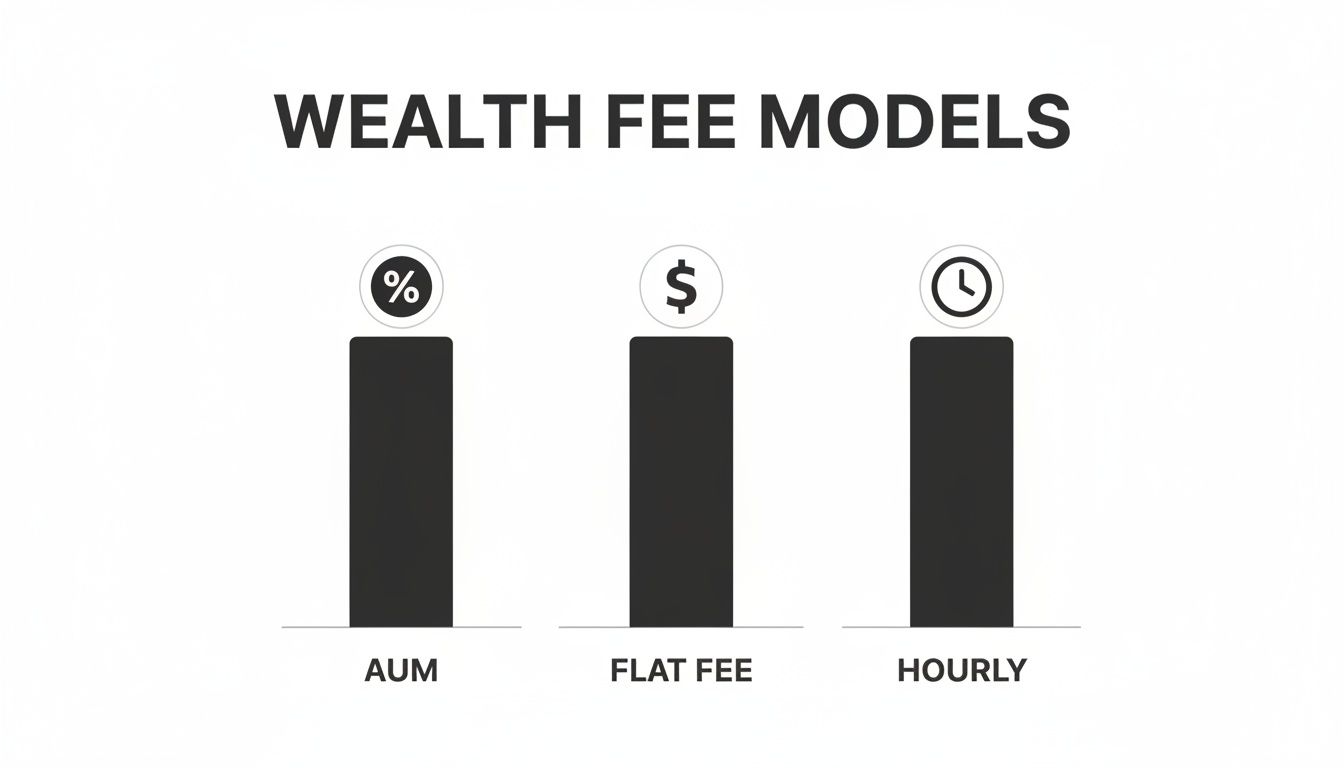
It’s a simple but crucial concept: AUM fees are variable and grow with your success, while flat and hourly fees provide cost predictability—a cornerstone of any solid long-term financial plan.
When Each Model Makes the Most Sense
This direct wealth management fees comparison isn’t about declaring one model as the "best." It’s about finding the right fit for your specific situation. The ideal choice depends on your asset level, the complexity of your finances, and the degree of day-to-day involvement you desire from an advisor.
Here’s a simple breakdown of who benefits most from each structure:
- The AUM Model: This often works best for investors with portfolios under a certain threshold—say, less than $2 million—who want an all-inclusive service. It aligns incentives for growth and simplifies the billing process.
- The Flat Fee Model: This is the sweet spot for many high-net-worth investors, typically with $2 million or more. Once your portfolio reaches a certain scale, a flat fee provides cost certainty and avoids "penalizing" you for strong market performance.
- The Hourly Model: Perfect for the DIY investor who needs a professional sounding board. It is designed for specific projects, like creating an initial financial plan, getting a second opinion, or navigating a complex event such as an inheritance or business sale.
Ultimately, you want a fee structure where the cost feels transparent, fair, and directly proportional to the value you receive. As your wealth grows, it is wise to periodically reassess whether your current fee model still makes sense. A proactive review can ensure your advisor's compensation supports your goals, rather than hindering them.
Uncovering Hidden Fees in Wealth Management
The management fee you're quoted is often just the tip of the iceberg. A true wealth management fees comparison requires digging deeper to uncover other costs that may be quietly siphoning off your investment returns.
These ancillary charges might seem small individually, but they can accumulate, creating a significant drag on your portfolio's long-term growth. To make a genuinely informed decision, you must understand your "all-in" cost. These fees are not always advertised, but they will certainly appear on your statements and reduce your net returns. Knowing what to look for can prevent unpleasant surprises down the road.
Beyond the Advisor's AUM Fee
While your advisor's direct fee is the most obvious expense, there are often several other layers of costs integrated into the relationship. It is your responsibility to identify and tally every single one to get a clear picture of your actual expenses.
These fees typically fall into a few categories:
- Custodian Fees: Your advisor does not hold your assets directly—a third-party custodian like Charles Schwab or Fidelity does. These institutions may have their own fee schedules for account maintenance, administrative tasks, or certain transactions.
- Platform or "Wrap" Fees: Some firms bundle all services—planning, investment management, custody—into a single "wrap fee." While convenient, this can obscure the cost of each individual service.
- Trading Commissions and Transaction Costs: Although many custodians now offer zero-commission trades on stocks and ETFs, that is not the complete picture. You may still incur fees for buying mutual funds, bonds, or other securities. These costs are applied each time a trade is executed in your account.
The Overlooked Cost of Underlying Investments
The single largest hidden cost often originates from the investments themselves. The mutual funds and ETFs that form the building blocks of your portfolio each have their own internal management fees, known as expense ratios. These are deducted directly from the fund's returns before you ever see them.
A 0.50% expense ratio on a mutual fund might not seem significant. But when added to your advisor's 1.00% AUM fee, your true annual cost jumps to 1.50%. This fee-layering is a critical detail that is easily missed in a surface-level cost analysis.
Uncovering all costs is a fundamental skill for savvy investors. This mindset extends beyond your portfolio; for instance, it's essential to learn effective strategies to navigate bank fee wars and avoid hidden charges to protect your wealth across all financial relationships.
Your Checklist for Full Fee Transparency
To get the complete picture, you must ask direct questions. A trustworthy fiduciary advisor will not only welcome this conversation but will also provide clear, detailed answers. Before your next meeting with a potential or current advisor, arm yourself with this checklist.
Questions Every Investor Must Ask:
- What is my "all-in" annual cost? Insist on a single, comprehensive figure—as a percentage or dollar amount—that includes the advisory fee, average underlying investment expenses, custodian fees, and any other platform charges.
- Are you a fee-only advisor? This is a crucial question. It confirms they are compensated only by you, which eliminates the conflicts of interest that come with product commissions.
- Do you receive any other forms of compensation? Ask specifically about revenue sharing, referral fees, or "soft-dollar" arrangements that could influence their decisions.
- What are the average expense ratios of the funds you typically use? This gives you a real sense of the built-in costs of the investments they prefer for their clients.
- Can you provide a detailed fee schedule? Get it in writing. This document should clearly outline all potential charges, from the AUM fee tiers to any possible transaction costs.
- How are trading costs handled? Clarify if there are any commissions or ticket charges for buying and selling securities within your portfolio.
By asking these questions, you transform a simple fee discussion into a proper audit of your total investment cost. This diligence is the final, essential step in a meaningful wealth management fees comparison that empowers you to protect and grow your capital.
How to Approach the Fee Conversation with an Advisor
Now that you have a firm grasp of the different fee models, you’re in the driver's seat. A thorough wealth management fees comparison isn't just an intellectual exercise—it's your playbook for picking the right advisor and confidently talking about what you’ll pay. This isn't about nickel-and-diming or finding the absolute cheapest option. It’s about making sure the value you get lines up perfectly with the price.
Choosing an advisor is a major commitment. How you frame that first conversation about fees sets the tone for the entire relationship. Your goal should be to clearly connect their compensation to your financial success.
Benchmarking Advisor Proposals
When a fee proposal lands on your desk, the first thing to do is see how it stacks up against the industry. Fees have been getting squeezed for years in the wealth management world, which gives you more leverage than ever. If a proposal feels high, it probably is.
Here’s a simple framework for evaluating any offer:
- Demand the "All-In" Number: Ask for a single, comprehensive cost estimate, either in dollars or as a percentage. This number needs to include their advisory fee, the typical expense ratios of the funds they plan to use, and any platform or custodian fees. That’s your real cost.
- Create a Peer Group: Don't just look at one proposal in a vacuum. Get proposals from at least three different but comparable advisors. This will quickly give you a feel for the competitive market rate for the services you actually need.
- Drill Down on the Value: Look past the percentage. What are you actually getting for that fee? Will they work directly with your CPA and estate attorney? Is real, in-depth financial planning included, or is it an add-on?
The single most powerful question you can ask is: "Can you walk me through exactly how your fee structure supports my specific goals?" If an advisor fumbles this or can't draw a straight line from their compensation to your success, they might not be the one.
This approach elevates the discussion from a simple price check to a genuine assessment of value.
Finding Your Negotiation Leverage
It's not just possible to negotiate wealth management fees—it's often expected, especially for high-net-worth clients. How much you can move the needle depends on a few key factors. Knowing where your leverage lies is everything.
You're in a much stronger negotiating position if:
- You have significant assets. Advisors are almost always more flexible on their AUM percentage for larger portfolios, typically those $5 million and up.
- Your financial life is relatively simple. A less complex portfolio that doesn't demand constant, hands-on management can justify a lower fee.
- You’re exploring a flat-fee model. These are often more negotiable than rigid AUM tiers because they’re built around a custom scope of work from the start.
But remember, this is less about haggling and more about finding a fee structure that's fair and sustainable for everyone. For instance, if you’re bringing $10 million to the table, paying a standard 1% AUM fee just isn't competitive. That’s a perfect opportunity to push for a much lower percentage or pivot the conversation entirely to a flat-fee arrangement.
Always Prioritize the Fiduciary Standard
At the end of the day, the most critical factor in choosing an advisor isn't about fees at all—it's about their legal duty to you. You should only consider working with an advisor who acts as a fiduciary. This is a legal standard that obligates them to put your best interests first, always.
This is where the line between "fee-only" and "fee-based" advisors becomes incredibly important. A fee-only advisor gets paid only by you. That’s it. This structure removes the dangerous conflicts of interest that pop up when an advisor can earn commissions for selling you certain products. To truly understand this distinction, our deep dive into fiduciary financial advisor vs fee-only models explains it all. Insisting on a fee-only fiduciary is your best defense against conflicted advice.
When you combine a sharp analysis of fees with an unwavering demand for a fiduciary commitment, you’ve built a powerful framework for selecting a wealth manager. This two-pronged approach ensures your partner is not only cost-effective but, more importantly, fundamentally aligned with your financial well-being.
A Few Final Questions About Advisor Fees
It's natural to have questions when you're navigating the complexities of advisor compensation. Getting clear, direct answers is the final piece of the puzzle, giving you the confidence to move forward and choose the right partner.
We've gathered some of the most common—and most critical—questions we hear from investors to help guide your final decision.
What Is a Reasonable Wealth Management Fee?
"Reasonable" is always relative, depending entirely on the size and complexity of your financial life. That said, for the typical Assets Under Management (AUM) model, fees generally fall between 0.50% to 1.25% a year. This is almost always a tiered structure, so the percentage you pay should drop as your assets grow, especially once you cross the $5 million mark.
Flat fees are also becoming a popular and often more transparent alternative for high-net-worth families. These can run anywhere from $5,000 to over $50,000 annually, based on the specific services you need.
The best fee isn’t just the lowest number. It’s a transparent, competitive rate that aligns directly with the value you get—value that should go far beyond just managing investments to include tax strategy, estate planning, and more.
Ultimately, a reasonable fee is one that feels fair for the expertise being delivered. The best way to know for sure is to benchmark any proposal against what other fiduciary advisors are offering.
Should I Choose a Fee-Only or Fee-Based Advisor?
This is one of the most important distinctions you can make. Fee-only advisors are widely seen as the gold standard for objective advice because their compensation comes only from their clients. This structure eliminates the conflicts of interest that come from earning commissions for selling certain financial products.
Fee-based advisors, on the other hand, use a hybrid model. They collect fees from their clients but can also earn commissions on products like insurance or specific mutual funds. While many fee-based advisors act with their client's best interests at heart, the structure itself opens the door to potentially biased advice.
If a strict fiduciary standard is your top priority and you want to remove any doubt about your advisor's motivations, the fee-only model is almost always the better choice.
How Can I Lower My Investment Management Fees?
You probably have more leverage here than you realize. A few smart moves can significantly lower your long-term costs, leaving more of your money to compound.
- Negotiate Your AUM Rate: As your portfolio grows, so does your negotiating power. Don't be afraid to ask for a better rate. Many firms would rather adjust their fee than lose a great long-term client.
- Consider a Flat-Fee Model: For larger accounts, switching from a percentage-based fee to a fixed annual one can lead to massive savings over time. Your costs will no longer automatically increase as your portfolio grows.
- Look Under the Hood: Audit the investments inside your portfolio. Are you primarily in low-cost ETFs and index funds, or are you paying for expensive, actively managed mutual funds? Shaving down these underlying expenses can make a huge difference in your "all-in" cost.
- Shop Around: Your most powerful tool is comparison. Getting detailed proposals from several different advisors is the only way to know for sure if you're getting a competitive rate for the service you need.
Do Wealth Managers Require a Minimum Investment?
Traditionally, yes, and it’s often been a significant hurdle. Many established wealth management firms have high account minimums—often starting at $500,000 or $1 million—to ensure the relationship is profitable for them.
But the industry is changing. Plenty of independent advisory firms and family offices are more flexible or have lower minimums. It's all about finding the right fit, which is something we cover in our guide on what to look for in a financial advisor. Plus, the rise of digital and hybrid advisory platforms has made professional management accessible to a much wider group of investors, sometimes with very low or no minimums at all.
At Commons Capital, we believe in full transparency and aligning our success directly with yours. If you're a high-net-worth individual, family, or institution seeking a dedicated partner to navigate your complex financial life, we invite you to learn more about our fiduciary approach. Visit us at https://www.commonsllc.com.