
Understanding the stock market basics for beginners is the foundational step toward building long-term wealth. For those new to investing, the stock market represents a powerful engine for growth. This isn't about risky day-trading; it's about taking an ownership stake in the world's leading companies to secure returns that consistently outpace inflation.
Why High-Net-Worth Investors Focus on the Stock Market
To many beginners, the stock market can seem complex or even intimidating. However, for savvy investors, it's not a place for speculative bets but the most effective tool for sustainable wealth creation.
When you buy stocks — also known as equities — you are purchasing a piece of a real business. This gives you a claim on its profits, assets, and future growth potential.
Think of it like acquiring prime real estate. You aren't just buying a property to flip next month; you're securing a foundational asset you expect to appreciate for decades. A well-located building generates rental income and increases in value. Similarly, owning shares in solid companies allows your capital to grow through both dividend payments and a rising stock price. This long-term mindset helps you ignore short-term market noise and focus on economic progress.
The Power of Compounding Returns
One of the most powerful concepts in finance is how patiently holding stocks has historically rewarded investors. Data stretching back to 1926 shows that broad U.S. stock market investments have delivered average annual returns of approximately 9–10% before inflation.
The effect of compounding at this rate is truly transformative.
For instance, a $500,000 portfolio compounding at 9% annually for 25 years could grow to around $4.3 million. In contrast, if that same portfolio grew at a more conservative 4%, it would only reach about $1.33 million. The difference is substantial.
This proven track record is why equity ownership is a cornerstone of any serious financial strategy. It is the primary mechanism through which your capital can overcome the corrosive effects of inflation and generate meaningful, real growth over time.
A Strategic Imperative for Wealth Preservation
For individuals with significant assets, simply holding onto them is not enough. Your capital must grow to maintain its purchasing power for you and future generations. The stock market provides a liquid and accessible way to participate in global economic expansion.
The core principle is this: by owning a diversified portfolio of leading companies, you are fundamentally investing in human ingenuity, innovation, and progress. Historically, that has proven to be a winning strategy.
Mastering these fundamentals is the critical first step for anyone serious about managing their financial future. Understanding these core concepts is central to building effective high-net-worth investment strategies that can stand the test of time.
Decoding the Language of Investing
Entering the world of investing can feel like learning a new language. Terms like stocks, bonds, ETFs, and market cap are thrown around, and it's easy to feel overwhelmed. We'll skip the dry, textbook definitions and focus on what these key concepts actually mean for your money.
First, the stock. A stock represents a small slice of ownership in a business. When you buy a share of a company like Apple, you're not just betting on its price; you become a part-owner. You share in the company's future successes (and failures). It's the most direct way to invest in the growth of the world's most innovative companies.
Next is the bond. If a stock signifies ownership, a bond is a loan. You are lending money to a government or a corporation, which in turn promises to pay you back in full, with interest, over a specified period. Bonds are generally more stable and predictable than stocks, often used to generate a reliable income stream.
Understanding Your Investment Choices
Not everyone has the time or expertise to handpick individual stocks and bonds. This is where investment funds come in, and they are powerful tools for most investors. The two main types are mutual funds and exchange-traded funds (ETFs).
Imagine going to a grocery store. Instead of picking every single item yourself, you buy a pre-packaged basket with a mix of everything you need. That's what a mutual fund or ETF is like. It's a single investment that holds dozens, sometimes hundreds, of different stocks or bonds, all professionally selected and managed. This provides instant diversification, which is simply a way of not putting all your eggs in one basket.
An investment in knowledge pays the best interest. Understanding these building blocks — stocks, bonds, and funds — is the absolute first step toward building a portfolio that can withstand market volatility.
These different investment types play distinct roles. A well-designed financial strategy typically involves a blend of these assets, carefully balanced to align with your personal goals and risk tolerance.
To help you keep them straight, here’s a quick summary of the core investment vehicles.
Core Investment Vehicles at a Glance
This table breaks down the fundamental differences between the four primary investment types, giving you a clear snapshot of what you own, the typical risk involved, and how they are managed.
This isn't an exhaustive list, but for most people starting out, these four investment types will form the core of their portfolio.
Where It All Happens and What to Watch For
So, where do you buy and sell all these investments? This occurs on a stock exchange, which is essentially a large, organized marketplace connecting buyers and sellers. The most famous exchanges are the New York Stock Exchange (NYSE) and the Nasdaq. Their role is to ensure that trading is fair, orderly, and transparent.
You’ll also frequently hear the term market capitalization, or "market cap." This is the total value of all of a company's shares combined, offering a quick way to gauge a company's size. For example, a company with 100 million shares trading at $50 each has a market cap of $5 billion. Companies are generally categorized by their market cap:
- Large-cap: Industry giants worth over $10 billion (think household names).
- Mid-cap: Established companies valued between $2 billion and $10 billion.
- Small-cap: Smaller companies valued under $2 billion, often with more growth potential but also higher risk.
This distinction is important because a company's size often indicates its stability and growth prospects. A well-diversified portfolio will almost always include a mix of companies from these different size categories.
Finally, there’s a key difference between public and private companies. Public companies have their shares listed on a stock exchange, meaning anyone can buy them. Private companies, on the other hand, are owned by a select group of individuals, and their shares are not available on the open market.
The process that transforms a private company into a public one is the Initial Public Offering (IPO). This is the first time a company offers its stock to the public. Sometimes, employees receive shares before an IPO; in such cases, understanding employee stock options becomes crucial. By getting comfortable with these core ideas, you’re building the foundation needed to make smarter, more confident investment decisions.
How to Read the Market's Health and Direction

Understanding what drives stock prices isn't as complex as it seems. At its core, the market operates on the fundamental principles of supply and demand. This is largely influenced by investor sentiment — the collective mood of millions of people making decisions.
When a company reports strong earnings or there's positive economic news, demand for stocks increases. Buyers outnumber sellers, pushing prices higher. Conversely, when negative headlines emerge or uncertainty rises, people may rush to sell, driving prices down. This continuous tug-of-war creates the daily fluctuations of the market.
So, how do you gauge the health of the entire market without getting lost in individual stock movements? This is where market indices come in.
Getting a Feel for the Market with Indices
A market index is essentially a snapshot of a specific segment of the stock market. It acts like a report card, offering a quick summary of how a large group of stocks is performing. Instead of tracking thousands of individual companies, an index bundles them together to provide a clear, high-level view of market trends.
For anyone just starting out, these indices are invaluable. They cut through the noise and provide a solid benchmark to assess the broader economy and measure the performance of your own investments.
The Big Three Indices You Need to Know
While there are many different indices, a few key ones tell the story of the U.S. market, which often sets the tone for global markets.
- The S&P 500: This is the most widely followed index. The S&P 500 tracks 500 of the largest and most influential public companies in the U.S. It is so comprehensive that it's often used as a proxy for the health of the entire American stock market.
- The Dow Jones Industrial Average (DJIA): Often called "the Dow," this is one of the oldest and most famous indices. It follows only 30 large, established "blue-chip" companies like Microsoft and Johnson & Johnson. Although not as broad as the S&P 500, its movements are still closely watched by investors worldwide.
- The Nasdaq Composite: If you want to know what’s happening in the technology sector, the Nasdaq is your go-to. This index is heavily weighted with technology companies, including over 3,000 stocks listed on the Nasdaq exchange. It serves as a key barometer for the tech sector's performance and investor appetite for growth and innovation.
These indices are more than just numbers on a screen; they function as powerful leading economic indicators for the stock market. Their movements can signal shifts in investor confidence long before those trends appear in official government reports.
In the U.S., these benchmarks drive many global investment decisions. The S&P 500 alone represents about 80% of the U.S. stock market's total value, making it the most common performance yardstick. A diversified global portfolio might allocate 50–60% to U.S. stocks, typically benchmarked against the S&P 500, with the remainder spread across international markets.
As an investor, your goal isn't necessarily to "beat the market" every day. Instead, these indices serve as your primary benchmark — a standard against which you can measure the success of your investment strategy over the long term.
By understanding how to read these vital signs, you can connect the abstract concept of "the market" to the real progress of your portfolio. This knowledge is a cornerstone for anyone learning the stock market basics for beginners and is critical for making strategic financial decisions.
Building a Resilient High-Net-Worth Portfolio
Knowing the market's language is one thing. Building a portfolio designed for resilience — not just growth — is where the real work begins. For anyone learning the stock market basics for beginners, this marks a critical shift in mindset. You must move beyond trying to find the one "perfect" stock and start thinking like a general manager constructing a balanced team.
Putting all your money into a single investment is like building a team around just one star player. It's a deeply flawed strategy. One piece of bad news, and your entire portfolio could be at risk.
The Bedrock Principles of Portfolio Construction
To build a portfolio that can withstand market volatility, you need to embrace two core principles: diversification and asset allocation.
Diversification is the age-old wisdom of not putting all your eggs in one basket. Instead of owning stock in only one tech company, you would own shares across various sectors like technology, healthcare, industrials, and consumer goods. The logic is simple: if one sector performs poorly, others can help stabilize your portfolio.
Asset allocation, on the other hand, is the strategic mix of different types of investments in your portfolio. This is where you decide how much to allocate to stocks, bonds, real estate, and other asset classes. Each asset class has a specific role.
A well-constructed portfolio is like a championship sports team. Stocks are your offense, driving for growth. Bonds are your defense, protecting what you've gained. And alternative assets, like real estate, are your versatile special teams, creating unique opportunities and adding stability.
This mix is not just a suggestion; it's the foundation of serious, long-term wealth management.
Designing Your Investment Blueprint
So, how do you determine the right mix for you? Your personal financial situation is the blueprint, and it comes down to two key factors: your risk tolerance and your time horizon.
- Risk Tolerance: This is your emotional and financial capacity to handle market fluctuations. Can you stomach significant drops in your portfolio's value in pursuit of higher returns, or does that volatility cause you stress?
- Time Horizon: This is the length of time you plan to keep your money invested before you need to access it. If you’re saving for a retirement that’s decades away, you have a longer runway, meaning you can afford to take on more risk because your portfolio has ample time to recover from downturns.
These two factors determine your ideal asset allocation. A younger investor with a high risk tolerance might have a portfolio that is 80% stocks and 20% bonds. In contrast, someone nearing retirement will likely prefer a more conservative split, perhaps 40% stocks and 60% bonds, to protect the wealth they've accumulated.
From Stock Picking to Strategic Wealth Management
Adopting this framework shifts the focus from the high-stakes gamble of "stock picking" to a disciplined process of strategic wealth management. Every decision is made to align your portfolio with your long-term goals.
This disciplined approach is most critical during unpredictable market conditions. To learn more about structuring your holdings for challenging times, you can explore detailed asset allocation strategies for a volatile market designed to safeguard and grow capital.
By focusing on asset allocation and diversification, you build a robust financial structure designed to last. It’s a patient, methodical approach that aims to capture market returns over the long haul while cushioning against short-term volatility. This strategy underpins nearly all successful, long-term investing.
Once your strategy is defined, it's time to turn those plans into actual investments. This is where you move from theory to practice — buying and selling securities.
Knowing how to place an order correctly is a fundamental skill. It's not as simple as clicking a “buy” button. The type of order you use provides critical control over the price you pay, ensuring your decisions are executed precisely as intended.
Understanding Different Stock Order Types
When you buy a stock, your broker will ask what kind of order you want to place. There are three main types every new investor should know. Each serves a different purpose, whether your priority is speed, price control, or risk management.
- Market Order: This is the most basic order type. You are telling your broker to buy or sell a stock immediately at the best available price. The advantage is speed — your trade is almost guaranteed to execute instantly. The downside is that the price might shift slightly in the seconds it takes to execute, a risk known as "slippage."
- Limit Order: A limit order gives you control over the price. When buying, you set the maximum price you're willing to pay. When selling, you set the minimum price you'll accept. Your trade will only execute if the stock reaches your target price or a better one.
- Stop-Loss Order: Think of this as your defensive strategy. A stop-loss order automatically sells a stock if its price falls to a specified level (your "stop price"). It's an excellent tool for limiting potential losses without constantly monitoring the market.
This diagram helps visualize how these practical steps fit into the broader portfolio strategy.
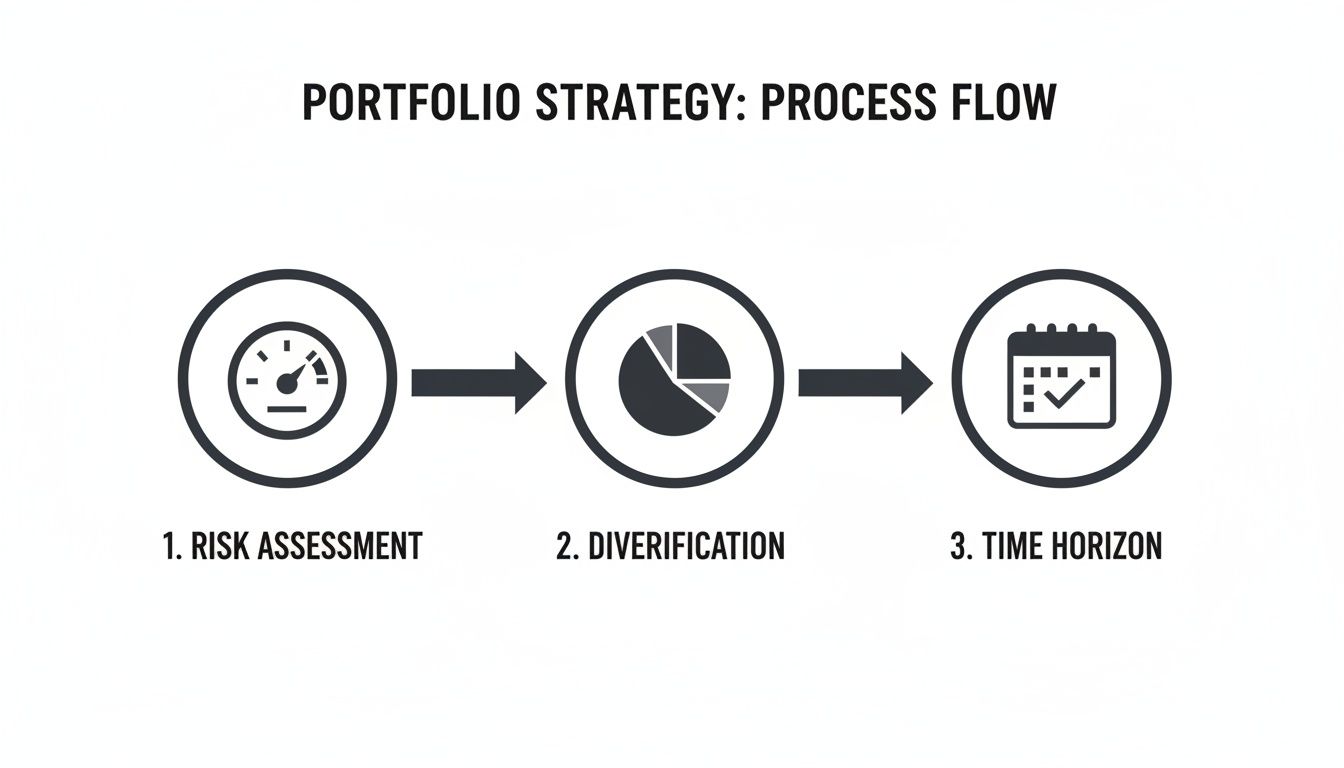
As you can see, successful investing begins with foundational work: assessing risk, diversifying properly, and having a clear time horizon.
The Importance of Market Liquidity
As you begin trading, you'll encounter the term market liquidity. It's a simple but crucial concept: how easily can you buy or sell an asset without significantly impacting its price?
Think of a deep lake versus a small puddle. In a deep, liquid market, you can drop a large rock (a big trade) in, and the water level (the price) barely moves. In an illiquid market — the puddle — even a small pebble can cause a huge splash.
Why does this matter? In a liquid market, there are many buyers and sellers at any given time. This activity tightens the bid-ask spread — the small gap between what buyers are willing to pay (the bid) and what sellers are willing to accept (the ask). A narrow spread means you're not losing money on the transaction itself.
For high-net-worth investors making larger trades, liquidity is critical. In major markets like the U.S., trading volume can exceed 100% of the country's GDP. This incredible activity creates deep, efficient markets where large orders are filled quickly and at a fair price.
For a beginner, the key takeaway is this: stick to highly liquid stocks, which usually belong to large, well-known companies. They are generally easier and cheaper to trade. Dabbling in illiquid markets with wide spreads can erode your returns before you even start.
You've made it this far. You've navigated the jargon and now have a solid grasp of the core concepts, from how the market works to building a resilient portfolio. But the leap from understanding the stock market basics for beginners to confidently putting your money to work is significant.
We've laid the foundation — thinking long-term, diversifying your investments, and tuning out the daily noise. Now it's time to apply these concepts to your own financial life. This is where abstract ideas become practical tools for building the future you envision.
First Things First: What Are You Actually Investing For?
Before you buy a single share, you must know why. Your financial goals are the North Star of your investment journey; they guide every decision you make. Simply wanting to "make more money" is not a plan — it's a wish. You need clear, tangible targets.
Let's break it down by timeline:
- Short-Term Goals (1-3 years): Are you saving for a down payment on a house? Or do you need to preserve capital for a business launch?
- Mid-Term Goals (3-10 years): This might include saving for a child's college education or buying a vacation property.
- Long-Term Goals (10+ years): For most people, this is retirement. It could also be about building a legacy to pass on to the next generation.
Clarity on these timelines will determine how much risk you can and should take. A short-term goal requires a more conservative approach than one that is decades away.
Get Honest About Your Risk Tolerance
Here's a hard truth: everyone feels like a risk-taker when the market is rising. Your true tolerance for volatility only reveals itself when markets get rocky. An honest self-assessment helps prevent emotional, knee-jerk decisions — like panic-selling at the bottom — that can permanently damage your wealth.
This isn't just about whether you can financially afford a loss; it's about your emotional capacity to watch your portfolio decline without abandoning your strategy. A brilliant plan is worthless if you can't stick with it when it matters most.
The most successful investors aren't the ones who chase the highest returns. They're the ones who have a plan so perfectly tuned to their own goals and temperament that they can stick with it, come what may.
Know When to Call in a Pro
While this guide provides a strong start, managing significant wealth introduces new complexities. Suddenly, you're dealing with tax optimization, estate planning, and identifying unique opportunities that the average investor might miss. This is where specialized expertise becomes invaluable.
For any serious investor, partnering with a qualified wealth management advisor isn't a sign of weakness; it's a logical next step. A good advisor can help translate your goals into a sophisticated, actionable strategy, ensuring the financial legacy you're building is not left to chance.
A Few Common Questions on Stock Market Investing
As you start putting theory into practice, questions will naturally arise. Below are some of the most common ones we hear from new investors, particularly those managing significant family assets for the first time.
How Much Do I Really Need to Start Investing?
Technically, you can start with just a few dollars today. However, for a high-net-worth investor, the real question is not about the minimum amount but how much capital is needed to build a genuinely diversified portfolio from the outset.
A more substantial starting sum allows for meaningful exposure across different asset classes from day one. This is where working with a financial advisor can be highly beneficial. They can help you design an initial allocation that effectively spreads risk, ensuring your capital is put to work strategically rather than being overly concentrated in one or two investments.
What’s the Biggest Mistake a New Investor Can Make?
The most common and costly mistake is reacting emotionally to short-term market noise and sensational headlines. This often leads to a destructive cycle: buying high during market euphoria and selling low during a panic.
A disciplined, long-term strategy guided by your financial goals — not the chaos of the daily news cycle — is the most effective defense against this behavior. Having a trusted advisor can be invaluable for maintaining that discipline during volatile periods.
How Are Stock Market Profits Taxed?
For any serious investor, tax efficiency is a crucial part of wealth preservation. When you sell a stock for a profit, that gain is considered a capital gain and is taxable. The tax rate depends on how long you held the investment.
- Short-Term Capital Gains: If you own a stock for one year or less, any profit is taxed at your ordinary income tax rate, which can be quite high for successful individuals.
- Long-Term Capital Gains: If you hold the stock for more than a year, the profit qualifies for much lower long-term capital gains tax rates.
Effective wealth management involves more than just picking winners; it's about maximizing your after-tax returns. This includes strategies like tax-loss harvesting and strategically placing assets in different types of accounts.
Should I Use Individual Stocks or Funds?
For most investors, especially when starting, investment funds like ETFs (Exchange-Traded Funds) and mutual funds are the ideal choice. They offer instant diversification by bundling together shares in dozens, or even hundreds, of different companies.
Achieving the same level of diversification by picking individual stocks would be incredibly difficult, time-consuming, and expensive. Using funds helps build a stable core for your portfolio, dramatically reducing the risk associated with a single company's performance.
For answers to additional frequently asked questions about stock market investing, this is a great resource to explore. Building your knowledge base is a lifelong process that pays dividends in confidence.
At Commons Capital, we specialize in guiding high-net-worth investors through every stage of their financial journey. Contact us to learn how we can build a personalized strategy that aligns with your long-term goals. Learn more at https://www.commonsllc.com.