

Figuring out how to minimize estate taxes isn't just a long-term goal for preserving wealth—it’s an urgent call to action. The rules are about to change, and the most powerful strategy you have is to use today's historically high lifetime gift tax exemption to your advantage. Leveraging tools like trusts and smart gifting is the key to securing your legacy.
That means moving assets out of your taxable estate now, before the exemption amount gets slashed in 2026. Leveraging tools like trusts and smart gifting isn't something to put off; it's the key to securing your legacy.
The Shrinking Window for Estate Tax Savings
Passing on your hard-earned assets requires a clear-eyed view of the current tax landscape, which presents a unique and fleeting opportunity. The federal government taxes the transfer of a person's assets after their death, but the federal estate tax exemption allows you to pass on a significant amount completely tax-free. This number represents the total value of assets you can give away—either during your life or at death—without triggering a massive tax bill.
But here’s the catch: this generous exemption isn’t permanent. A major shift is on the horizon, making proactive planning more critical than ever.
Understanding the Upcoming Exemption "Sunset"
The Tax Cuts and Jobs Act of 2017 nearly doubled the federal estate and gift tax exemption, a huge win for high-net-worth families. But a "sunset" provision was built into the law, which means these higher exemption amounts are set to expire automatically.
This creates a time-sensitive, use-it-or-lose-it scenario. The current exemption is a powerful tool for transferring substantial wealth with minimal tax pain, but the clock is ticking. Waiting could literally cost your heirs millions of dollars, leaving them with a much bigger tax burden and a smaller inheritance than you intended.
The core issue is simple: the tax-free wealth transfer window is closing. Failing to act before the end of 2025 means accepting a far less favorable tax environment for your estate.
With the end of 2025 fast approaching, it’s crucial to understand just how dramatic this change will be. The current exemption is at a historic high, but it’s scheduled to revert to roughly half its current value on January 1, 2026. This cliff creates an urgent need for strategic action, and you can find more insights about these projected 2025 estate planning updates and what they mean for your financial future.
Here’s a quick look at the numbers to put it all in perspective.
Key Estate Tax Thresholds and Rates at a Glance
This table breaks down the current federal estate tax landscape and what we expect to see after the sunset provision kicks in, highlighting the urgency of the moment.
Note: The Post-2025 projected amount is an estimate based on pre-TCJA levels adjusted for inflation.
The takeaway is clear: the amount you can shield from a 40% tax rate is about to be cut in half.
Federal vs. State Estate Taxes
While the federal "sunset" gets all the headlines, it's not the only tax you need to worry about. Many states have their own, separate tax systems that can take a bite out of your estate.
- Federal Estate Tax: This is the big one, levied by the U.S. government on estates that exceed the federal exemption. The top tax rate is a steep 40%.
- State Estate Tax: A dozen states and the District of Columbia impose their own estate tax. The exemptions are often much lower than the federal level, meaning your estate could be federally tax-free but still owe a hefty bill to your state.
- Inheritance Tax: Don't confuse this with an estate tax. A handful of states levy an inheritance tax, which is paid by your heirs on the assets they receive. The rate they pay often depends on their relationship to you (a child might pay less than a cousin).
Navigating this dual system is where a good plan becomes indispensable. An effective strategy for minimizing estate taxes has to account for both federal and state rules to truly protect your assets.
Mastering Gifts and Trusts to Secure Your Legacy
With the massive estate tax exemption likely to be cut in half soon, getting a handle on the core tools for wealth preservation has never been more urgent. At the heart of any solid estate plan are two key pillars: smart gifting and the strategic use of trusts.
These aren't just legal maneuvers; they are proven methods for transferring wealth efficiently, letting you move assets—and all their future growth—out of your taxable estate for good.
Before we dive in, it’s critical to understand how the IRS values these assets. Everything hinges on a concept called Understanding Fair Market Value (FMV). This is the price an asset would sell for on the open market, and it's the number the IRS uses whether you gift something during your lifetime or pass it on after you're gone.
The Power of Proactive Gifting
One of the most direct ways to start chipping away at your future estate tax bill is to simply give assets away while you're still here. This does more than just shrink your taxable estate; it gives you the immense satisfaction of seeing your family enjoy and benefit from your generosity.
There are a few incredibly effective, tax-advantaged ways to do this:
- Use the Annual Gift Exclusion: For 2025, you can give up to $19,000 to as many individuals as you want, and it won't even touch your lifetime gift tax exemption. If you're married, you and your spouse can combine your exclusions to give $38,000 per recipient. This is a workhorse strategy for methodically transferring significant wealth over time.
- Pay for Education and Medical Bills Directly: This one is a game-changer that people often miss. Any payment you make directly to a school for tuition or to a hospital or doctor for medical care doesn't count as a taxable gift. It’s a way to provide substantial support to loved ones completely outside of the annual or lifetime limits.
These gifting techniques are simple, but don't underestimate their power. They are a straightforward starting point for reducing your taxable estate today.
The infographic below really drives home the urgency. We have this incredibly high exemption right now, but the clock is ticking toward the 2026 sunset.
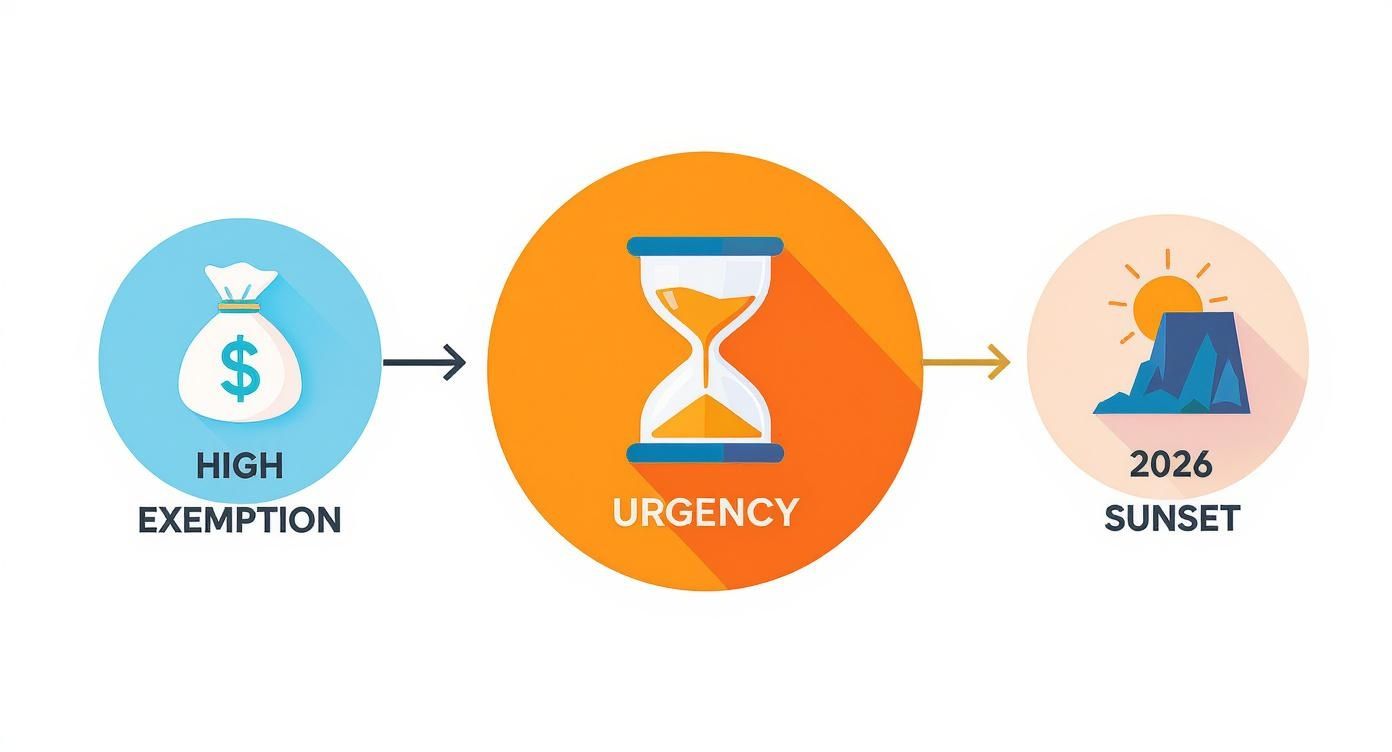
This window of opportunity to use today's favorable laws is closing fast. Taking action now is the key to locking in these benefits and securing your legacy.
Unlocking the Potential of Trusts
While gifting is fantastic, trusts bring a whole new level of control and sophistication to the table. When you move assets into a properly structured irrevocable trust, you're legally removing them from your name. They are no longer part of your estate, which shields them—and their future growth—from estate taxes.
Trusts are not just for the ultra-wealthy; they are essential legal structures that provide control, protection, and significant tax advantages for anyone serious about preserving their legacy.
Different trusts are designed for different jobs. Let's look at a few of the most impactful ones we use in estate planning.
Irrevocable Life Insurance Trust (ILIT)
Here’s a common trap: a large life insurance policy. The death benefit can unexpectedly swell your estate's value, pushing it right over the exemption threshold and creating a tax problem. An Irrevocable Life Insurance Trust (ILIT) is the classic solution.
With an ILIT, the trust owns the policy, not you. When you pass away, the insurance proceeds are paid to the trust, completely bypassing your taxable estate. This provides your heirs with a pool of tax-free cash, which is perfect for covering estate taxes or other expenses.
Grantor Retained Annuity Trust (GRAT)
For assets you expect to appreciate significantly—like company stock or real estate—a Grantor Retained Annuity Trust (GRAT) is a powerful tool. You place the assets into the trust and, in return, receive a fixed annuity payment for a set number of years.
At the end of the term, any growth in the assets above a specific IRS interest rate passes to your beneficiaries completely free of gift or estate tax. It’s a brilliant way to transfer wealth from high-growth assets.
Qualified Personal Residence Trust (QPRT)
Your home or a beloved vacation property is often one of your most valuable assets. A Qualified Personal Residence Trust (QPRT) lets you transfer your home into a trust for your beneficiaries at a gift-tax value that's significantly lower than its current market price.
You get to keep living in the home for a predetermined number of years. When that term is up, the home belongs to the trust, and its entire value is officially outside of your taxable estate.
For those with assets poised for explosive growth, another advanced tool worth exploring is the Intentionally Defective Grantor Trust (IDGT). You can get into the weeds on how this works in our guide on the Intentionally Defective Grantor Trust. In short, it allows you, the grantor, to pay the income taxes on the trust's earnings, which lets the assets inside the trust grow completely unburdened by taxes for your beneficiaries. It's like pouring fuel on the fire of tax-free wealth transfer.
Advanced Strategies for High-Net-Worth Families
When you're dealing with significant wealth, especially with complex assets like a family business or extensive real estate, the standard estate plan just won't cut it. To really move the needle on minimizing estate taxes, you have to go beyond basic trusts and annual gifting.
This is where more specialized techniques come into play—strategies designed specifically for larger, more intricate financial pictures. They offer powerful ways to transfer wealth, keep control of family assets, and even meet philanthropic goals, all while seriously reducing your estate's exposure to taxes.
Using Family Entities for Valuation Discounts
One of the most effective tools for transferring business or investment assets is the Family Limited Partnership (FLP), or its cousin, the Family Limited Liability Company (FLLC). Think of it as creating a container. You consolidate assets—your business, property, a stock portfolio—into this single legal entity that you control.
From there, you can gift minority shares of the FLP or FLLC to your kids or other heirs over time. Here's the kicker: because these gifted shares are a minority interest and don't come with control or an easy way to sell them, they can often be valued at a discount for gift tax purposes. This lets you move the real value of the underlying assets to the next generation while burning through less of your lifetime gift tax exemption.
A huge advantage of an FLP is transferring economic value to your heirs at a discount while you, as the general partner, keep the reins. This is an absolute game-changer for business succession.
In practice, a 20-30% valuation discount isn't out of the ordinary. That allows you to pass on a whole lot more wealth, tax-efficiently, than if you’d just gifted the assets directly. It's a structured way to hand down ownership without giving up the driver's seat.
Strategic Charitable Giving for Tax Reduction
Philanthropy is often about personal values, but it can also be a savvy financial move. When you structure it right, charitable giving can lock in immediate income tax deductions, create an income stream, and shrink the final size of your taxable estate.
Two of the go-to vehicles for this are Charitable Remainder Trusts and Charitable Lead Trusts.
- Charitable Remainder Trust (CRT): You put assets into an irrevocable trust. It then pays you (or someone you name) an income for a set number of years or for life. Once the trust's term is up, whatever is left goes to a charity you care about. The asset is now out of your estate, and you get a nice income tax deduction upfront.
- Charitable Lead Trust (CLT): This is basically the reverse. You fund a trust that makes payments to a charity for a period of time. When that period ends, the remaining assets pass to your heirs, like your children. The gift's value to your heirs is lowered by the amount the charity received, which can dramatically cut the gift tax.
These tools let you support causes close to your heart while achieving some very real tax savings. It's a true win-win.
A Real-World FLP Scenario
Let's walk through an example. Imagine Sarah, a business owner whose family manufacturing company is worth $20 million. If she passed away today, a huge chunk of that value would be hit with a 40% estate tax.
To get ahead of it, Sarah and her advisors put an FLP in place.
- Formation: She transfers the company into the new FLP. She keeps a small general partner interest, which gives her total control over business decisions, and holds the rest as a limited partner.
- Gifting: Over the next several years, Sarah gifts limited partnership interests to her two children. She uses her annual gift exclusion and a piece of her lifetime exemption to do this tax-free.
- Valuation Discount: An independent appraiser looks at the gifted shares and, due to the lack of control and marketability, assigns a 25% valuation discount. This means that when she gifts shares with an underlying value of $1 million, it only counts as a $750,000 gift for tax purposes.
By the time she's ready to step back, Sarah has moved most of the company's economic value to her children at a much lower tax cost. The business is still in one piece and under family control, and her future taxable estate is a fraction of what it would have been. Building these kinds of multi-year plans is what sophisticated wealth preservation is all about, and you can see how this fits into the broader universe of high-net-worth tax strategies available.
Navigating State and International Tax Rules
It's a classic—and costly—mistake to focus only on the federal estate tax exemption. While the federal rules get all the headlines, many families get a nasty surprise when they discover a second layer of taxes lurking at the state level. If you want to successfully minimize estate taxes, you need a dual strategy that keeps an eye on both Washington D.C. and your state capital.
This jurisdictional dance adds a whole new dimension to your planning. A strategy that looks perfect for federal purposes could still leave your heirs with a hefty state tax bill if you’re not careful.
The Patchwork of State Estate and Inheritance Taxes
A growing number of states impose their own taxes on a deceased person's assets, and their rules are often a lot less generous than Uncle Sam's. It's really important to know the difference between the two flavors of state-level taxes.
- State Estate Tax: This is a tax paid directly by your estate before anyone inherits a dime. The tax is based on the total value of your estate, and right now, a dozen states plus the District of Columbia levy one.
- Inheritance Tax: This tax is different—it's levied on your heirs. The amount they owe often depends on how they're related to you. A child might pay a very low rate or nothing at all, while a niece, nephew, or a close friend could get hit with a much higher tax bill.
The real kicker? State exemption amounts are often just a fraction of the federal level. For instance, an estate worth $8 million would be completely in the clear from federal taxes. But it could easily face a significant tax bill in a state with a $2 million or $4 million exemption.
Your legal state of residence when you pass away is the main factor that determines which state taxes, if any, will apply. This makes residency planning a surprisingly critical piece of a truly comprehensive estate strategy.
International Estate Planning Complexities
For families with global connections, things get even more tangled. Owning property in another country or having a non-citizen spouse throws a unique set of rules into the mix that you have to manage carefully to sidestep double taxation and other traps.
One of the biggest hurdles involves non-citizen spouses. You can generally leave an unlimited amount to a U.S. citizen spouse completely tax-free—that’s the unlimited marital deduction. But this powerful tool doesn't apply to non-citizen spouses. The government’s logic is to prevent assets from being transferred entirely out of the U.S. tax system.
Thankfully, there are specific workarounds. The annual exclusion for gifts to non-citizen spouses, for example, is set to increase from $185,000 in 2024 to $190,000 in 2025. This allows for more significant tax-free transfers during your lifetime.
Keep in mind, the global rules on this vary wildly. For perspective, the U.S. has a 40% top estate tax rate, but a recent guide covering 44 jurisdictions shows that countries like the Netherlands also impose a 40% rate on both inheritances and gifts. You can discover more in the 2025 Worldwide Estate and Inheritance Tax Guide.
Layering Your Federal and State Strategy
To skillfully navigate this multi-layered system, your estate plan must be designed with both sets of rules in mind. A common and effective approach is to use specific trusts that are structured to account for those lower state-level exemptions.
For example, a bypass trust (also known as a credit shelter trust) can be set up to use the state exemption amount of the first spouse to die. This carves out and preserves that exemption, preventing the surviving spouse’s estate from becoming unnecessarily inflated and, in turn, minimizing the state tax bill when they pass away.
This checklist highlights some of the different mindsets required when planning for federal versus state taxes.
Federal vs. State Estate Tax Planning Checklist
At the end of the day, a robust plan is one that's flexible and built to handle both tax authorities. Ignoring one for the other is a surefire way to leave your heirs with an avoidable financial headache.
Building Your Expert Team and Action Plan
Knowing the strategies to minimize estate taxes is one thing; actually putting them into action is a completely different ballgame. This is absolutely not a DIY project.
A truly successful estate plan is born from a coordinated effort—a team of seasoned professionals, each bringing a critical perspective to the table to protect your wealth. Assembling this team is the single most important step you'll take to move your plan from theory to reality.
This kind of collaboration is what ensures every angle is covered, from the legal nitty-gritty to the tax implications and investment management. Without that synergy, even the most brilliant strategies can fall short.
Assembling Your Financial A-Team
Your core team really needs to have three key players who work in concert to build and maintain your estate plan. Each one has a distinct—and indispensable—role.
- Estate Planning Attorney: Think of them as your legal architect. They're the ones drafting the foundational documents—wills, trusts, powers of attorney—that form the backbone of your entire plan. Their deep knowledge of federal and state laws is non-negotiable for structuring entities like ILITs or FLPs correctly so they can withstand IRS scrutiny.
- Certified Public Accountant (CPA): Your CPA is your tax strategist. They'll analyze the tax consequences of every single move you're considering, from gifting strategies to funding a trust. Their job is to make sure your plan is not only legally sound but also as tax-efficient as humanly possible, handling gift tax returns and keeping everything compliant.
- Financial Advisor / Wealth Manager: This professional provides the 30,000-foot view. They help align your estate plan with your broader financial life, making sure decisions about transferring wealth don't put your own retirement security at risk. They also manage the underlying assets, ensuring they are invested appropriately to meet the plan's long-term goals.
Preparing for Your First Advisory Meeting
Walking into that first meeting prepared will make the process dramatically more efficient. Seriously. Your goal is to give your team a crystal-clear picture of your financial life right from day one.
Before you sit down with them, take the time to gather these essentials:
- Current Estate Planning Documents: Bring any existing wills, trusts, or powers of attorney.
- Financial Balance Sheet: A simple list of your assets (bank accounts, investments, real estate, business interests) and liabilities (mortgages, loans) is perfect.
- Recent Tax Returns: Your last two years of income tax returns provide a ton of valuable information.
- Life Insurance Policies: Details on policy types, death benefits, and who currently owns them.
- Business Ownership Documents: Any partnership agreements, LLC operating agreements, or corporate bylaws.
An organized start is the foundation of a successful outcome. The more clarity you provide upfront, the more tailored and effective the advice you receive will be.
Key Questions to Drive the Conversation
Once your team is in place and has your information, the real work begins. Your role is to guide the conversation by asking sharp, focused questions that ensure the final plan truly reflects your wishes and your comfort level with risk.
Don't be afraid to probe and challenge their assumptions. A great advisory team will welcome your engagement.
Here are a few questions to get the ball rolling:
- Given the upcoming 2026 exemption sunset, what are the top three things I should seriously consider doing this year?
- How are these strategies going to impact my current cash flow and lifestyle?
- What are the ongoing maintenance requirements and costs for this plan? I want to know what this looks like year after year.
- Can you walk me through a worst-case scenario if the market tanks or the laws change unexpectedly?
The urgency to act isn't just talk. Planning advisors are strongly recommending that individuals with estates over $7 million and couples with over $14 million should prioritize lifetime gifting before the exemption reverts. Taking advantage of the current laws could save an estate roughly $2.8 million in federal taxes.
Your Top Estate Tax Questions Answered
Diving into estate tax planning can feel like opening a can of worms—the more you look, the more questions pop up. It's completely normal. As families start thinking about their legacy and putting together their team of advisors, a few key questions almost always surface.
Let's clear the air and tackle some of the most common questions we hear every day.
When Should I Really Start Planning for Estate Taxes?
The short answer? Right now.
Estate planning isn't a one-and-done task you can just check off a list; it’s a living, breathing part of your financial life. That said, the urgency ramps up significantly if your net worth is getting anywhere close to the post-2025 exemption levels, which we expect to land around $7 million per person.
With the federal exemption set to get slashed by nearly 50% at the end of 2025, the clock is ticking. Taking action now lets you "lock in" today's historically high exemption amounts through strategic lifetime gifts—a massive advantage that simply disappears once the law changes.
Starting early gives you options. You have more time to implement strategies like annual gifting over many years, and it gives assets you place in trusts a longer runway to grow, all outside of your taxable estate.
How Does Life Insurance Factor Into My Estate?
This is a huge one, and it's a blind spot for so many people. If you personally own a life insurance policy, the death benefit is automatically included in your taxable estate. A sizable policy can easily tip an otherwise non-taxable estate over the exemption line, leaving your heirs with an unexpected tax bill.
The go-to strategy here is setting up an Irrevocable Life Insurance Trust (ILIT). By making the trust the owner of the policy, the proceeds are paid directly to the trust when you pass away, not to your estate. This simple move keeps the entire death benefit out of your taxable estate and gives your family immediate, tax-free cash to cover any taxes or other expenses.
What if I Gift More Than the Annual Limit?
So you want to give more than the annual gift exclusion—which is $19,000 for 2025—to one person this year. Good news: it's not immediately taxed.
What happens is you’ll need to file a federal gift tax return (Form 709). The amount you gave over that annual limit just gets subtracted from your lifetime estate and gift tax exemption.
You won't actually pay a dime in out-of-pocket gift tax until you’ve used up your entire lifetime exemption (which is over $13 million in 2025). In fact, this is a core strategy for high-net-worth families looking to move significant assets now and take full advantage of the current high exemption before it's gone.
Sometimes, managing an estate means dealing with complex assets. For instance, many people find themselves navigating the legal hoops of selling a house in probate and need to understand their options. And at a more fundamental level, it's crucial to know your basic tools. We break down two of the most important ones in our guide on the differences between a living trust vs a will.
At Commons Capital, we specialize in creating financial plans that address these questions and more, ensuring your wealth is protected for generations to come. Contact us today to build a strategy that secures your legacy.


