

When inflation is running hot, the old investing playbook gets tossed out the window. Learning how to invest during high inflation isn't about simple growth; it's about actively defending your portfolio's purchasing power. This isn't the time for traditional buy-and-hold; it's a moment for a strategic pivot toward assets that have inherent value and can pass on rising costs, like real estate and companies with serious pricing power.
How High Inflation Impacts Your Wealth

High inflation is much more than an economic headline—it's a direct assault on the long-term value of your wealth. Every percentage point jump in the Consumer Price Index (CPI) chips away at what your cash and fixed-income assets will be able to buy in the future.
For high-net-worth families and sophisticated investors, the stakes are considerably higher. A large asset base is simply more exposed, and the standard advice you hear on the news often doesn't cut it. In today's economic environment, with modest global growth forecasts and persistent price pressures, sitting back and waiting is a losing game.
The Erosion of Purchasing Power
The real danger of high inflation is how silently and steadily it devalues your money. Think about it: a $1 million portfolio earning a 5% nominal return in a year with 4% inflation has only actually grown by 1% in real terms. Any cash sitting in a standard savings account is effectively bleeding value every single day.
This reality forces a hard look at your portfolio's makeup. Assets that once felt safe, like long-duration government bonds, can quickly become liabilities. That's because rising interest rates—the central bank's primary weapon against inflation—drive their market value down.
High inflation completely reframes the investment challenge. The goal isn't just seeking returns anymore; it's about securing real returns—growth that actually outpaces the rate at which your money is losing value.
Why High-Net-Worth Investors Need a Specialized Strategy
Generic investment advice falls apart when faced with the complexities that come with substantial assets. A more tailored strategy is essential for a few key reasons:
- Greater Exposure: Simply put, a larger portfolio has more to lose from the corrosive effects of inflation.
- Tax Implications: Shifting assets can trigger major capital gains taxes, so every move has to be made with tax efficiency in mind.
- Liquidity Needs: You still need access to cash for opportunities or personal expenses, but holding that cash becomes a real drag on performance. It's a tough balancing act.
- Legacy Preservation: The focus isn't just on short-term gains. It's about ensuring wealth is protected for the next generation.
To really get a handle on how inflation warps the financial landscape, it's worth taking a deeper look into understanding interest rates.
At Commons Capital, our entire philosophy is built around this specialized approach. We see high inflation not as a crisis, but as a complex puzzle that can be solved with the right moves. The key is a proactive pivot toward assets with real, tangible value and pricing power—the ability to pass rising costs on to customers, protecting profit margins and, ultimately, your returns. You can see more of our thinking on this in our analysis of the impact of the federal deficit on long-term interest rates.
Building Your Core Portfolio with Equities and Real Assets

When inflation is eating away at the value of cash and conventional fixed-income assets, experienced investors know it's time to pivot. The bedrock of a portfolio designed to weather rising prices is built on two things: top-tier equities and hard assets. Together, they offer a formidable defense, combining growth potential with real-world, tangible value.
But this isn't about indiscriminately buying stocks or property. You have to be incredibly selective. The entire strategy hinges on finding assets with specific traits that allow them to hold their own—and even gain value—while everything else gets more expensive.
Identifying Equities with Pricing Power
In an inflationary world, a company's ability to raise prices without losing its customers is everything. We call this pricing power. Businesses with powerful brands, indispensable products, or what we call "high moats" are in the best position to defend their profit margins.
As their own costs for labor, materials, and transport go up, these companies can simply pass them on. This translates directly to higher revenues and earnings, which is why their stock prices often keep pace with, or even beat, the inflation rate over the long haul.
You'll typically find these kinds of companies in a few key sectors:
- Consumer Staples: Think about the brands people buy no matter what—food, drinks, household necessities. They have incredible pricing power.
- Healthcare and Pharmaceuticals: Demand for critical medical care and breakthrough drugs doesn't really change with the economy, giving these companies leeway to adjust prices to cover their rising costs.
- Dominant Technology Firms: Companies with deeply embedded software, massive networks of users, or essential infrastructure can often set their own prices without much pushback.
When you look at the long-term data, it's hard to argue against equities. The best companies just find a way to adapt, grow their earnings, and ultimately protect your purchasing power better than almost anything else.
Stocks have historically served as a strong shield. Just look at the long-term performance of the S&P 500. A hypothetical $100 invested in the index in 1900 would have grown significantly, but more importantly, its real value adjusted for inflation would still demonstrate how quality stocks have consistently outrun rising prices over time. You can explore this performance further on OfficialData.org.
Embracing Real Assets for Tangible Security
While stocks give you growth, real assets add a layer of tangible security. These are physical assets whose value often moves in lockstep with inflation.
Direct Real Estate Investment
Owning residential or commercial property has long been a go-to strategy for fighting inflation. As prices rise, so do property values and, just as importantly, rental income. This creates both capital growth and a cash flow stream that adjusts to the new cost of living.
Of course, to get the most out of a real estate investment, you have to be on top of all the costs. Property taxes, for instance, can be a major drag on returns, so knowing the ins and outs of things like how to reduce property taxes in Texas and other states is a key piece of the puzzle.
To provide a clearer picture, here’s a look at how different asset classes have historically stacked up when inflation is running hot.
Historical Performance of Asset Classes During High Inflation
This table compares how various assets have performed during periods of significant inflation, offering insight into their effectiveness as hedges within a high-net-worth portfolio.
As you can see, there isn't one perfect solution. The right approach is a carefully constructed blend of these different assets, each playing a specific role in protecting and growing your wealth.
Commodities as a Direct Hedge
Commodities are the basic ingredients of the global economy, so their prices are often a direct reflection of inflation. Adding a slice of commodities to your portfolio can be a very effective, straightforward hedge.
A few categories to consider:
- Precious Metals: Gold is the classic "store of value" when people lose faith in currencies. Its performance can be choppy, but it has a long and storied history as a safe-haven asset. For a deeper dive, you can explore the historical correlation between gold and the stock market in our analysis.
- Energy: Oil and natural gas are core components of inflation indices. When you're paying more at the pump or for your heating bill, an investment in the energy sector can directly offset those higher personal costs.
- Agricultural Products: When the cost of producing food goes up, so do the prices of commodities like wheat, corn, and soybeans.
By thoughtfully combining high-quality stocks that have pricing power with a diversified mix of real assets, you can build a core portfolio that’s genuinely resilient. The goal isn't just to get through an inflationary period—it's to use the environment to build lasting wealth.
Using Inflation-Protected Securities for Portfolio Stability
While stocks and real assets are the growth engines in an inflationary world, what do you do with your fixed-income allocation? Letting it sit in traditional bonds is like leaving cash out in the rain—rising prices will simply wash its value away. But abandoning fixed income altogether isn't the answer either.
This is where specialized instruments come in. They provide the stability and predictable income you need, but with a direct defense against inflation.
The Most Direct Inflation Hedge: TIPS
Your first line of defense is Treasury Inflation-Protected Securities (TIPS). These are U.S. government bonds built from the ground up to shield investors from inflation. The mechanics are simple, but the protection they offer is powerful.
Unlike a normal bond, the principal value of a TIPS actually goes up with the Consumer Price Index (CPI). So, as inflation climbs, the value of your bond holding increases right along with it. Your interest rate is fixed, but it's paid on that new, higher principal. The result? Your income payments grow, too.
When the bond matures, you get back the higher, inflation-adjusted principal. This structure guarantees that the purchasing power of your original investment is preserved. In Wall Street speak, this provides a guaranteed real return—the return you actually make after accounting for inflation.
For high-net-worth families focused on preserving capital, TIPS aren't about chasing huge gains. They are about providing an unbreakable defense. Think of them as the anchor for your fixed-income strategy during an inflationary storm, ensuring a core part of your wealth holds its real value.
We’ve seen them prove their worth time and again. For instance, when CPI climbed sharply in the early 2020s, TIPS held up far better than standard Treasuries, whose real yields cratered. As inflation eventually cooled, TIPS yields adjusted right along with the changing environment, continuing to offer positive real returns. You can dig into the historical data yourself on the St. Louis Fed's website.
Building a TIPS Ladder for Predictable Income
If you need reliable, inflation-adjusted cash flow—for retirement income or other known family expenses—a TIPS ladder is a fantastic strategy. It’s a straightforward approach: you buy individual TIPS with maturity dates staggered over several years (say, in 2, 4, 6 years, and so on).
As each bond in the ladder matures, you can either reinvest the principal into a new, longer-term TIPS or simply take the cash. This gives you a few key advantages:
- Predictable Cash Flow: You know exactly when you'll get your principal back, and you know its value will be adjusted for whatever inflation occurred.
- Reduced Reinvestment Risk: By spreading out the maturities, you aren't forced to reinvest one giant lump sum at a time when rates might be terrible.
- Customization: You can build the ladder to line up perfectly with future financial needs, like college tuition bills or a planned real estate purchase.
This is very different from just buying a bond fund. When you own individual bonds, you have absolute certainty about getting your principal back at maturity. We dig into this more in our guide on the difference between a bond fund and individual bonds.
Exploring Floating-Rate Instruments
Beyond government-backed securities, another smart tool is floating-rate debt. These are bonds or loans where the interest payments aren’t fixed. Instead, their yields reset on a regular schedule—usually every 30 to 90 days—based on a benchmark rate like the Secured Overnight Financing Rate (SOFR).
When inflation pushes the Federal Reserve to raise interest rates, the income from these instruments automatically adjusts upward. This shields investors from the pain fixed-rate bondholders feel when rates climb and their bonds lose value.
While floating-rate debt is a great inflation hedge, the devil is in the details—specifically, the credit quality of who issued the debt. These are often issued by corporations, so you have to do your homework on the underlying business to avoid getting caught in a default. At Commons Capital, we stick to high-quality, investment-grade floating-rate notes for our clients. This lets us capture that adaptive income stream without taking on unnecessary risk.
By combining both TIPS and carefully selected floating-rate debt, you can truly fortify the defensive side of your portfolio, creating a stable foundation and an income stream that won't fall behind.
Finding Opportunity in Inflation-Driven Market Volatility

When inflation headlines start flashing, it's easy to see why fear takes over. The knee-jerk reaction for many investors is to sell, convinced that a rising Consumer Price Index (CPI) is a death sentence for stocks. They dump quality holdings at what is often the worst possible moment.
But this common belief that high inflation automatically torpedoes the stock market just doesn't hold up.
A hard look at the past 74 years of data shows that the S&P 500 has actually posted strong returns in all kinds of inflationary cycles. It's surprising to many, but some of the market's very best years happened when inflation was running hot. In fact, when you compare the 10 best and 10 worst annual returns, the average inflation rates are remarkably similar. You can see the full data breakdown in this guide on how inflation affects your portfolio.
This history is a critical reminder for any serious long-term investor, especially business owners and those nearing or in retirement. While you can certainly expect short-term bumps, quality companies have a knack for navigating rising costs and protecting their value over the long haul.
Turning Market Dips into Strategic Advantages
Volatility feels like a threat, but for a prepared investor, it’s a source of real opportunity. When panic selling drives down the entire market, it creates attractive entry points for buying excellent companies at a discount. Instead of fearing a market dip, you should start to see it as a sale on the world’s best businesses.
Think about it this way: a blue-chip tech company with a wide competitive moat sees its stock drop 15%. It's not because their business is failing; it's because of broad market anxiety over an inflation report. For you, that's a chance to buy more shares at a lower price, which brings down your average cost and sets you up for better returns when the market inevitably recovers.
Of course, this requires discipline. It means having a "buy list" of companies you’ve already researched and want to own. When the market gets turbulent, you’re not scrambling—you’re executing a plan you've already made.
Identifying Resilient Sectors in Volatile Times
Not all stocks are created equal in an inflationary environment. Certain corners of the market have a history of holding up better—and even outperforming—when prices are on the rise. Focusing on these areas can be a powerful way to not just survive, but thrive.
Two areas that immediately come to mind are value stocks and dividend-paying companies.
- Value Stocks: These are companies trading for less than what they’re truly worth. They typically have stable cash flows and solid balance sheets, which makes them less vulnerable to the speculative froth that evaporates in a downturn. In inflationary times, their tangible value acts as a reassuring floor under their stock price.
- Dividend Payers: Businesses that consistently pay and grow their dividends tend to be mature, profitable, and disciplined. That dividend check provides a reliable income stream even if the stock price is treading water, and reinvesting it becomes a powerful way to compound your wealth over time.
Market volatility creates a psychological test. The investors who succeed are those who can look past the alarming headlines and see the underlying opportunity to acquire exceptional assets at a favorable price.
By shifting your perspective from threat to opportunity, you can turn a period of high inflation from a source of stress into a strategic advantage. It all comes down to staying invested, being selective, and using the market's own turbulence to build a stronger portfolio for the years ahead.
Putting Your Inflation-Resistant Investment Plan Into Action
You’ve got a smart plan on paper. Now for the hard part: turning that strategy into reality without letting market noise or emotion get in the way. This isn't about making frantic trades based on the latest headline; it's about methodically fortifying your portfolio against the real, tangible threat of rising prices.
It all starts with a clear-eyed look at where you stand today. A great strategy is only as good as its execution, and that means moving from broad ideas to a concrete, step-by-step process.
We can break this down into three core phases: Assess, Rebalance, and Manage.
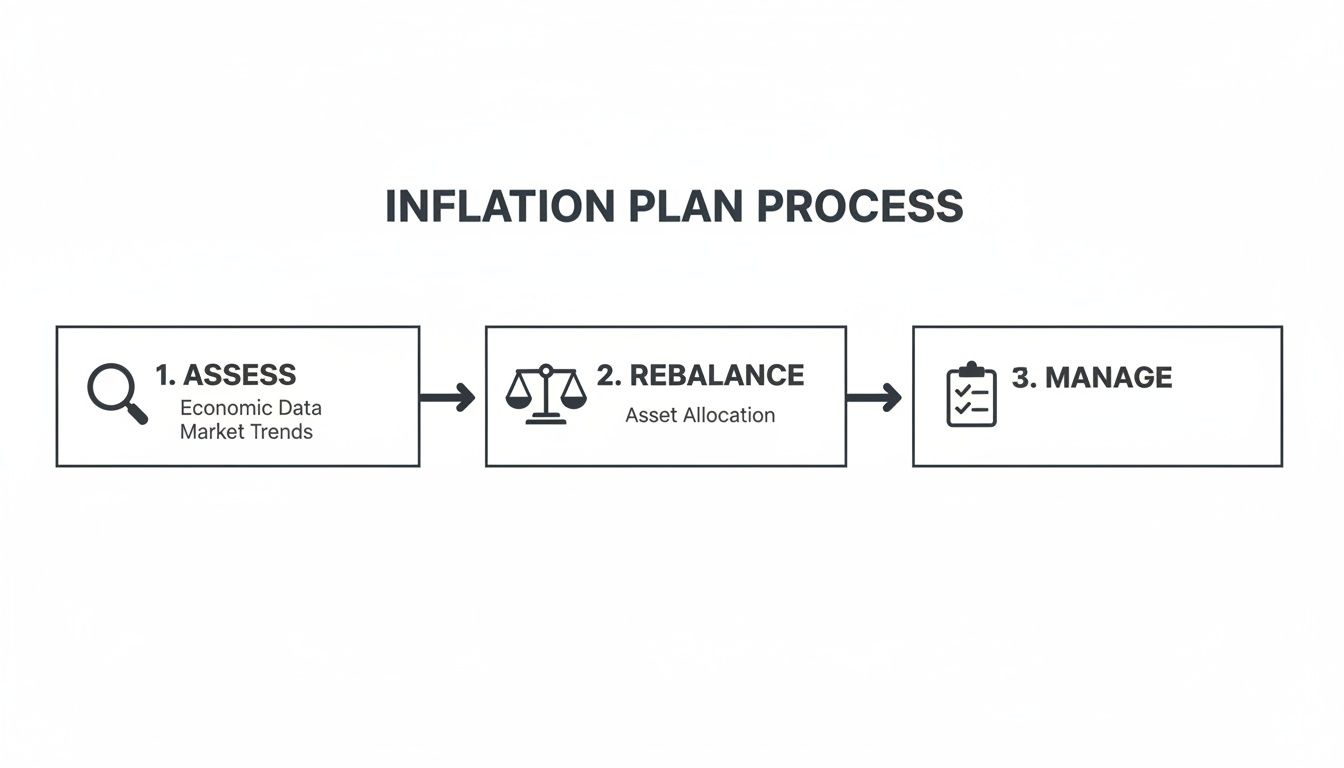
Think of this as a continuous cycle, not a one-and-done fix. In a dynamic economy, that discipline is what separates successful investors from the rest.
Run an "Inflation Audit" on Your Current Portfolio
Before you buy or sell a single share, you need to conduct what I call an "inflation audit." This is a deep dive, where you analyze every holding to see how it’s likely to behave when inflation is running hot. It's the essential diagnostic that will inform every move you make.
Your main goal here is to pinpoint two things:
- Where are you overexposed? The usual suspects are long-duration nominal bonds. As interest rates rise to fight inflation, these fixed-income assets can get hit hard. An oversized cash position, beyond what you need for liquidity, is another major drag, losing purchasing power every single day.
- Where are the gaps? Does your portfolio have enough exposure to companies with genuine pricing power? What about real assets like property and commodities, or inflation-protected securities? The audit will make these gaps impossible to ignore.
An inflation audit isn’t just about finding risk. It’s also about spotting opportunity. Figuring out where you're underexposed to inflation-hedging assets is every bit as important as finding where you're vulnerable.
Get granular with this. For your stocks, ask yourself: which of these companies can really pass on higher costs to their customers without losing business? For your bonds, calculate the real yield (the nominal yield minus the inflation rate). This data gives you the foundation for what comes next.
Rebalance with Discipline, Not Emotion
With your audit results in hand, it’s time to rebalance. This is probably the most critical part of learning how to invest during high inflation. I want to be clear: this is not market timing. It's a methodical, disciplined shift to align your portfolio with your new, inflation-aware targets.
This means systematically trimming positions that are vulnerable to inflation and redeploying that capital into assets that are more resilient. For instance, you might sell a portion of a long-duration bond fund and use the proceeds to build a TIPS ladder or invest in a high-quality infrastructure fund.
It’s often best to do this gradually. Making sudden, massive changes can trigger a big tax bill and might lock in losses if you sell into a panic. A phased approach gives you flexibility and lets you potentially use market dips to your advantage.
Manage the Tax and Liquidity Puzzle
For high-net-worth families, rebalancing is never as simple as just selling one thing to buy another. The tax implications are a huge piece of the puzzle, especially for anyone in the top brackets.
- Hunt for Tax-Losses: Look for opportunities to sell any underperforming assets at a loss. You can use these losses to offset capital gains from selling your winners, which can significantly soften the tax bite of your rebalancing.
- Get Smart with Asset Location: Try to place your most tax-inefficient assets (like corporate bonds or actively traded funds) inside tax-advantaged accounts like an IRA. Your more tax-efficient assets, like growth stocks held for the long term, are better suited for your taxable accounts.
- Keep Your Powder Dry: As you shift into less liquid assets—think private equity or direct real estate investments—make absolutely sure you’re keeping enough cash on hand. You need it for short-term needs and, just as importantly, to pounce on new opportunities that arise. Getting "locked up" in illiquid assets is a classic mistake that can force you to sell at the worst possible time.
Finally, after you’ve rebalanced, you need to stress-test the new portfolio. Run simulations. What happens if inflation sticks around for another 3 years? What if the Fed over-corrects and we get a sharp economic slowdown? Knowing how your portfolio might hold up in different scenarios gives you the confidence to stay the course when things get choppy.
Common Questions About Investing During Inflation
Even the most well-crafted strategy can get tested during periods of high inflation. It's only natural for questions and second-guessing to pop up. Let's tackle some of the most frequent ones we hear from sophisticated investors, because clarity is the key to acting with confidence.
Should I Sell My Bonds When Inflation Is High?
The gut reaction for many is to dump fixed-income holdings. After all, when inflation rises, interest rates usually follow, and that hammers the value of existing bonds with lower yields.
But a blanket sell-off is a classic mistake. It can throw your entire portfolio out of balance, leaving you far too exposed if the stock market takes a turn.
A much sharper approach is to be selective. Instead of a fire sale, focus on rotating out of your most vulnerable assets, particularly long-duration nominal bonds. These are the most sensitive to interest rate hikes. At the same time, you can lean into fixed-income instruments that are actually built for this kind of environment.
- Treasury Inflation-Protected Securities (TIPS): As we've covered, the principal value on these bonds adjusts upward with the CPI. It's a direct hedge that helps your capital keep its buying power.
- Floating-Rate Notes: The income stream from these instruments isn't fixed; it resets periodically based on current interest rates. This means that as the Federal Reserve tightens its policy, your cash flow can actually increase. You're turning a headwind into a tailwind.
By making this kind of surgical shift, you keep the stabilizing benefits of fixed income without letting inflation eat away at your returns.
Is Gold Still a Reliable Inflation Hedge?
Gold’s reputation as the ultimate hedge against inflation is legendary. For centuries, it’s been the asset people turn to when they lose faith in paper money. But in a modern portfolio, its role is a lot more nuanced, and its performance isn't always the slam dunk many believe it to be.
If you look at the data, gold's correlation with inflation is spotty. It had an incredible run during the high-inflation 1970s, for example. But there have been plenty of other times when the CPI was climbing and gold’s price went nowhere—or even fell.
Think of gold less as a direct inflation-fighting tool and more as portfolio insurance. Its real value emerges during moments of extreme market stress, geopolitical shocks, or a genuine crisis of confidence in the financial system.
For that reason, a small allocation to gold—typically in the 3-5% range—can be a smart diversification move. But it shouldn't be your main strategy for how to invest during high inflation. Overloading on a volatile, non-income-producing asset like gold can be a serious drag on your portfolio’s long-term growth. It has its place, but it's a supporting role, not the main event.
How Often Should I Rebalance My Portfolio in an Inflationary Environment?
When markets get choppy, the temptation is to constantly tinker and react to every headline. This is a dangerous game that usually just leads to buying high and selling low. True discipline is the key to long-term success, even when inflation is running hot.
Instead of making reactive trades, stick to a disciplined rebalancing schedule. A great best practice is to review your portfolio at set intervals, maybe quarterly or semi-annually.
During these reviews, you simply compare where you are to where you want to be. For instance, if your target for equities with pricing power is 40%, but a strong run has pushed that allocation up to 45%, you trim that position back to its target. This process forces you to systematically sell what has done well and buy what has lagged—the very definition of disciplined investing.
The only real exception to a schedule-based plan is adding threshold rebalancing. This means setting tolerance bands around your targets, say +/- 5%. If any single asset class moves outside its band, you rebalance right away, even if it's between your scheduled reviews. It acts as a guardrail against major portfolio drift without encouraging you to meddle every day.
At Commons Capital, we help our clients build and execute these disciplined strategies, providing the expert guidance needed to navigate complex economic climates with confidence. To learn how we can help you create a robust, inflation-resistant investment plan, visit us at https://www.commonsllc.com.


