

When you hear "investing in artificial intelligence," what comes to mind? For most, it's about buying shares in the companies that are either building AI, supplying the gear for it, or using it in a big way to get ahead. When considering an investment in stocks in artificial intelligence, it's crucial to understand the vast ecosystem it encompasses.
It covers a huge range of businesses. You've got the chipmakers laying the foundation with powerful hardware, and on the other end, software companies rolling out slick, AI-powered apps. For an investor, this is a front-row seat to one of the biggest technological shifts we've seen in decades.
A Generational Investment Opportunity in AI
Let's be clear: artificial intelligence isn't just another tech trend. It's a fundamental rewiring of how entire industries work, innovate, and compete. For high-net-worth investors and their families, getting a handle on the sheer scale of this change is the first real step toward building a portfolio that's truly looking ahead.
We're already seeing AI's fingerprints everywhere — from sharper medical diagnostics and complex financial modeling to self-driving cars and the eerily personal retail ads that follow us around. It’s this broad-spectrum impact that makes AI such a compelling place to put capital to work.
And the money is definitely flowing. Global private investment in AI recently hit an all-time high of $252.3 billion, a number that shows just how much confidence is backing this wave. If you're curious about the data, Stanford HAI's latest AI Index Report is a great resource for a deeper dive.
Why AI Stocks Deserve Your Attention Now
So, what’s different this time? Why has AI suddenly jumped from sci-fi movie plots to boardrooms and balance sheets? It’s because three massive forces finally clicked into place at the same time:
- Mind-Bending Computing Power: Today's machines can chew through massive datasets at speeds that were unthinkable just a few years ago. This is the raw horsepower that modern AI runs on.
- The Big Data Gold Rush: Our digital lives create an incredible amount of data every single day. This isn't just noise; it's the raw material AI models need to learn and get smarter.
- Smarter-Than-Ever Algorithms: Major leaps in machine learning and neural networks have unlocked capabilities that were once stuck in research labs, letting AI tackle incredibly complex tasks.
Thinking about investing in AI today is a lot like looking at the internet in the late '90s or smartphones just before the App Store opened. It's a foundational shift that will spawn entirely new markets and completely upend old ones. Getting your positioning right now could lead to significant long-term growth.
A Framework for Thinking About AI Investing
To get your arms around the AI stock universe, it helps to picture it like building a city from the ground up. Each layer depends on the one below it, and every part is crucial.
- The Foundation (Semiconductors): This is the bedrock. These are the chip companies creating the specialized processors that provide the raw computing muscle.
- The Infrastructure (Cloud Platforms): Think of this as the city's power grid and utility system. These platforms make AI scalable and accessible to everyone, not just a few tech giants.
- The Operating System (AI Software & Models): Here you have the core programs and large language models — the brains of the operation that allow for specific, intelligent functions.
- The Businesses (AI Applications): Finally, you have the skyscrapers and storefronts. These are the companies using the underlying tech to build products and services that solve real problems for real people.
Grasping this structure is key. It helps you see who the leaders are at every level and where the next big opportunities might be hiding across the entire value chain.
Getting to Grips With the AI Stock Universe
If you want to invest successfully in artificial intelligence, you first have to understand the landscape. This isn't just about picking the hot new software company. The AI world is a complex, interconnected system, a lot like the supply chain for any major industry. Thinking about stocks in artificial intelligence means appreciating the whole value chain, from the raw computing power all the way to the app on your phone.
This ecosystem is best understood as a series of distinct, yet totally dependent, layers. Each one builds on the one below it, creating a "tech stack" where value gets added at every single stage. For an investor, this structure reveals a ton of different opportunities — from the established giants making the chips to the nimble startups building the next killer app.
The Four Foundational Layers of AI
The AI market isn't a single entity; it's a tiered structure. At the very bottom, you've got the hardware that makes everything else possible. Move up a level, and you find the massive platforms that manage all that power. Above that are the software models that provide the actual intelligence. And at the very top, you have the applications that deliver real value to people and businesses.
This diagram shows how the whole system stacks vertically, starting with the foundational hardware and building up to the final applications we all interact with.
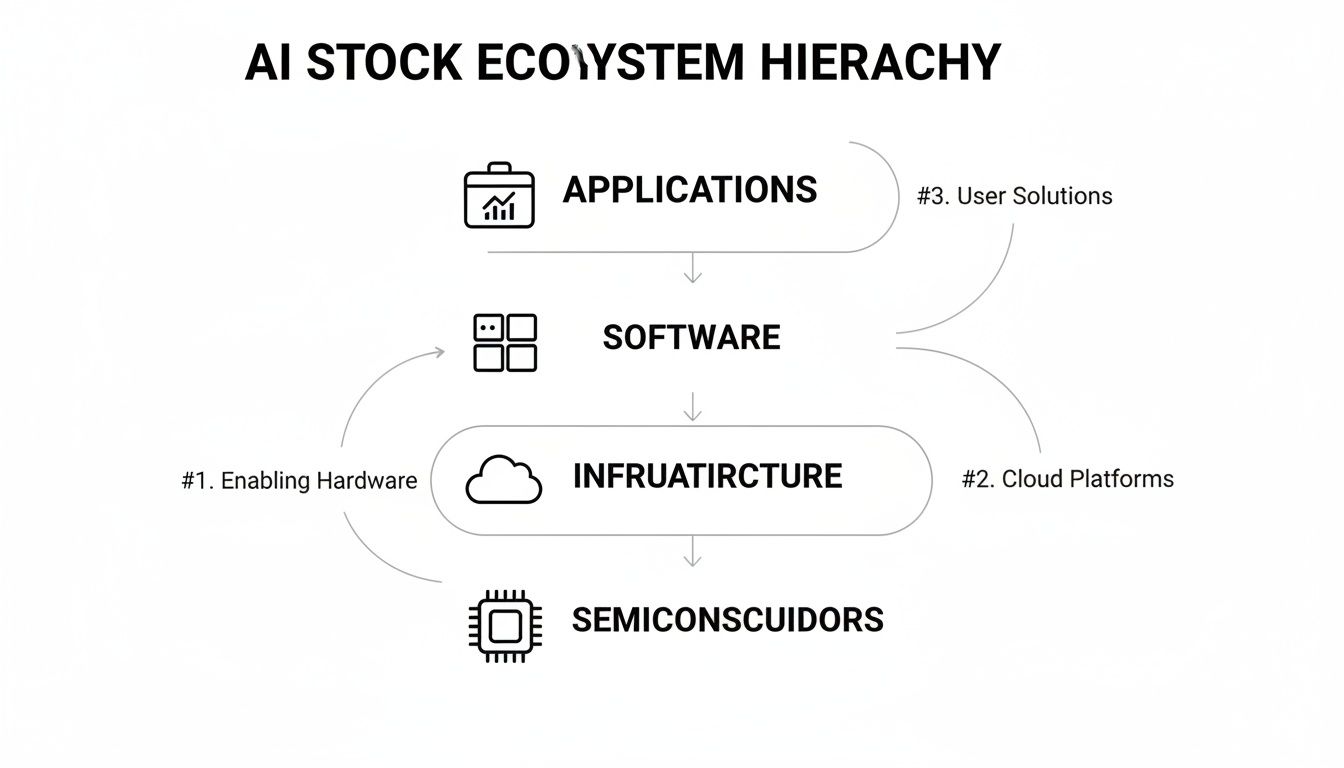
As you can see, each layer is a prerequisite for the one above it. That means breakthroughs in semiconductor hardware directly fuel the creation of more powerful and widely used AI applications.
To help break this down, the table below maps out the key segments, what they do, and who the major players are.
Understanding where a company fits into this stack is the first step toward figuring out its potential and its risks. Now, let's dig into each layer.
Semiconductors: The Bedrock of AI
Right at the bottom of the AI ecosystem, you'll find the semiconductor companies. Think of them as the foundries forging the steel and concrete for our digital world. They're the ones designing and making the high-performance chips — especially Graphics Processing Units (GPUs) and other specialized AI accelerators — that provide the raw muscle for training and running complex AI models.
These chips are non-negotiable. They are the foundation. Without their constant innovation, the progress we're seeing in AI would grind to a halt.
Companies in this space often have massive competitive moats built from staggering R&D costs, incredibly complex manufacturing processes, and deep patent portfolios. Their fortunes are directly tied to the insatiable demand for more processing power from cloud providers and data centers.
Infrastructure: The Power Grid
The next layer up is infrastructure, a space dominated by the major cloud computing platforms. These companies, often called "hyperscalers," provide the services that make AI accessible and scalable for everyone else. They build and operate colossal data centers packed with the latest AI chips, then rent out computing power, storage, and networking as a utility.
For most businesses, building an AI-ready data center from scratch is prohibitively expensive. Cloud providers democratize access to supercomputing power, effectively acting as the utility company for the entire AI economy.
Their business models are all about consumption and subscriptions, placing them at the center of AI deployment across every industry. They are the biggest customers for the semiconductor firms below them and the essential platform for the software companies above them. We see a similar dynamic in other tech sectors, which you can read more about in our guide on investing in robotics and AI.
AI Software and Models: The Brains
This is the layer where raw computing power gets turned into actual intelligence. It includes the companies developing the large language models (LLMs), machine learning frameworks, and data analytics platforms that act as the core "brains" of AI systems. You could think of them as the operating systems of the AI world.
Their value comes from creating powerful, general-purpose models that other developers can then build on top of. The business model usually involves licensing their models through APIs (Application Programming Interfaces) or selling comprehensive software suites to large enterprises. These firms are the crucial bridge between hardware muscle and functional intelligence.
AI Applications: The End-User Value
Finally, at the very top of the stack, you have the application companies. These are the businesses that take all the underlying infrastructure and models and use them to create tangible products and services for consumers and other companies. This is easily the most diverse and fastest-growing part of the AI stock universe.
You can find them everywhere:
- Enterprise Software: Think of companies embedding AI into their CRM, ERP, or cybersecurity products to automate tasks and offer predictive insights.
- Industry-Specific Solutions: These are firms developing specialized AI for fields like medical diagnostics, legal research, or autonomous vehicles.
- Consumer Apps: This includes businesses using AI to power recommendation engines, virtual assistants, and creative content tools.
These companies win by solving specific, real-world problems. While this guide is focused on long-term investing, a broader market perspective can be helpful. Understanding different trading approaches like swing trading can show how various stocks behave within the larger financial ecosystem. Recognizing the unique role each of these layers plays is the first step toward building a smart and effective AI investment strategy.
How to Analyze and Value AI Companies
Trying to value a company at the center of the AI boom with old-school metrics is a bit like trying to measure a rocket ship's speed with a car's speedometer. Traditional tools like the price-to-earnings (P/E) ratio, while not useless, just can't keep up. They often flash warning signs that don't tell the whole story.
Why? Because many of these high-growth AI firms are plowing every single dollar they make right back into research, hiring top talent, and grabbing market share. That laser focus on growth crushes short-term profits, making standard valuation methods look completely out of whack.
To get it right, you have to start thinking less like a traditional stock analyst and more like a venture capitalist. The real question isn't what the company is earning today, but what its market position and technological edge will look like five or ten years down the road.
Looking Beyond Standard Financials
To really get a feel for stocks in artificial intelligence, you need to blend the old with the new. Of course, a rock-solid understanding of financial statements is table stakes, but for AI, some numbers just carry more weight.
Here’s where you should focus your attention:
- Total Addressable Market (TAM): It's not just about how big the company's target market is, but how fast that market is growing. A company that’s even just a small player in a market that's exploding has a massive tailwind at its back.
- Customer Acquisition Cost (CAC) and Lifetime Value (LTV): This is the engine room. This ratio tells you how efficiently the company is turning marketing dollars into long-term customers. A healthy AI business will show a high LTV relative to its CAC, proving its model for acquiring and keeping customers actually works.
- Revenue Growth and Quality: Look for revenue that’s not just growing, but accelerating. Even more important is the quality of that revenue. Predictable, recurring subscription revenue is worth far more than one-off project fees because it provides a stable foundation for future growth.
Getting the numbers right is everything. If you need a refresher on digging into a company's financial health, our guide on how to analyze financial statements is a great place to start.
Identifying a Durable Competitive Moat
In a field moving as fast as AI, a company's long-term survival hinges on its "moat" — a durable competitive advantage that keeps rivals at bay. For AI companies, these moats don't look like the giant factories or brand names of the past.
A strong competitive moat in AI isn't just about having a better algorithm today. It's about creating a self-reinforcing cycle where the product gets smarter with each new user, making it nearly impossible for competitors to catch up.
This creates a powerful "flywheel" effect. The more data a company gathers, the smarter its AI models get. Smarter models pull in more users, who then generate even more data for the models to learn from. The cycle just keeps spinning, faster and faster.
Key Moats in the AI Sector
When you're digging into a potential AI investment, you need to hunt for hard evidence of these specific competitive advantages. A company that has one — or better yet, several — is in a powerful position to lead for years to come.
- Proprietary Data Sets: This is often the most powerful moat of all. An AI model is only as good as the data it's trained on. A company sitting on a unique, massive, and hard-to-replicate dataset has a head start that money can't easily buy.
- Network Effects: This is the magic that happens when a product gets more valuable as more people use it. Think of a navigation app that uses real-time traffic data from its users to find the fastest routes for everyone. The more drivers join, the better the service gets for all of them.
- World-Class Talent: The fight for top-tier AI researchers and engineers is absolutely brutal. The companies that can attract and keep the brightest minds — what some call high "talent density" — are the ones that will continue to innovate and stay ahead of the pack.
- High Switching Costs: How much of a pain would it be for a customer to switch to a competitor? For enterprise AI software, these costs can be staggering. Once a company has woven an AI platform deep into its core operations, ripping it out is an expensive, disruptive nightmare. That creates an incredibly "sticky" customer base.
By focusing on these pillars — growth potential, economic efficiency, and the strength of the moat — you can start to build a much clearer picture of an AI company’s real long-term value. It’s the best way to cut through the hype and base your decisions on fundamental strength, not just today's headlines.
Building a Diversified AI Portfolio Strategy
Investing in individual stocks in artificial intelligence can feel like chasing lightning in a bottle. The potential for massive returns is undeniable, but so is the concentrated risk. One wrong step from a promising company can send a big chunk of your holdings down the drain. This is why a structured, thoughtful approach isn't just a good idea — it's essential for navigating the sector's wild swings while capturing that long-term growth.
Simply picking a few big names you've heard of isn't a strategy; it's a bet. A much smarter approach is to build a diversified portfolio that balances the steady players with the high-octane growth stories. This method helps cushion your portfolio against inevitable market shocks while keeping you in the game for the explosive upside of true innovators.
The Core and Satellite Approach
One of the most effective ways to structure this is the core and satellite strategy. Think of it like building a solar system for your investments. The "core" is your sun — a big, stable center of gravity. The "satellites" are the planets orbiting it, each with its own unique characteristics and path.
- The Core: This is the bedrock of your AI portfolio, usually a broad, market-tracking investment like an AI-focused Exchange-Traded Fund (ETF). Its job is to provide stability and capture the overall growth of the entire AI sector, spreading your risk across dozens, sometimes hundreds, of companies.
- The Satellites: These are your hand-picked, high-conviction stocks. This is where you allocate capital to specific companies you genuinely believe have a competitive edge, whether it's a titan like NVIDIA or a disruptive newcomer carving out a unique technological moat.
This structure anchors the bulk of your capital to the broad market trend, while your satellite positions give you the chance to really outperform. You can read more about the principles of spreading risk in our guide on how to diversify your portfolio.
Blending Giants with Innovators
Within those satellite holdings, it's critical to strike a balance between established market leaders and smaller, high-growth innovators. Each plays a different, but equally important, role.
The established giants — think dominant semiconductor or cloud infrastructure players — offer stability and more predictable, if slower, growth. They have proven business models, generate massive cash flows, and are woven into the very fabric of the AI supply chain.
On the flip side, smaller, disruptive companies offer the potential for absolutely explosive growth. These are the firms pioneering a new AI application or cracking a breakthrough algorithm. Sure, they carry higher risk, but their success can generate the kind of returns that define a portfolio for years to come.
Exploring Alternative AI Investments
Beyond just picking stocks and ETFs, sophisticated investors have other ways to get exposure to artificial intelligence, each with a different risk-reward profile.

For many investors, the public markets are just the beginning. Private equity and venture capital offer a direct line to the next generation of AI innovation before it ever hits the stock market, though this path requires a higher tolerance for risk and longer investment horizons.
Consider these alternatives:
- AI-Focused ETFs: As we mentioned for the "core," ETFs are fantastic tools. They give you instant diversification across various sub-sectors like robotics, cybersecurity, and AI software, taking the edge off single-stock risk.
- Private Equity & Venture Capital: For accredited investors, investing directly in private AI companies means getting in on the ground floor. This route has the highest growth potential but comes with the trade-offs of illiquidity and a much longer time horizon.
- Mutual Funds: Some actively managed technology or growth funds have significant stakes in AI leaders, offering professional management and diversification without you having to pick every winner.
The AI sector has been the engine driving the market lately. The NASDAQ's remarkable 20%+ surge was heavily fueled by AI stocks, cementing it as the dominant theme. But analysts are right to warn that we're starting to see a separation between the winners and losers based on real execution in chips, cloud, and enterprise software.
This shakeout creates strategic opportunities, with comeback stories like Intel rocketing 80% and platform players like Palantir soaring 143.1% as they capture enterprise demand. By carefully blending these different investment vehicles, you can build a robust portfolio that’s truly tailored to your financial goals and what keeps you up at night.
Managing Risks in the AI Sector
Putting money into a fast-moving field like artificial intelligence means dealing with a unique set of challenges that go way beyond typical market swings. While the growth story is undeniably compelling, a clear-eyed view of the potential hurdles is essential if you want to succeed long-term. The same forces that fuel incredible innovation can also whip up serious volatility and risks you just don't see coming.
The sheer excitement around stocks in artificial intelligence has already pushed valuations to nosebleed levels. This creates a very real risk of a valuation bubble, where share prices get completely disconnected from the company's actual ability to make money. When market sentiment eventually cools, these high-flying stocks can — and often do — fall back to Earth with a painful thud.
Navigating Competition and Obsolescence
The competitive landscape in AI is, to put it mildly, brutal. Today’s market leader could easily become tomorrow's cautionary tale if a rival comes up with a better algorithm or a more efficient chip. This risk of getting left behind by the next wave of technology is a constant threat.
A company's dominance can be shockingly brief. As an investor, you have to constantly ask whether a firm can keep innovating and defend its position against a flood of well-funded competitors, from established tech giants to nimble startups.
The greatest risk in AI investing isn't just picking a losing stock; it's being over-exposed to a company whose groundbreaking technology is rendered obsolete by the next big breakthrough. Diligence isn't a one-time event but a continuous process.
The Evolving Regulatory Landscape
Beyond the market itself, a growing web of government oversight is becoming a major risk factor. As AI gets woven into the fabric of society, regulators around the world are taking a much closer look at its impact, creating a lot of uncertainty for investors.
Here are the key areas they're focused on:
- Data Privacy: Tough new rules about how companies collect, use, and store our personal data can drive up compliance costs. More importantly, they can limit the power of AI models that need massive datasets to work well.
- Algorithmic Bias: There's a ton of pressure to make sure AI systems don't amplify existing biases in critical areas like mortgage lending or hiring decisions. We're likely to see new laws that hold companies liable for discriminatory outcomes.
- National Security: Governments are starting to see AI as a critical strategic asset. This could lead to restrictions on tech exports, foreign investment, and even international research collaboration, which would disrupt global supply chains.
Even in a dynamic sector like AI, a key part of responsible investing is knowing what protections are in place for you. That includes things like FINRA suitability rules, which require brokers to make sure any investment recommendation actually fits your financial situation and goals.
A Practical Due Diligence Checklist
To make smart decisions and manage these risks, a thorough due diligence process is non-negotiable. Asking the right questions helps you cut through the hype and really gauge a company’s resilience.
Before you invest a dime, dig into these key areas:
- Leadership and Vision: Does the management team actually have deep technical expertise? Do they have a clear, long-term plan? Find out who the key engineers and researchers are that are driving the real innovation.
- Technology and Defensibility: What is the company's core technological edge? Is it protected by patents, unique data, or high switching costs that create a real "moat" around the business?
- Ethical and Regulatory Readiness: Does the company have a public stance on AI ethics? What are they doing to prepare for potential rule changes around data privacy and algorithmic transparency?
- Financial Health: Look past the shiny revenue growth numbers. How is the company managing its cash burn? Do they have a credible path to profitability that doesn't rely on an endless stream of venture capital?
By systematically working through these questions, you can get much better at spotting the companies that are built to last and sidestepping the unique risks that come with the AI gold rush.
What’s Next for AI Investing?
When you look past the day-to-day noise of the market, the big picture for artificial intelligence investing is crystal clear and incredibly powerful. Sure, there will be ups and downs — that's just how markets work. But the real story is the steady, unstoppable march of AI into every corner of the economy. This isn’t a flash in the pan; it's a fundamental rewiring of how companies work.
For patient investors who can see the forest for the trees, this is where the opportunity lies. We’re still in the early innings. The lasting value will be captured by those who build a smart, deliberate allocation to stocks in artificial intelligence and stick with it.
The Trends Defining the Next Wave
The next phase of AI is already taking shape, and a couple of major trends are creating brand-new openings for investors. If you want to stay ahead of the game, these are the areas to watch.
- Generative AI Gets Specialized: What started with chatbots is now branching out into highly specific, high-value industries. We’re seeing generative AI used to discover new drug compounds, draft complex engineering blueprints, and even create photorealistic marketing campaigns. This is cracking open entirely new revenue streams for companies that can apply the tech effectively.
- AI on the Edge: Not all the action is happening in giant data centers. More and more AI processing is moving directly onto devices — think smartphones, factory robots, and even cars. This "edge AI" cuts down on lag time and boosts privacy, which in turn is fueling massive demand for smaller, more efficient chips and the software to run them.
Why the Long-Term View Matters
The raw numbers from the AI sector continue to tell a story of explosive potential. Look at a company like Micron Technology (MU), which has seen its stock jump 251.2%, or Palantir Technologies (PLTR), with a jaw-dropping 143.1% gain. Micron's performance, in particular, points to a crucial theme: it's not just about the big-name chip designers. The components that make it all work, like high-bandwidth memory (HBM), are becoming critical. In fact, the global HBM market is set to expand dramatically, proving that the opportunity in AI stocks is much broader than many realize. You can find more analysis on recent AI stock performance here.
The real secret to AI investing isn’t about timing the market; it's about time in the market. The compounding power of this technological shift will build serious wealth, but it's going to reward patience and conviction, not knee-jerk reactions.
Trying to navigate this fast-moving space takes more than just capital — it requires a disciplined strategy and deep expertise. A trusted advisor can be the difference-maker, helping you cut through the hype, manage the inherent risks, and build a personalized AI investment plan that's actually designed to capture the incredible opportunity ahead.
Common Questions About Investing in AI Stocks
Diving into the world of AI investing brings up plenty of questions, even for seasoned market veterans. It's a dynamic space, and getting the nuances right is what separates a smart strategy from a speculative bet. Let's tackle some of the most common queries we hear from investors.
How Much of My Portfolio Should I Allocate to AI?
There's no single magic number here. The right allocation depends completely on your personal risk tolerance, your investment timeline, and where you are financially. A younger investor with decades ahead of them might feel comfortable taking a bigger swing, while someone on the cusp of retirement would naturally prefer a more conservative position.
A really practical way to think about it is the "core and satellite" approach. You could anchor your AI exposure with a broad AI ETF to capture the whole market's growth. Then, you can add smaller, more targeted "satellite" positions in individual stocks you have high conviction in.
For many balanced portfolios, a thematic allocation to AI in the 5% to 15% range is a reasonable starting point. But this is just a benchmark — it absolutely must be tailored to your specific goals in a detailed conversation with your financial advisor.
What's the Best Way to Start Investing in AI Stocks?
For most people, the simplest and smartest entry point is an AI-focused Exchange-Traded Fund (ETF). Think of it as one-stop shopping. An ETF spreads your money across dozens of companies in the sector, from the chipmakers powering the revolution to the software firms building on top of it. This move alone dramatically lowers the risk you'd face by betting on just one company.
This strategy saves you from the incredibly difficult task of trying to pick individual winners and losers in such a complex field. It ensures you get a piece of the action from the broad growth in AI without needing a Ph.D. in machine learning.
How Can I Tell Hype from Real Long-Term Potential?
This is the central challenge, isn't it? Separating genuine, game-changing innovation from fleeting market mania is what investing in artificial intelligence is all about. The key is to look right past the buzzy headlines and dig into the fundamental strength of the business itself.
Start asking the tough questions:
- Does the company have a real competitive moat? I'm talking about things competitors can't easily copy, like proprietary data sets, customers who are locked in by high switching costs, or an engineering team that's the best in the world.
- What does the revenue actually look like? You want to see companies with predictable, recurring subscription revenue. That's a much healthier sign than a business relying on one-off projects.
- Is there a clear path to making money? It's fine for AI companies to reinvest heavily in growth, but they still need a believable plan for how they'll eventually generate sustainable profits.
By focusing on these core business metrics, you can start to identify the companies built to last, not just the ones riding a temporary wave of excitement.
At Commons Capital, our specialty is helping high-net-worth individuals and families navigate complex investment landscapes like artificial intelligence. Learn how we can build a personalized financial strategy to help you achieve your goals.