
---meta_title: "Top 8 Estate Tax Planning Strategies for 2025"meta_description: "Discover eight essential estate tax planning strategies to preserve wealth, minimize liabilities, and secure your legacy for 2025 and beyond."---The current estate tax landscape presents both significant challenges and unique opportunities for high-net-worth individuals and families. With a federal exemption of $13.61 million per person set to be halved in 2026, proactive **estate tax planning strategies** and tax-efficient estate planning are more critical than ever. Failing to act can result in a substantial portion of your wealth being lost to transfer taxes, rather than supporting your heirs or philanthropic goals. For foundational insight into your tax responsibilities, see [understanding tax obligations for inheritance tax](https://www.endurego.com.au/understanding-tax-obligations-for-inheritance-tax/).This guide moves beyond basic advice, diving into eight powerful, actionable techniques for wealth preservation, gift and estate tax exemption strategies, and multi-generational wealth transfer planning. We’ll explore tools from Irrevocable Life Insurance Trusts (ILITs) to Dynasty Trusts, with practical examples and expert tips to help you craft a resilient, tax-efficient estate plan. Whether you’re a business owner, investor, or family steward, these strategies will help you minimize estate taxes and secure your legacy.## 1. Irrevocable Life Insurance Trust (ILIT)An Irrevocable Life Insurance Trust (ILIT) is a sophisticated estate tax planning strategy designed to shield life insurance proceeds from federal and state estate taxes. When you own a policy directly, the death benefit is included in your gross estate, potentially triggering a hefty tax liability. An ILIT removes the policy from your estate by creating a separate legal entity to own it.### How an ILIT Works in Practice- Business owner with a \$20 million estate uses the ILIT to purchase a \$5 million policy.- Upon death, the \$5 million flows to the trust—not the estate—saving roughly \$2 million in estate taxes (40% rate).- Trust proceeds can also fund a buyout of illiquid assets, avoiding fire-sale scenarios.### Actionable Implementation Tips* Establish the trust before purchasing the policy to avoid the IRS’s three-year lookback.* Utilize **Crummey powers**: grant beneficiaries a temporary withdrawal right to qualify for the annual gift tax exclusion.* Appoint an independent trustee to maintain legal separation and protect tax benefits.## 2. Grantor Retained Annuity Trust (GRAT)A Grantor Retained Annuity Trust (GRAT) lets you transfer assets expected to appreciate significantly with minimal gift tax liability. You transfer assets into an irrevocable trust and retain a fixed annuity payment for a set term. After the term, any growth above the IRS Section 7520 rate passes gift-tax free to beneficiaries.### How a GRAT Works in Practice- Transfer \$10 million of pre-IPO stock into a two-year GRAT at a 3% hurdle rate.- Structure as a "zeroed-out" GRAT: annuity payments equal the \$10 million plus 3% interest.- If stock grows to \$15 million, the \$5 million appreciation passes tax-free to children.### Actionable Implementation Tips* Use short-term, rolling GRATs (two years) to minimize mortality risk.* Fund with high-growth assets like pre-IPO shares or real estate.* Aim for a zeroed-out structure to reduce the initial taxable gift to near zero.## 3. Charitable Remainder Trust (CRT)A Charitable Remainder Trust (CRT) provides an income stream while making a future gift to charity. Transfer appreciated assets into the trust, receive an immediate charitable income tax deduction, and remove those assets from your estate. The trust then pays you or your beneficiaries for life or a term, with the remainder going to charity.### How a CRT Works in Practice- 65-year-old places \$5 million of appreciated stock into a 5% CRUT.- Immediate income tax deduction ~\$750,000; sells stock without capital gains tax.- \$5 million fully invested, generating lifetime income and a charitable gift.### Actionable Implementation Tips* Choose a CRAT for fixed payments or a CRUT for variable income tied to trust value.* Fund with low-basis, highly appreciated assets to bypass capital gains taxes.* Pair with an ILIT: use tax savings to purchase a policy and replace asset value for heirs.## 4. Family Limited Partnership (FLP) or Limited Liability Company (LLC)A Family Limited Partnership (FLP) or Family LLC centralizes management of family assets while transferring wealth. Senior members hold control, gifting minority interests to children at valuation discounts for lack of marketability and control.### How an FLP Works in Practice- Family transfers \$20 million in real estate to an FLP.- Gifts 40% limited partnership interests; a 35% appraisal discount lowers the gift’s value to \$5.2 million.- Saves \$2.8 million of lifetime exemption on the \$8 million underlying value.Explore more on the benefits of a [Family Limited Liability Company](https://www.commonsllc.com/insights/family-limited-liability-company).### Actionable Implementation Tips* Form the entity with a legitimate business purpose beyond tax savings.* Maintain formalities: separate accounts, annual meetings with minutes, and tax filings.* Use a qualified appraiser to justify valuation discounts; avoid personal-asset commingling.## 5. Intentionally Defective Grantor Trust (IDGT)An IDGT “freezes” the value of appreciating assets for estate tax purposes while shifting growth tax-free to beneficiaries. The grantor pays the trust’s income taxes, effectively making additional tax-free gifts.### How an IDGT Works in Practice- Business owner sells \$30 million of company shares to an IDGT for a promissory note at the AFR (4.5%).- If the business grows at 12%, the 7.5% spread passes to beneficiaries free of gift and estate taxes.- Potentially saves over 40% in estate taxes on that appreciation.### Actionable Implementation Tips* Make a “seed” gift (~10% of asset value) to establish economic substance.* Obtain an independent appraisal to support fair market value.* Retain sufficient personal assets to cover living expenses and income tax payments.## 6. Qualified Personal Residence Trust (QPRT)A QPRT transfers your home at a discounted gift value while you retain the right to live in it for a term. By leveraging IRS valuation tables, you remove a highly appreciating asset from your estate at a fraction of market value.### How a QPRT Works in Practice- 60-year-old places a \$4 million vacation home into a 15-year QPRT.- Gift value discounted to \$1.5 million; saves heirs over \$1 million in estate taxes.- After term end, beneficiaries own the home; you can lease it at fair market rent.See how a [Qualified Personal Residence Trust (QPRT) on commonsllc.com](https://www.commonsllc.com/insights/qualified-personal-residence-trust) fits into a comprehensive plan.### Actionable Implementation Tips* Select a term you’re likely to outlive (10–20 years) to secure benefits.* Time transfers when real estate values are low; obtain a qualified appraisal.* Plan a post-term lease agreement with fair market rent to continue occupancy.## 7. Annual Gifting and Lifetime Exemption UtilizationAnnual gifting leverages the annual gift tax exclusion to transfer wealth tax-free, reducing your taxable estate over time. Paired with your lifetime exemption, it becomes a cornerstone of estate tax protection and wealth transfer planning.### How It Works in Practice- Married couple with three children and eight grandchildren gifts \$36,000 per person.- Transfers \$396,000 annually; removes nearly \$4 million from the estate in a decade.- Proactively uses the current \$13.61 million exemption before it’s halved in 2026.### Actionable Implementation Tips* Start early and be consistent to maximize cumulative tax-free transfers.* Leverage educational and medical exclusions for tuition and healthcare payments.* Gift appreciating assets like business interests to remove future growth from your estate.* Utilize the current high lifetime exemption before it sunsets.## 8. Dynasty Trust (Generation-Skipping Trust)A Dynasty Trust, or Generation-Skipping Trust (GST), transfers wealth across multiple generations, avoiding estate, gift, and GST taxes. Assets grow tax-free and are shielded from creditors and divorce claims.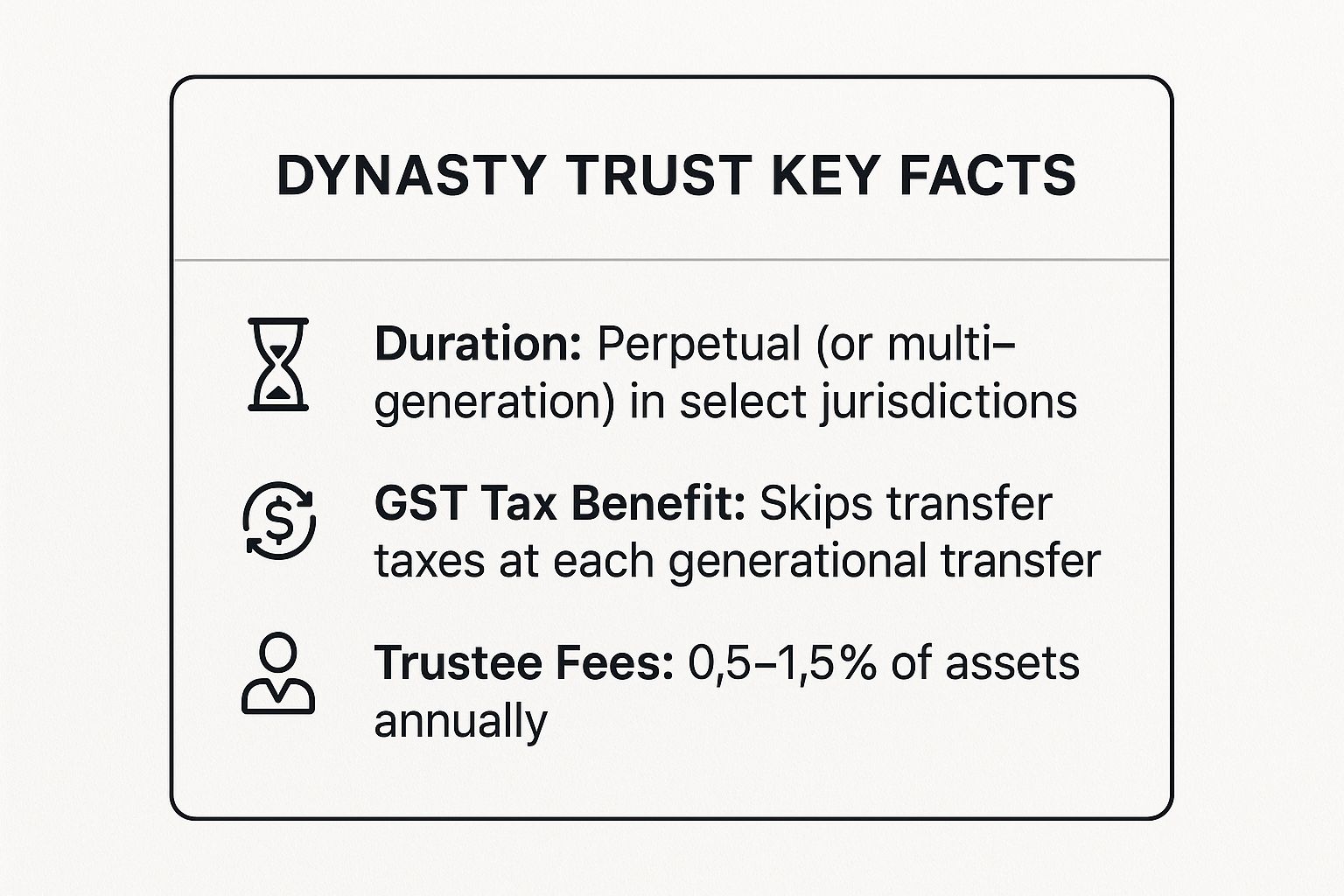### How It Works in Practice- \$10 million of stock funds a Dynasty Trust with your GST exemption.- Two generations later, the stock grows to \$200 million—completely outside the tax system.- Trust principal remains protected and can provide distributions for education and health.### Actionable Implementation Tips* Select a jurisdiction without a Rule Against Perpetuities (e.g., South Dakota, Alaska, Delaware).* Allocate your lifetime GST exemption to the trust assets.* Fund with high-growth assets like pre-IPO shares or diversified portfolios.## Estate Tax Planning Strategies Comparison| Estate Planning Tool | Complexity | Requirements | Outcomes | Ideal Uses | Key Advantages ||----------------------------------------|------------------------------|--------------------------------------|---------------------------------------------|------------------------------------------------------|----------------------------------------------------|| Irrevocable Life Insurance Trust (ILIT)| High – legal & trustee fees | Legal fees (\$3k–\$10k), premiums | Removes insurance from estate; tax-free | High-net-worth individuals | Estate tax savings, asset protection || Grantor Retained Annuity Trust (GRAT) | High – valuation & setup | Setup fees (\$5k–\$15k), admin | Transfers appreciation gift-tax free | Rapidly appreciating assets | Wealth transfer of growth, zeroed-out strategy || Charitable Remainder Trust (CRT) | High – admin & filings | Setup (\$3k–\$10k), investment fees | Income stream; charitable remainder; deduction | Donors with low-basis assets | Capital gains tax avoidance, income & estate reduction || Family FLP/LLC | High – ongoing compliance | Setup (\$10k–\$25k), appraisals | Valuation discounts; control retention | Families with substantial real estate or business | Valuation discounts, succession planning || Intentionally Defective Grantor Trust (IDGT) | Very High – structuring | Legal (\$15k–\$40k), appraisals | Estate freeze; tax-free appreciation | Appreciating assets exceeding exemption | Estate value freeze, grantor pays income tax || Qualified Personal Residence Trust (QPRT) | Moderate – term & appraisal| Legal (\$4k–\$10k), appraisal | Transfer home at discounted gift value | Owners of valuable residences aged 55–75 | Significant gift tax discount, continued residence || Annual Gifting & Lifetime Exemption | Low – simple transfers | Record keeping; attorney (\$1k–\$5k) | Gradual estate reduction | All individuals | Immediate, flexible, uses exclusions || Dynasty Trust (GST) | Very High – multi-gen admin | Setup (\$15k+), trustee fees | Multi-gen tax-free compounding | Ultra-high-net-worth families | Eliminates estate & GST taxes, asset protection |## Taking the Next Step: Integrating Your Estate PlanNavigating sophisticated **estate tax planning strategies** requires weaving these tools into a cohesive, dynamic plan aligned with your goals and family values. A successful blueprint might layer an FLP to protect business interests, use an IDGT to freeze appreciation, and deploy a CRT or ILIT for liquidity and philanthropy.### Your Path Forward: From Knowledge to Action* Conduct a comprehensive asset inventory.* Define your legacy and financial objectives.* Assemble a professional team: financial advisor, estate planning attorney, CPA.* Model different scenarios to project future tax liabilities and outcomes.For more actionable steps, download our estate tax planning checklist.### The Long-Term Vision: A Living StrategyYour estate plan must adapt to life events, market shifts, and tax law changes. Regularly review and adjust strategies—from GRATs to Dynasty Trusts—to ensure continued growth and protection. Consider [diversifying your investment portfolio](https://blog.publicview.ai/how-to-diversify-investment-portfolio) within these structures for resilience.By proactively implementing these advanced estate tax planning strategies, you’ll secure your legacy and provide a lasting foundation for generations to come.---At **Commons Capital**, we specialize in guiding high-net-worth individuals and families through complex wealth transfer plans. Schedule a consultation with [Commons Capital](https://www.commonsllc.com) today to begin securing your legacy.
Top 8 Estate Tax Planning Strategies for 2025
Discover 8 essential estate tax planning strategies for high-net-worth individuals. Learn how to minimize taxes and protect your legacy with expert insights.