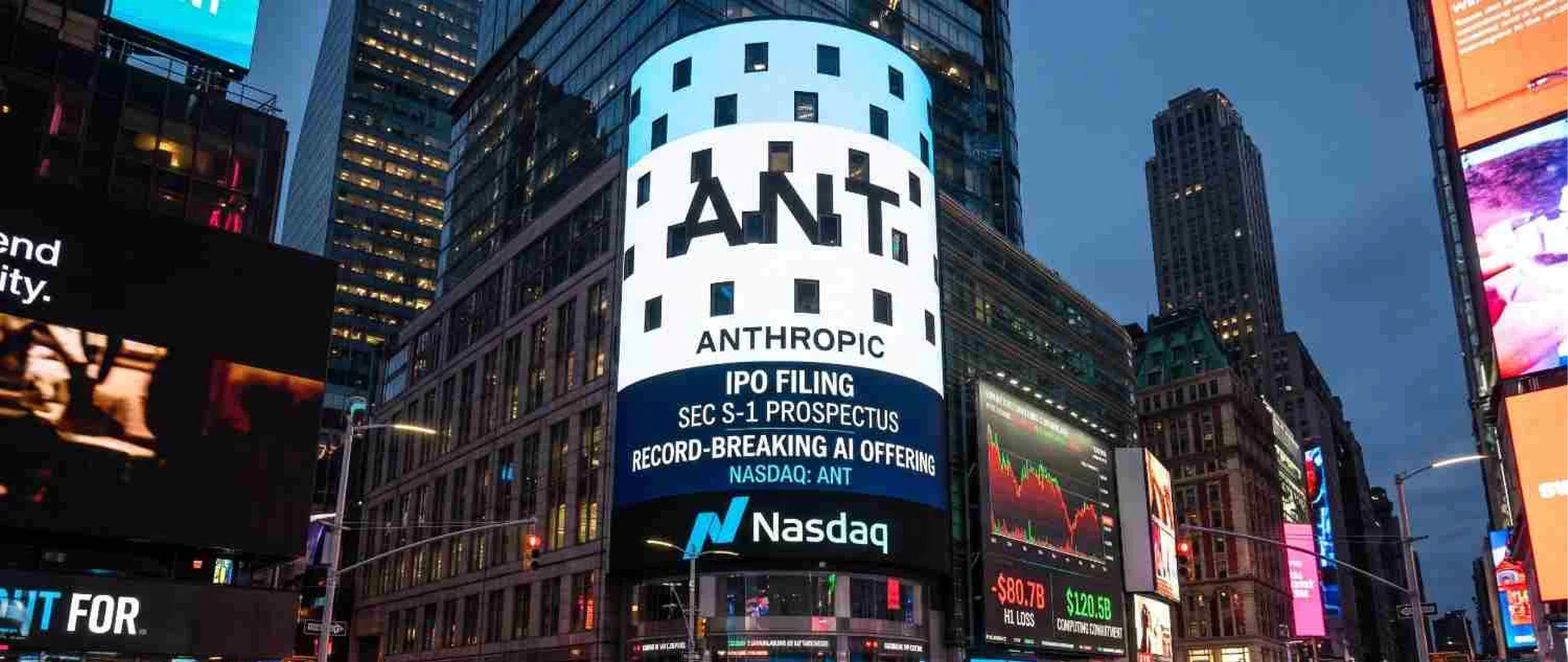
On Monday, October 26, 2026, Anthropic, PBC filed a registration statement on Form S-1 with the Securities and Exchange Commission for an initial public offering of its Class A common stock. The company has applied to list on the Nasdaq Global Select Market under the ticker "ANT." Goldman Sachs and Morgan Stanley lead a syndicate of more than twenty underwriters.
An S-1 is the document a company must file before it can sell shares to the public. It is long, it includes audited financial statements, and for a private company it is usually the first full public look at the books. Anthropic submitted a confidential draft in June. Monday's filing is the public version.
Some important pieces are still blank: the number of shares, the price range, and third-quarter results. Those arrive in an amended filing before the shares are marketed to investors. Press reports put a possible valuation between $1.5 trillion and $2 trillion and suggest trading could begin in mid-to-late November. Those figures come from reporting, not from the filing, and nothing is set until the deal prices.
The numbers, without the noise
The growth is the headline, and the filing backs it up.
Anthropic revenue · US dollars
Six months of 2026 brought in more than three times all of 2025
Dashed line marks full-year 2025 revenue. First-half 2026 revenue was also about fourteen times the $1.2 billion reported for the first half of 2025.
Source: Anthropic, PBC Form S-1, filed October 26, 2026. Figures are from a preliminary prospectus and are subject to amendment. First-half 2026 covers six months; prior periods are full years. Educational only; not a recommendation to buy or sell any security. Past performance is not indicative of future results.
In the first six months of 2026, Anthropic booked more than three times the revenue it earned in all of 2025, and about fourteen times its $1.2 billion from the first half of 2025.
The loss number needs translating. Anthropic reported a net loss of $80.7 billion for the first half of 2026. That sounds alarming, and most of it is an accounting effect: $72.4 billion came from revaluing convertible notes and similar instruments upward as the company's own valuation climbed. Put simply, certain obligations to investors became more valuable on paper because the company did. That is not cash leaving the building.
The operating picture is much closer to break-even. Anthropic reported an operating loss of $693 million for the half, compared with $8.1 billion for all of 2025. On its own adjusted (non-GAAP) basis, the company reported operating income of $1.6 billion. Adjusted figures exclude items management chooses to exclude, so they are worth reading alongside the standard numbers, not instead of them.
The balance sheet is large. As of June 30, Anthropic held about $131.7 billion in cash and short-term investments, after raising $141.1 billion since its founding in 2021. As of September 30, it counted more than 11,900 customers paying $100,000 or more over the prior twelve months, more than 1,900 paying $1 million or more, and about 250 paying $10 million or more.
What the risk section says
Every S-1 has a risk factors section, and most of it reads as boilerplate. This one deserves a closer look. Three themes stand out.
Computing capacity. Anthropic's business runs on enormous amounts of specialized computing power, bought years in advance from a small number of suppliers. Some of those suppliers are also investors, customers and competitors. The filing describes commitments stretching out to 2045, and the total dollar figure is left blank in this draft. It is one of the numbers worth watching for in the amendment.
Customer concentration. The company discloses that a substantial portion of its revenue comes from a limited number of customers and distribution channels. Fast growth from a concentrated base is a different risk profile than slower growth from a broad one.
The technology itself. Anthropic tells investors its models could behave in unintended or misaligned ways, and that its contracts and insurance may not cover the resulting liabilities. It also discloses that it has delayed model releases for safety reasons and may do so again, even if that lets competitors move faster. It is unusual for a company to tell prospective shareholders, in writing, that it may deliberately slow itself down.
Who will actually be in charge
This is the section most readers will skip, and it may matter more than the revenue table.
Anthropic is a public benefit corporation. Under Delaware law, its board must balance shareholders' financial interests with the interests of those affected by the company and a stated public purpose: "the responsible development and maintenance of advanced AI for the long-term benefit of humanity."
Control sits in two places. A Long-Term Benefit Trust of five financially disinterested trustees holds a single share of Class T stock, which generally lets it elect a majority of the board. A separate LLC owned by the seven co-founders will hold a single share of Class F stock carrying 50.1% of the vote on most shareholder matters, including the election of the remaining directors. Shares sold to the public carry one vote each and, together, less than half the vote. The company will be a "controlled company" under Nasdaq rules.
Who controls Anthropic after the IPO
Public buyers get the economics. The Trust and the founders hold control.
Class T · one share
Long-Term Benefit Trust
Five financially disinterested trustees. No economic rights.
Elects a majority of the board
Class F · one share
Founder LLC
The seven co-founders. 50.1% of the stockholder vote. No economic rights.
Controls the vote on the remaining directors
Class A · offered to the public
Public shareholders
One vote per share. Share in profits and value. Together, under 50% of the vote.
Votes on the remaining directors, but is outweighed
Board of directors
Class T directors: a majority
Elected by the Trust alone
Remaining directors
Elected by stockholder vote, where the founders’ 50.1% decides
Buying Class A shares buys a share of the economics, not a say in the direction.
Source: Anthropic, PBC Form S-1, filed October 26, 2026. Simplified for illustration; see the prospectus sections on governance and capital stock for full terms, including Class N and Class E stock. Terms are from a preliminary prospectus and are subject to amendment. Educational only; not a recommendation to buy or sell any security.
In plain English: buying ANT buys a share of the economics, not a say in the direction. That structure is disclosed clearly and is legitimate. It should simply be priced knowingly.
Two other details affect future share counts. Anthropic has contributed 5% of its fully diluted shares to a wholly owned public benefit fund, and its board approved a framework to issue up to an additional 2% each time the share price rises 50% above the prior milestone, starting from the IPO price. The co-founders have also pledged 80% of their personal equity to philanthropy.
What this means if you are an investor
The right question depends on where you sit.
If you own index funds, you may end up owning Anthropic without ever deciding to. When a company this size is added to the major indexes, every fund tracking them buys it at whatever weight the index assigns and whatever price the market sets that day. Many "diversified" portfolios already carry heavy exposure to a handful of AI-linked companies, a point we covered in The Hidden Concentration in "Diversified" Portfolios. The question is not whether you own AI. It is how much, and who decided.
If you are thinking about buying at the IPO, know how the process works. Shares at the offering price go mostly to large institutions. Most individuals buy once trading opens, at whatever price demand sets, which can differ meaningfully from the offering price. Early trading in heavily anticipated offerings is often volatile. For any single stock, however compelling the story, position size matters more than timing: it should be measured against what you already own and what you can afford to watch fall.
If you already hold Anthropic equity, as an employee, former employee or early investor, the IPO turns private paper wealth into a concentrated public position. The filing describes lock-up restrictions with staged releases, including small partial releases within the first two months. Between lock-ups, trading windows, withholding on restricted stock units, and capital gains timing, the decisions made in the first year are hard to undo. That is a planning problem before it is an investment one, and it is worth working through with your tax advisor well before shares become sellable.
In practice, that planning usually covers a handful of questions. What do you actually own, across vested and unvested restricted stock units, options and any shares bought outright? Which shares become sellable when, and how do those dates line up with trading windows and a 10b5-1 plan? How much tax will be withheld at settlement, and will it be enough? How much of your net worth should stay in one company, and what should the rest look like? And if charitable giving is part of the picture, which appreciated shares make sense to give, and when?
Commons Capital works with executives and early employees on exactly these decisions, alongside their tax and legal advisors. If you, or someone you know at Anthropic, would like to work through them before the first shares become sellable, we would be glad to talk. More on how we approach this in our Financial Planning practice.
How we approach a moment like this
Commons Capital builds client portfolios from individual securities across asset classes rather than fund baskets. The practical consequence for a moment like this is that whether a client owns a newly public company, and how much, is a deliberate decision made for that client's tax picture, existing concentrations and goals. It is not a side effect of an index committee's rebalancing.
For some clients the right answer will be none. For others it may be a measured position. For an employee, the more useful question is often how to reduce what they already hold. We do not predict how ANT will trade. We help clients decide what role, if any, it should play.
Quick answers
When will Anthropic go public?
No date has been set. Press reports suggest mid-to-late November 2026. Trading can begin only after the SEC declares the registration effective and the offering prices.
What is Anthropic's ticker symbol?
ANT, on the Nasdaq Global Select Market.
How much revenue does Anthropic make?
$4.6 billion in 2025 and $16.3 billion in the first half of 2026, according to its S-1.
Is Anthropic profitable?
Not on a standard (GAAP) basis. It reported an $80.7 billion net loss for the first half of 2026, most of it a non-cash revaluation charge, and a $693 million operating loss. On its own adjusted basis, it reported $1.6 billion of operating income.
Will public shareholders control the company?
No. A Long-Term Benefit Trust elects a majority of the board, and the co-founders hold 50.1% of the vote on most matters.
Can individual investors buy at the IPO price?
Access is generally limited. Most individuals buy once shares begin trading.
Sources
- Anthropic, PBC, Form S-1 Registration Statement, filed October 26, 2026 (SEC EDGAR)
- Anthropic, "Anthropic files S-1 with the SEC for proposed initial public offering," October 26, 2026
- NPR, "AI giant Anthropic files for an IPO that could break records," October 26, 2026 (reported valuation range)
- Investing.com, "Anthropic said to plan 9 a.m. S-1 filing as mid-November IPO remains on track," October 26, 2026 (reported timing)
This material is educational and reflects our analytical framework. It is not a recommendation to buy or sell any security. Past performance is not indicative of future results. Holdings discussed may or may not be currently held in client portfolios. Figures are drawn from a preliminary prospectus that is subject to completion and amendment; final terms may differ. Valuation and timing estimates are press reports, not company disclosures. Tax and lock-up considerations depend on individual circumstances; consult your tax and legal advisors before acting.
Commons Capital is a fee-based fiduciary Registered Investment Adviser regulated under the Investment Advisers Act of 1940. Additional information, including our Form ADV Part 2, is available on the SEC's Investment Adviser Public Disclosure system.